

$39.99
ARE YOU 21 YEARS OF AGE OR OLDER?
REMEMBER ME
Seriously, by using this site you are confirming that you are of legal age (21+) to view and purchase these products. If you are you are not over 21. you are not authorized by us to use or view any of the pages of this site. Please review our terms and conditions at checkout for further stipulations.
 >
Blogs
>
CBD >
Is CBD Legal in Oklahoma? 2026 Guide to Oklahoma CBD Laws
>
Blogs
>
CBD >
Is CBD Legal in Oklahoma? 2026 Guide to Oklahoma CBD Laws
THE STATEMENTS ON THIS BLOG ARE NOT INTENDED TO DIAGNOSE, TREAT, CURE, OR PREVENT ANY DISEASE. THE FOOD AND DRUG ADMINISTRATION HAS NOT EVALUATED ANY STATEMENTS CONTAINED WITHIN THE BLOG. ATLRX DOES NOT IN ANY WAY GUARANTEE OR WARRANT THE ACCURACY, COMPLETENESS, OR USEFULNESS OF ANY MESSAGE. THE INFORMATION CONTAINED WITHIN THIS BLOG IS FOR GENERAL INFORMATIONAL PURPOSES ONLY.
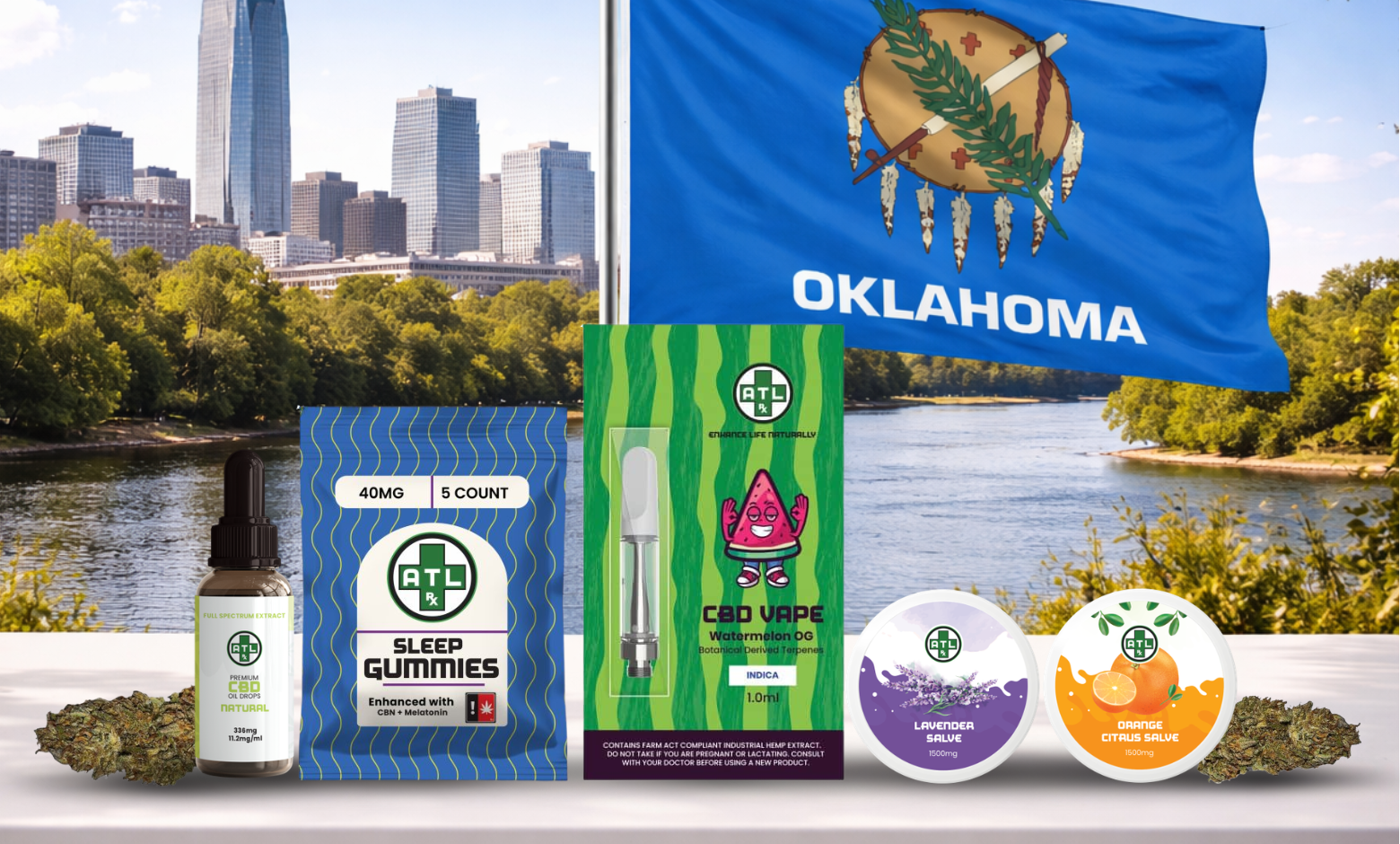
CBD Legal Status in Oklahoma:
Yes, Hemp-derived CBD with 0.3% THC or less is fully legal in Oklahoma for adults 18 and older. No medical card, doctor’s prescription, or state registration is required. You can purchase hemp-derived CBD at licensed retail stores across the state or from reputable online retailers. Medical marijuana patients can only obtain CBD derived from marijuana through licensed dispensaries.
If you are wondering whether CBD is legal in Oklahoma, the short answer is yes. Hemp-derived CBD products are fully legal in the Sooner State for adults 18 and older, with no doctor’s prescription or medical marijuana card required. Whether you prefer CBD oil, CBD gummies, capsules, or CBD topicals, you can purchase them in physical stores or from reputable online retailers without jumping through legal hoops.
That said, not all CBD products are treated equally under Oklahoma law. The source of your CBD, its THC content, and how it is labeled all play a role in whether the product is considered legal. With new federal developments expected to take effect later in 2026, staying informed has never been more important.
This guide walks you through everything you need to know about Oklahoma CBD laws in 2026, from the key legislation that made CBD legal to where you can buy it and what to watch for in the months ahead.
Table of contents:
Before diving into the full legal history, here is a quick snapshot of the current rules that govern CBD in Oklahoma:
| Topic | Current Rule in Oklahoma (2026) |
| Hemp-derived CBD | Legal statewide for adults 18+ |
| Marijuana-derived CBD | Legal only for registered medical marijuana patients |
| THC Limit (Hemp CBD) | Must not exceed 0.3% Delta-9 THC (dry weight) |
| Age Requirement | 18+ to purchase (minors only with physician supervision) |
| Prescription Required? | No prescription or card needed for hemp CBD |
| Possession Limit | No state-set possession limit for hemp-derived CBD |
| Where to Buy | Licensed retailers, health and wellness shops, online stores |
| Recreational Marijuana | Illegal in Oklahoma (State Question 820 failed in 2023) |
Keep in mind that this snapshot reflects the rules as of early 2026. Federal legislation currently moving through Congress could affect product formulations and availability later this year, which we cover in detail below.
Understanding why CBD is legal in Oklahoma today requires a quick look at the chain of legislation that led here. Oklahoma’s path from cannabis prohibition to a well-established hemp market is a story that spans more than a decade.
House Bill 2154 (HB 2154) was signed into law by Governor Mary Fallin in April 2015. In the beginning, the bill allowed healthcare providers to recommend hemp-based CBD oil to patients who met certain state-defined criteria. For the first time, Oklahomans had a legal pathway to access CBD oil. By 2016, the scope of HB 2154 was expanded under updated state guidelines.
Two pieces of legislation in 2018 fundamentally changed the landscape. The Agriculture Improvement Act of 2018 is commonly known as the 2018 Farm Bill. The federal Controlled Substances Act exempted industrial hemp and its derivatives (including CBD) if they contained less than 0.3% Delta-9 THC on a dry weight basis.
Federal action was followed by Oklahoma. Oklahoma passed HB 2913, also known as the Oklahoma Agricultural Industrial Hemp Pilot Program (OAIHPP). This bill formally legalized industrial hemp in Oklahoma, allowed licensed universities and colleges with plant science programs to cultivate hemp for research purposes, and set the same 0.3% THC threshold as the federal definition. Critically, it also legalized hemp-derived CBD products for consumers statewide.
Senate Bill 868 (SB 868) was signed into law by Governor Kevin Stitt in April 2019. In addition to decriminalizing hemp cultivation at the state level, the Oklahoma Department of Agriculture, Food, and Forestry (ODAFF) was required to establish rules and standards aligned with the federal program. It also created the Oklahoma Industrial Hemp Program, which allowed independent producers — not just universities — to participate through licensing.
In 2021, ODAFF developed the Oklahoma State Hemp Plan in accordance with federal regulations. This plan formalized ODAFF’s regulatory role and outlined licensing requirements, testing protocols, and compliance standards for hemp growers, processors, and handlers in the state. This gave the Oklahoma hemp industry a clear and structured regulatory framework.
On March 7, 2023, Oklahoma voters weighed in on State Question 820 (SQ 820), which would have legalized recreational Cannabis. The measure failed with only about 40% of the vote. As of 2026, recreational marijuana remains illegal in Oklahoma, while the medical marijuana program — regulated by the Oklahoma Medical Marijuana Authority (OMMA) — continues to operate as one of the largest per-capita medical cannabis markets in the country.
One of the most important things to understand about CBD legality in Oklahoma is that not all CBD comes from the same source — and that source matters enormously under state and federal law.
Hemp CBD contains less than 0.3% Delta-9 THC on a dry weight basis. These products are legal to purchase, possess, and use in Oklahoma without a medical card, a doctor’s prescription, or any registration with a state program. Adults 18 and older can walk into a licensed retail store or order from a reputable online brand and legally receive hemp-derived CBD products.
Marijuana-derived CBD is derived from cannabis plants with a THC content above 0.3%. In Oklahoma, this type of CBD product is only legal for patients registered with the state’s medical marijuana program. Registered patients can purchase marijuana-derived CBD from licensed dispensaries regulated by the OMMA. CBD derived from marijuana remains illegal without a valid medical marijuana license under state law.
The hemp vs. marijuana distinction is the single most important factor in determining whether a CBD product is legal for you in Oklahoma. Always check the product label and the certificate of analysis (COA) to confirm the source and THC content before purchasing.
Oklahoma CBD shoppers and businesses need to pay close attention to significant federal developments that are unfolding throughout 2026.
In December 2025, Congress passed legislation (Section 781 of a broader act) that materially amended the federal definition of hemp. Rather than measuring only Delta-9 THC, the amended law introduces a “total THC” standard. Under this new definition:
To put this in perspective, many hemp CBD products currently on the market contain between 2.5 and 10 milligrams of Delta-9 THC per unit, which would substantially exceed the new 0.4-milligram container limit if the rule takes effect unchanged.
The Hemp Planting Predictability Act (H.R. 7024), introduced in January 2026, would defer the November 2026 effective date by three years, pushing compliance deadlines to November 2028. This bipartisan bill has been introduced in both the House and Senate and currently has 15 co-sponsors in the House. Upon passage, it would give the industry and Congress time to develop a permanent regulatory framework.
The chairman of the House Agriculture Committee, Glenn Thompson, filed an 802-page draft of the Farm, Food, and National Security Act of 2026. While the draft addresses regulatory relief for industrial hemp producers — including proposals to reduce testing requirements and streamline compliance — it does not directly address the consumable hemp product ban introduced by the December 2025 legislation.
Important Note for Oklahoma Shoppers: As of March 2026, these federal rules have not yet taken effect, and hemp-derived CBD products remain legal and available in Oklahoma. However, the regulatory environment is evolving rapidly. ATLRx recommends purchasing from brands that provide transparent third-party testing and up-to-date certificates of analysis to ensure product compliance.
Adults 18 years and older can purchase hemp-derived CBD products in Oklahoma without a prescription or medical registration. Minors under 18 are permitted to access CBD products only under the supervision of a licensed physician, and only when enrolled in the state’s medical marijuana program as a registered patient.
Oklahoma does not set a state-mandated possession limit for hemp-derived CBD products. However, this does not mean there are zero standards: the product must still comply with the 0.3% THC threshold and other applicable requirements.
Hemp-derived CBD is not subject to a doctor’s prescription in Oklahoma. While doctors may recommend CBD oil to licensed medical marijuana patients, there is no legal requirement for a prescription for over-the-counter hemp CBD products.
Any manufactured product containing CBD must indicate on the label: where the CBD comes from and whether it’s synthetic or natural. These labeling rules are designed to promote consumer transparency. Always look for clear, compliant labeling when choosing a product.
Oklahoma does not distinguish between product formulations by name (full-spectrum, broad-spectrum, or isolate) in its legal framework. On a dry weight basis, it must contain less than 0.3% Delta-9 THC and be derived from industrial hemp.
Full-spectrum CBD products contain a full range of hemp cannabinoids, including trace amounts of Delta-9 THC (up to 0.3%). These products are legal in Oklahoma as long as they stay within the THC threshold.
Broad-spectrum CBD products contain multiple cannabinoids and compounds but have the THC removed or reduced to non-detectable levels. These are legal in Oklahoma and may be a good option for those who want to avoid any THC exposure.
CBD isolate contains 99% pure cannabidiol without any other cannabinoids. It is fully legal in Oklahoma and is often used by those who want a straightforward CBD product without additional cannabinoids.
Shopping Tip: Regardless of the type of CBD product you choose, always verify the product’s certificate of analysis (COA) from an independent third-party lab. You can shop with confidence since the COA confirms the cannabinoid profile and THC content.
Oklahomans have multiple convenient options for purchasing legal hemp-derived CBD products.
Hemp-derived CBD products are available at a variety of retail locations in Oklahoma, including:
When buying in-store, ask for the product’s COA before purchasing and confirm that the store is a licensed retailer operating in compliance with ODAFF and state consumer protection standards.
Purchasing hemp-derived CBD from a reputable online retailer is one of the most reliable ways to shop. Federal law permits the transport and sale of compliant hemp-derived CBD across state lines. Buying online from established brands gives you direct access to:
Why ATLRx? ATLRx is dedicated to quality, transparency, and compliance. Every ATLRx product undergoes rigorous third-party testing, and our certificates of analysis are readily available so you always know what you are getting.
Because the hemp industry does not yet have standardized federal oversight for finished consumer products, the quality and compliance of CBD products can vary significantly between brands.
Here is what every Oklahoma CBD shopper should look for:
Oklahoma has largely aligned its state hemp regulations with federal standards, particularly with the 2018 Farm Bill. Here is a brief side-by-side comparison:
| Regulation Area | Federal Law (2018 Farm Bill) |
| Hemp Definition | Cannabis with less than 0.3% Delta-9 THC (dry weight) |
| CBD Legality | Legal from hemp; FDA retains oversight of food/drug use |
| Medical Cannabis | Still federally illegal (Schedule I) |
| Recreational Cannabis | Federally illegal |
| Licensing Authority | USDA oversees state hemp program plans |
| 2026 Update | New total THC standard effective Nov. 12, 2026 (pending legislation) |
So, is CBD legal in Oklahoma? Absolutely. Hemp-derived CBD with 0.3% THC or less is fully legal for adults 18 and older across the Sooner State. You do not need a doctor’s note, a medical marijuana card, or any state registration to purchase it. Whether you shop in-store at a licensed retailer or order from a trusted online brand like ATLRx, you have straightforward access to a wide range of compliant hemp-derived CBD products.
Oklahoma’s hemp framework, built on HB 2154 (2015), HB 2913 (2018), and SB 868 (2019) and maintained by ODAFF, has created one of the more accessible state environments for hemp-derived CBD in the country. Marijuana-derived CBD remains reserved for registered medical patients, and recreational Cannabis is still prohibited under state law.
Looking ahead, the December 2025 federal legislation introducing a new total THC standard is the most significant development to watch in 2026. While the rule does not take effect until November 12, 2026, and pending legislation could delay or modify it further, Oklahoma shoppers and businesses should stay informed and choose products from brands that prioritize testing, transparency, and compliance.
At ATLRx, we are committed to delivering high-quality, lab-tested hemp-derived CBD products that meet current legal standards. All of our products come with a published certificate of analysis, so you always know what you are putting into your body.
No. CBD products derived from hemp are available over the counter to anyone 18 or older. A medical marijuana card is only required if you want to purchase marijuana-derived CBD products from a licensed dispensary.
Yes. CBD derived from hemp can be transported within Oklahoma. The product must comply with the 0.3% Delta-9 THC threshold. For travel outside the state or across state lines, check the laws of the destination state before traveling with CBD products.
Yes. CBD oil derived from industrial hemp and containing no more than 0.3% Delta-9 THC is fully legal to purchase and possess in Oklahoma. Marijuana-derived CBD oil requires a valid medical marijuana patient license.
Yes. Hemp-derived CBD-infused edibles containing no more than 0.3% Delta-9 THC are legal in Oklahoma. SB 868 (2019) specifically authorized the production of CBD foods and beverages that comply with the state’s hemp regulations and applicable food safety standards.
Yes, Delta-8 THC derived from legal hemp has generally been sold in Oklahoma as a hemp-derived product. However, this area is evolving rapidly at both the state and federal levels. The December 2025 federal legislation’s new “total THC” standard specifically includes Delta-8 THC in its calculation. Consumers should monitor legislative developments closely in 2026 before purchasing Delta-8 products.
Yes, A moratorium on new dispensary, grower, and processor licenses has been extended through August 1, 2026. Current licensees can renew, and existing licenses may be purchased or transferred with OMMA approval. The moratorium does not affect the ability to open a retail hemp (non-marijuana) business, which falls under ODAFF licensing rather than OMMA.
Disclaimer: This article is for informational purposes only and does not constitute legal advice. CBD laws and regulations are subject to change at both the state and federal levels. Always consult a licensed attorney for specific legal guidance.

June 26, 2026
June 25, 2026
June 23, 2026
June 19, 2026
$39.99
$49.99
$29.99
$39.99
$39.99
$39.99