Is CBD Legal in Kentucky? 2026 Guide to Kentucky CBD Laws
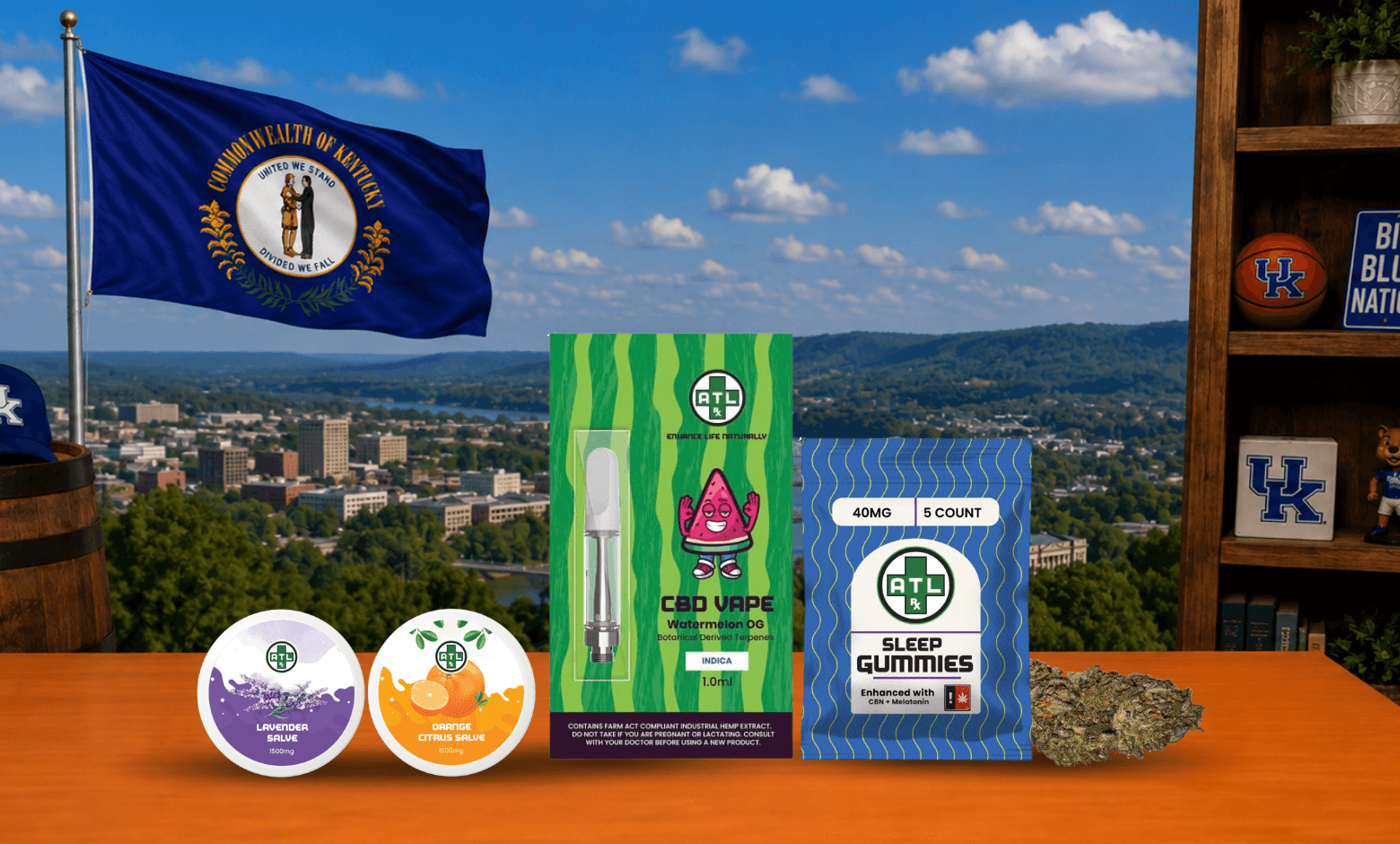
CBD Legal Status in Kentucky:
Yes. CBD derived from hemp with no more than 0.3% Delta-9 THC is legal under federal law and Kentucky law.
Governing law: KRS 260.850–260.869, HB 544 (2023), 902 KAR 45:190, and 902 KAR 45:021.
You must be 21 or older to purchase adult-use hemp-derived cannabinoid products (including any product containing intoxicating cannabinoids).
Marijuana-derived CBD remains restricted. Kentucky’s medical cannabis program under SB 47 took effect January 1, 2025, with patient registration; the first legal medical cannabis sale occurred in December 2025 as dispensaries opened.
A major federal change (P.L. 119-37, signed November 12, 2025) takes effect exactly one year later on November 12, 2026, and will tighten the federal definition of hemp.
Buying online from a licensed, lab-tested retailer is legal and is the safest way to verify compliance.
If you are wondering, “Is CBD legal in Kentucky?” hemp-derived CBD is legal in Kentucky if it contains less than 0.3% Delta-9 THC by dry weight. The longer answer involves a layered set of federal and state rules that have shifted again in 2026, and a major federal law that takes effect on November 12, 2026. This guide walks you through everything Kentucky residents and visitors need to know in 2026: the legal foundation, the state-specific rules, age requirements, what is changing later this year, and how to shop with confidence.
ATLRx has spent over eight years navigating hemp compliance across the United States. Every product we sell is backed by a third-party Certificate of Analysis, and our goal with this guide is the same as it is with our products: clear, transparent information so you can make informed decisions.
Keep Browsing
Explore Our CBD Categories
Shop real CBD products and collections.
Key Takeaways
- 01Hemp-derived CBD is legal in Kentucky if it contains less than 0.3% Delta-9 THC by dry weight.
- 02Adult-use age limit is 21, per HB 544 (2023) and 902 KAR 45:190. The retailer must verify the identity of the customer with a government-issued photo ID.
- 03Governing rules are the 2018 Farm Bill, KRS 260.850–260.869, HB 544 (2023), and the 902 KAR 45 series.
- 04Marijuana-derived CBD remains restricted and is only available through Kentucky’s medical cannabis program (effective January 1, 2025) for registered patients.
- 05Hemp bud and floral material for retail sale are restricted under Kentucky’s administrative rules.
- 06A major federal change (P.L. 119-37) takes effect on November 12, 2026, replacing the Delta-9 standard with a total-THC standard and adding a 0.4 mg per-container cap.
- 07Verify a Certificate of Analysis before buying. A reliable retailer publishes batch-specific COAs from accredited third-party labs.
What Is CBD and How Kentucky Defines It
There are more than 100 naturally occurring cannabinoids in the Cannabis sativa L. plant. CBD does not produce the same effects as Delta-9 THC, such as intoxication. Kentucky’s legal framework draws a sharp line between two sources of CBD:
- CBD is derived from hemp plants that contain less than 0.3% Delta-9 THC on a dry weight basis. It is legal under both federal and Kentucky law.
- Marijuana-derived CBD: extracted from cannabis plants exceeding 0.3% Delta-9 THC. Treated as marijuana under Kentucky law and only accessible through the state’s medical cannabis program (effective January 1, 2025) for registered patients with qualifying conditions.
Throughout this guide, when we refer to “CBD,” we mean hemp-derived CBD unless otherwise stated.
Is CBD Legal in Kentucky? The Short Answer
Yes. Hemp-derived CBD is legal to buy, possess, and use in Kentucky for adults 21 and older, provided the product complies with the following requirements:
- Derived from hemp grown under a USDA-sanctioned program.
- It contains no more than 0.3% Delta-9 THC by dry weight.
- Manufactured by a Kentucky-permitted processor or a registered out-of-state processor.
- Labeled and packaged according to 902 KAR 45:190 and 902 KAR 45:021.
- Sold or shipped by a retailer that follows Kentucky’s age-verification and packaging rules.
This means CBD oils, tinctures, gummies, capsules, softgels, and topicals are widely available in Kentucky. Some product categories, such as hemp bud or floral material for retail sale, are restricted under Kentucky’s administrative rules.
Kentucky’s CBD Legal Framework: A Layered View
Kentucky’s CBD rules are best understood as four layers stacked on top of each other. Each layer adds detail to the one below it.
- Federal floor: The 2018 Farm Bill (7 U.S.C. § 1639o) sets the national baseline for what counts as hemp.
- State statute: KRS 260.850–260.869 codifies the federal definition into Kentucky law and authorizes the Kentucky Department of Agriculture (KDA) to administer the state hemp program.
- State legislation: HB 544 (2023) directed the Cabinet for Health and Family Services to regulate hemp-derived cannabinoids, including age limits, testing, and labeling.
- Administrative regulations: 902 KAR 45:190 (labeling and packaging) and 902 KAR 45:021 (product registration, processing, manufacturing, storage, and distribution) carry the day-to-day rules retailers and consumers actually encounter.
The 2018 Farm Bill: Federal Foundation
Known as the 2018 Farm Bill, the Agriculture Improvement Act of 2018 removed hemp from the Controlled Substances Act and legalized its cultivation, processing, and interstate commerce. Delta-9 THC concentrations of no more than 0.3% on a dry weight basis are the federal threshold.
CBD derived from hemp is legal under this federal framework nationwide. This is why a licensed online retailer like ATLRx can lawfully ship compliant CBD products to Kentucky addresses.
Kentucky Hemp Statute (KRS 260.850–260.869)
Kentucky was an early adopter of industrial hemp. Kentucky authorized its industrial hemp research pilot program through Senate Bill 50 in 2013, and the state planted its first modern hemp crop in 2014 under Section 7606 of the federal Agricultural Act of 2014. House Bill 333 amended Kentucky’s controlled substances law in 2017 to clarify that hemp-derived CBD products containing no more than 0.3% Delta-9 THC are not considered “marijuana” under state law. After the 2018 federal Farm Bill, House Bill 197 (2019) aligned Kentucky’s definition of industrial hemp with the new federal definition.
KRS 260.850–260.869 is the current Kentucky hemp statute. It places the Kentucky Department of Agriculture in charge of hemp cultivation, licensing growers and processors, and enforcing the 0.3% Delta-9 THC threshold.
HB 544 (2023) and 902 KAR 45:190
HB 544, passed during the 2023 legislative session, was a turning point for Kentucky’s hemp-derived cannabinoid market. The bill directed the Cabinet for Health and Family Services to regulate Delta-8 THC and other hemp-derived substances, establish testing standards, require age-restricted sales, and set strict labeling requirements.
HB 544’s rules are now implemented through two key administrative regulations:
- 902 KAR 45:190 — Packaging and Labeling: requires child-resistant packaging, tamper-evident seals, specific warning statements, and clear cannabinoid descriptions. Products may not imitate candy, snacks, or use the words “candy” or “candies.”
- 902 KAR 45:021 — Registration & Distribution: requires in-state processors to be permitted by the cabinet and out-of-state processors to file annual registrations. Each adult-use cannabinoid product must be registered, accompanied by a label copy and a Certificate of Analysis.
Both regulations also restrict who can be employed in adult-use hemp businesses (employees must be 21, or at least 18 and supervised by someone 21 or older) and prohibit the manufacture or retail sale of hemp bud or floral material.
Both regulations were first promulgated as emergency administrative regulations in 2023 and have since been updated through the standard rulemaking process; check the Kentucky Legislative Research Commission for the current text.
What’s Changing on November 12, 2026 (P.L. 119-37)
This is the most important update for anyone buying CBD in Kentucky in 2026.
On November 12, 2025, Congress passed, and the President signed P.L. 119-37, the Continuing Appropriations, Agriculture, Legislative Branch, Military Construction and Veterans Affairs, and Extensions Act, 2026. Section 781 of Division B rewrites the federal definition of hemp in 7 U.S.C. § 1639o. It rewrites the federal definition of hemp in section 781. The new definition becomes effective exactly one year after signing: November 12, 2026.
Three Key Changes Coming
- Delta-9 standard becomes a total THC standard. TThe 0.3% threshold remains, but it will apply to total THC concentration calculated as delta-9 THC plus 0.877 × THCA rather than Delta-9 THC alone. THCA flower and similar products that pass today’s Delta-9-only test will not meet the new standard. It is required that the FDA publish a list of naturally occurring cannabinoids, THC-class cannabinoids, and other cannabinoids with similar effects to THC within 90 days of enactment (by February 10, 2026), which will clarify which compounds count toward total THC. THCA flower and similar products that pass today’s Delta-9-only test will not meet the new standard.
- Strict per-container cap on consumable products. Hemp-derived consumable products will be capped at 0.4 mg of total THC per container.
- Hemp does not include synthetic or synthesized cannabinoids. Under the new law, cannabinoids that cannot be naturally produced by Cannabis sativa L. are excluded, as are cannabinoids that are synthesized or manufactured outside the plant. Most commercial Delta-8 today is produced by chemical conversion from CBD rather than direct extraction, which places it in the second category and outside the federal hemp definition once the new law takes effect.
Kentucky, as one of the nation’s leading hemp-producing states by licensed acreage, will be significantly affected. The state has not yet announced whether it will mirror the federal definition directly or carve out a narrower state-level approach. What is clear is that many products legal in Kentucky today will require reformulation before November 12, 2026, and the FDA’s forthcoming lists of cannabinoids will further shape compliance strategies.
For shoppers, the practical takeaway is simple: CBD isolate products and pure, non-intoxicating CBD formulations are well-positioned under the new rules. Full-spectrum products with measurable total THC may be reformulated by reputable brands. We recommend buying only from retailers who publish full Certificates of Analysis and actively update their products as rules evolve.
Hemp-Derived vs. Marijuana-Derived CBD in Kentucky
Both hemp and marijuana come from the same plant species, Cannabis sativa L. The legal line between them is drawn entirely by Delta-9 THC concentration (and, after November 12, 2026, by total THC). Kentucky’s position is straightforward:
| CBD Type | Legal Status in Kentucky | Who Can Access |
|---|---|---|
| Hemp-derived CBD (under 0.3% Delta-9 THC) | Legal | Adults; 21+ for adult-use hemp-derived cannabinoid products |
| Marijuana-derived CBD (over 0.3% THC) | Restricted | Only through Kentucky’s medical cannabis program (effective 1/1/2025) for registered patients |
| Hemp bud / floral material at retail | Not permitted for retail sale under 902 KAR 45 | Not available through standard retail |
| Smokable or vapable hemp products | Subject to Kentucky cannabinoid product rules | Adults 21+; verify state registration |
Age Requirements for Buying CBD in Kentucky
Kentucky’s HB 544 (2023) and the associated administrative regulations require buyers to be at least 21 years old to purchase, possess, or receive adult-use hemp-derived cannabinoid products. This applies whether the product is purchased in person or shipped to a Kentucky address.
Shop CBD
View all →
Retailers must verify age at the point of sale with a government-issued photo ID. Online sellers shipping into Kentucky are expected to comply with the same standard through age verification at checkout and delivery.
Labeling, Packaging, and Testing Rules
Under 902 KAR 45:190, every hemp-derived cannabinoid product sold in Kentucky must meet detailed labeling and packaging standards. Key requirements include:
- Product name or statement of identity on the main display panel.
- Net quantity in both standard and metric units, placed in the lower 30% of the main panel.
- The common cannabinoid description (for example, “Full-spectrum CBD extract”) in the product name, using the same or larger font size as the product name.
- Required warning statements for adult-use products, including notices about the 21+ age requirement, the risk of a positive drug screen, and operating vehicles or machinery.
- Child-resistant packaging for adult-use products and tamper-evident seals for non-intoxicating cannabinoid products and cosmetics.
- No imitation of candy, snack, or beverage packaging, and no use of the words “candy” or “candies.”
- No state seals, flags, or insignia that could imply government endorsement.
- No claims on the label that suggest the product is intended for a medical or therapeutic purpose.
An accredited third-party laboratory must conduct the testing and provide a Certificate of Analysis. Every batch must be traceable to its lab results.
Where to Buy CBD in Kentucky
CBD is available across Kentucky through several channels:
- CBD shops and wellness retailers are available in Louisville, Lexington, Bowling Green, Owensboro, and Covington.
- Health food stores and select pharmacies that carry hemp-derived CBD lines.
- Online retailers like ATLRx ship lab-tested CBD products directly to Kentucky addresses.
When buying in-store, look for the state-required warning labels, the cannabinoid description in the product name, and a scannable QR code or product registration code that ties back to a Certificate of Analysis. If a retailer cannot show you a current COA, walk away.
Buying CBD Online in Kentucky
Buying CBD online is fully legal in Kentucky as long as the product is hemp-derived, complies with the 0.3% Delta-9 THC threshold (and, after November 12, 2026, the new total-THC standard), and the retailer follows age-verification rules. Online shopping has practical advantages:
- You can review the Certificate of Analysis before you buy.
- You can compare cannabinoid profiles across brands.
- You can verify that a brand updates its products as rules evolve.
- You can read independent customer feedback.
ATLRx publishes a batch-specific Certificate of Analysis for every product and ships compliant hemp-derived CBD to Kentucky customers, including CBD Oil, CBD Gummies, CBD Topicals, and other product categories.
How to Read a Certificate of Analysis (COA)
A Certificate of Analysis is your most important compliance document. A good COA should clearly show:
- There should be a match between the product name and batch or lot number on the label.
- The testing laboratory’s name and ISO/IEC 17025 accreditation.
- The date the sample was tested.
- Including Delta-9 THC, Delta-8 THC, CBD, CBG, CBN, and THCA, where applicable.
- Contaminant screening: pesticides, heavy metals, residual solvents, microbes, and mycotoxins.
- A signature or analyst stamp.
When any of these fields are missing, consider it a red flag and look elsewhere. Reputable retailers make COAs accessible through a QR code or a public batch lookup tool.
Kentucky vs. Neighboring States
If you travel across state lines, the destination state’s laws govern what you can possess. Kentucky’s rules are reasonably consumer-friendly, but its neighbors vary.
| State | Is Hemp CBD Legal? | Age Requirement | Notes |
|---|---|---|---|
| Kentucky | Yes | 21+ for adult-use | KRS 260.850; HB 544; 902 KAR 45:190 |
| Tennessee | Yes (non-intoxicating CBD) | 21+ | HB 1376 (effective January 1, 2026) shifted regulation to the Alcoholic Beverage Commission (TABC), bans online sales (face-to-face transactions only), and effectively bans THCA flower and synthetic cannabinoids. Legacy TDA licensees may operate under prior rules through June 30, 2026 |
| Indiana | Yes (hemp-derived CBD) | No statewide age for non-intoxicating CBD; 21+ for ‘craft hemp flower products’ (gummies, edibles, tinctures, e-liquids) under SB 478 (effective July 1, 2025) | Recreational and medical marijuana remain illegal |
| Ohio | Non-intoxicating CBD: Yes. Intoxicating hemp products: restricted to licensed marijuana dispensaries | 21+ for adult-use products | SB 56 took effect March 20, 2026; Governor DeWine line-item vetoed the proposed THC-beverage carveout |
| Virginia | Yes | 21+ | SB 903 imposes a 2 mg total THC per package cap unless a 25:1 CBD: THC ratio is met |
| West Virginia | Non-intoxicating CBD: Yes. Intoxicating hemp cannabinoids (Delta-8, Delta-10, HHC, intoxicating THCA): restricted | 21+ for hemp-derived cannabinoid products at retail (ABCA rule, 2025); no statewide minimum age for non-intoxicating CBD | ABCA retailer permits required; THC access otherwise routed through the state medical cannabis program |
Always verify the destination state’s current laws before crossing state lines with any hemp-derived product. Keep products in their original, clearly labeled packaging and carry the Certificate of Analysis.
Final Word: Stay Compliant Through 2026
To recap: CBD is legal in Kentucky in 2026, hemp-derived, third-party-tested, and sold by retailers who follow the state’s registration, labeling, and age-verification rules. Kentucky’s legal framework is one of the most developed in the country, anchored by KRS 260.850, HB 544 (2023), and the 902 KAR 45 series.
Mark your calendar for November 12, 2026. After that date, the federal definition of hemp tightens significantly, the total-THC standard replaces the Delta-9-only standard, and a strict per-container cap takes effect. Kentucky’s response is still developing. Buying from a transparent retailer that publishes batch-specific COAs and updates its products as rules evolve is the best way to stay compliant.
ATLRx crafts every hemp-derived CBD product with full transparency. We publish third-party Certificates of Analysis for every batch and design our formulations to meet the strictest state and federal compliance standards. Whether you are exploring CBD for the first time or are an experienced shopper, we are here to help you buy with confidence.
Frequently Asked Questions
Is CBD Legal in Kentucky Without a Prescription?
+
Yes. CBD products derived from hemp that contain no more than 0.3% Delta-9 THC are legal to buy without a prescription. Marijuana-derived CBD is only available through Kentucky’s medical cannabis program for registered patients.
What Is the Minimum Age to Buy CBD in Kentucky?
+
Adult-use hemp-derived cannabinoid products require buyers to be 21 or older, per HB 544 (2023) and 902 KAR 45:190. The retailer must verify a customer’s age with a government-issued photo ID.
Can I Order CBD Online and Have It Shipped to Kentucky?
+
Yes. Buying hemp-derived CBD online and shipping it to a Kentucky address is fully legal. Choose a retailer that publishes batch-specific Certificates of Analysis and verifies your age at checkout.
Will CBD Show up on a Drug Test?
+
Standard workplace drug tests detect THC-COOH, the primary metabolite of Delta-9 THC. They are not designed to detect CBD itself, but they commonly cross-react with metabolites produced by other hemp-derived cannabinoids, including Delta-8 THC and THC from THCA. It is also possible for full-spectrum CBD products to contain trace amounts of Delta-9 THC, which could contribute to a positive test result. Check the Certificate of Analysis carefully if you are subject to workplace testing. If you are subject to workplace testing, you should consider a broad-spectrum CBD product or a CBD isolate product.
Is Delta-8 THC Legal in Kentucky?
+
As of early 2026, Delta-8 THC is regulated as an adult-use hemp-derived cannabinoid in Kentucky and is legal for buyers 21 and older when sold by registered processors. However, Delta-8 produced through chemical conversion is expected to fall outside the federal hemp definition after November 12, 2026, when P.L. 119-37 takes effect.
Can I Travel with CBD to or from Kentucky?
+
Domestically, hemp-derived CBD that complies with federal law is generally permitted on TSA-regulated flights. The destination state’s laws apply once you arrive. Be sure to keep products in their original packaging and carry the COA.
Do I Need a License to Buy CBD in Kentucky?
+
No. Consumers do not need a license to buy compliant hemp-derived CBD products. Licensing applies to processors, manufacturers, and retailers.
How Will the November 12, 2026, Federal Change Affect My Purchases?
+
Most CBD isolate and non-intoxicating CBD products will continue to be available. Products with measurable total THC will require reformulation to remain compliant with the new 0.4 mg per-container federal cap. Reputable brands like ATLRx are already preparing for the transition.
Legal Disclaimer
This article is provided for general informational purposes only and does not constitute legal advice. Kentucky and federal laws regarding hemp and CBD products are subject to change. Verify the most current rules with the Kentucky Department of Agriculture, the Cabinet for Health and Family Services, or a qualified Kentucky attorney.
Why Trust This Guide
- ATLRx has sold third-party lab-tested hemp products out of Georgia since 2019.
- Every real batch we sell is tested by an accredited outside lab, with the Certificate of Analysis published before you buy.
- We operate 3 real physical stores in Georgia — this isn't a drop-shipped storefront.
- Legal information is rechecked and updated as rules change, not published once and forgotten.
Don't Trust the Label. Check the Lab.
ATLRx publishes third-party Certificates of Analysis for real batches so you can verify cannabinoid content before you buy — not just take the package's word for it.
View Lab Results →Have Questions?
Visit an ATLRx store in Georgia and talk to our team.
Real Customers, Real Reviews
What Customers Are Saying
“Product was smooth and mellow. Quite nice!”
“Exactly what was promised excellent product”
“Really nice high”

Jen Hight
Cannabis Industry Expert & Compliance Specialist Jen Hight is a cannabis industry professional with extensive experience in hemp compliance, product development, and consumer education. With a background in regulatory affairs and a passion for helping consumers navigate the complex world of cannabinoids, Jen provides accurate, up-to-date information on hemp legality and best practices. Her work focuses on making cannabis knowledge accessible while ensuring readers understand both the opportunities and responsibilities that come with legal hemp products.
View all articles →Keep Learning
Is CBD Legal in Delaware? 2026 Law Updates & Guide
CBD Legal Status in Delaware: Yes, CBD is legal in Delaware. Under the federal 2018 Farm Bill and Delaware’s hemp program, hemp-derived CBD containing less than 0.3% delta-9 THC is legal to buy, possess, and use. Marijuana-derived (higher-THC) products are legal only through Delaware’s state-licensed dispensaries. ATLRx ships only hemp-derived Delta-9 (≤0.3% THC) and THCV […]
Jul 7, 2026 · 12 min read
Is CBD Legal in New Mexico? 2026 Legal Guide
CBD Legal Status in New Mexico: Yes. Hemp-derived CBD containing no more than 0.3% delta-9 THC on a dry-weight basis is legal in New Mexico for adults. Cannabis-derived CBD is also legal, but it can only be purchased from licensed dispensaries. New Mexico finalized a permanent hemp rule in January 2026, and a federal ban […]
Jul 3, 2026 · 14 min read
Is CBD Legal in New Jersey? The Complete 2026 Guide
CBD Legal Status in New Jersey: Yes. CBD derived from hemp that contains no more than 0.3% total THC is legal in New Jersey. The controlling development in 2026 is S4509 (P.L.2025, c.215), signed January 12, 2026. Key changes effective January 13, 2026, include a ban on online sales of any hemp-derived product and a […]
Jul 1, 2026 · 12 min read
Is CBD Legal in Montana? Complete 2026 Legal Guide
CBD Legal Status in Montana: Yes. CBD derived from hemp is legal in Montana. It is legal to purchase and possess hemp-derived CBD products in Montana, and they are sold widely across the state, provided they comply with both federal law and Montana’s hemp rules. Under Senate Bill 375 (effective May 2025), however, any consumable […]
Jun 30, 2026 · 16 min read
Stay Informed
New product releases, hemp law updates, and useful cannabinoid guides.