


$39.99
ARE YOU 21 YEARS OF AGE OR OLDER?
REMEMBER ME
Seriously, by using this site you are confirming that you are of legal age (21+) to view and purchase these products. If you are you are not over 21. you are not authorized by us to use or view any of the pages of this site. Please review our terms and conditions at checkout for further stipulations.
 >
Blogs
>
CBD >
Is CBD Legal in New Hampshire? 2026 Legal Guide
>
Blogs
>
CBD >
Is CBD Legal in New Hampshire? 2026 Legal Guide
THE STATEMENTS ON THIS BLOG ARE NOT INTENDED TO DIAGNOSE, TREAT, CURE, OR PREVENT ANY DISEASE. THE FOOD AND DRUG ADMINISTRATION HAS NOT EVALUATED ANY STATEMENTS CONTAINED WITHIN THE BLOG. ATLRX DOES NOT IN ANY WAY GUARANTEE OR WARRANT THE ACCURACY, COMPLETENESS, OR USEFULNESS OF ANY MESSAGE. THE INFORMATION CONTAINED WITHIN THIS BLOG IS FOR GENERAL INFORMATIONAL PURPOSES ONLY.
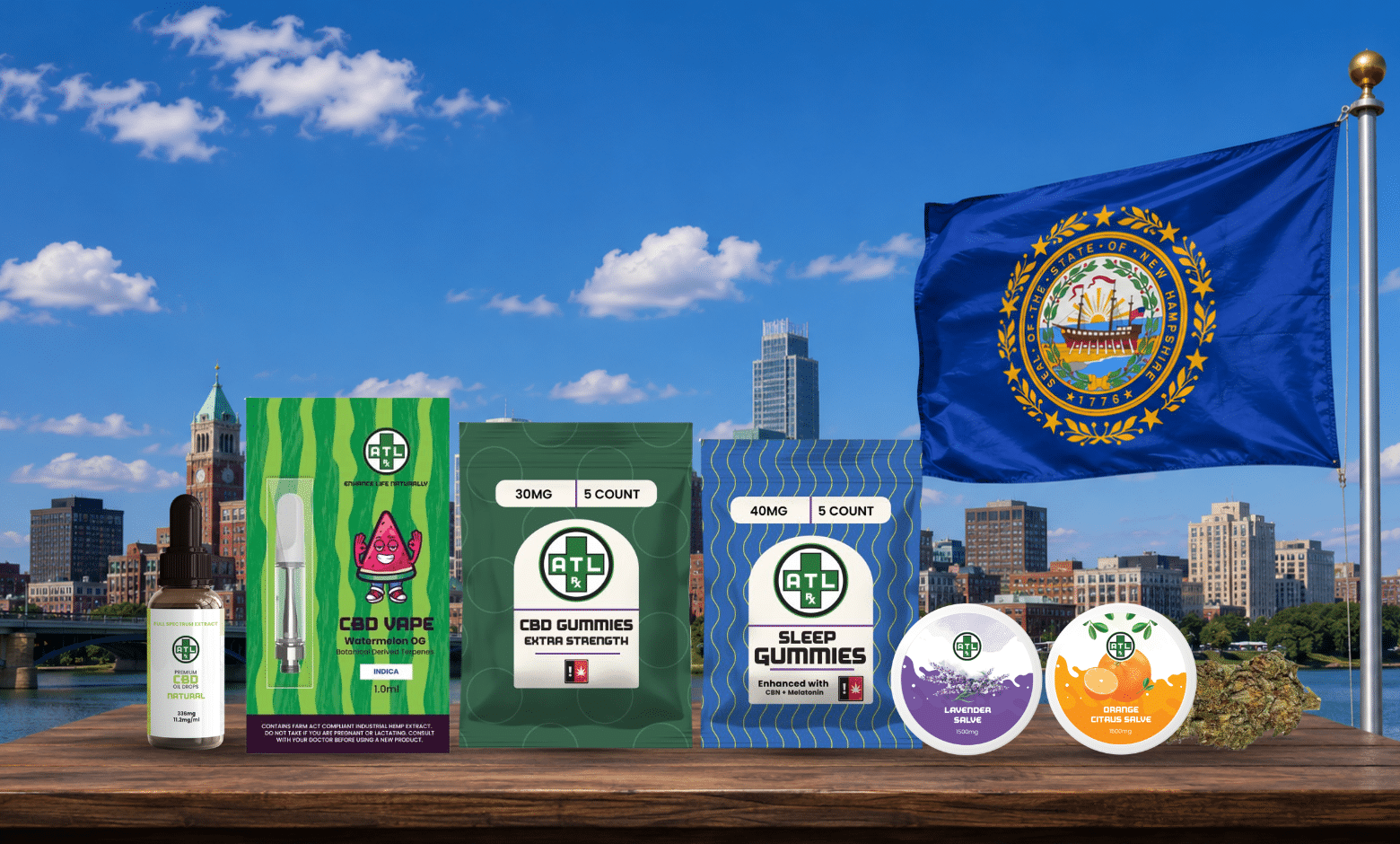
CBD Legal Status in New Hampshire
If you’re shopping for CBD in New Hampshire, the short version is this: most non-intoxicating, hemp-derived CBD products you can buy today are legal here, but the rules around anything containing THC are stricter than most consumers expect, and a federal law signed in late 2025 is about to redraw the line again. This guide walks through what’s actually legal in the Granite State right now, where the state and federal frameworks differ, and what changes on November 12, 2026.
New Hampshire allows the sale and possession of hemp-derived CBD products that meet the federal hemp definition. Cannabidiol itself isn’t a controlled substance, and the state’s hemp chapter, RSA 439-A, treats hemp as an ordinary agricultural commodity. What the state doesn’t allow is the sale of intoxicating products derived from hemp, including delta-8, delta-9 gummies, and similar items, even when the underlying plant material complies with the 0.3% delta-9 THC threshold. That distinction, set by a 2023 amendment, makes New Hampshire one of the stricter hemp markets in New England.
A separate state program, the Therapeutic Cannabis Program, governs higher-THC cannabis for registered patients. It is administered by the New Hampshire Department of Health and Human Services and is entirely separate from over-the-counter hemp-derived CBD. ATLRx is a hemp-derived CBD retailer and does not operate within the Therapeutic Cannabis Program. Recreational marijuana remains illegal under state law as of 2026.
Table of contents:
The state’s hemp framework was built in two legislative steps.
The first was HB 459, signed by Governor Chris Sununu on July 30, 2019 (Chapter 306, Laws of 2019). The bill added a new chapter, RSA 439-A, to state law. It defines hemp as the Cannabis sativa L. plant with a delta-9 THC concentration of no more than 0.3% on a dry weight basis, classifies hemp as an agricultural product that may be grown, processed, possessed, and traded commercially, and removes hemp grown under RSA 439-A from the state’s definition of “marijuana.” In other words, hemp and its derivatives, including CBD, are not controlled substances in New Hampshire.
The state chose not to run its own hemp production plan under the 2018 federal Farm Bill. Growers in New Hampshire register with the U.S. Department of Agriculture directly rather than going through a state-administered program.
The second step was HB 611, signed on August 8, 2023 (Chapter 237, Laws of 2023). Section 6 of that bill added RSA 439-A:4, which took effect on October 7, 2023. The provision reads in full:
Nothing in this chapter shall be construed to authorize the sale of products that are derived from hemp which contain natural or synthetic tetrahydrocannabinol (THC) greater than 0.3 percent on a dry weight basis, which appear in any formulation, including delta-8 THC, delta-9 THC, or any other THC isomer variant.
HB 611 also contained a Section 7 that was originally written to repeal RSA 439-A:4 on October 7, 2024. That repeal never took effect — the legislature reversed it in 2024, so the prohibition remains in force in the current New Hampshire Revised Statutes.
A gummy, tincture, vape, or beverage that contains hemp-derived intoxicating THC above 0.3% in any form is not authorized for retail sale in New Hampshire, regardless of whether the underlying hemp itself was federally compliant. This is the rule that puts the state out of step with neighbors like Vermont and Massachusetts, where adult-use cannabis retail exists, and even with states that have permitted intoxicating hemp products under the federal Farm Bill framework.
What remains lawful for general retail in New Hampshire are CBD products that don’t carry meaningful THC. That covers CBD isolate (cannabidiol with no detectable THC), broad-spectrum CBD (cannabinoids and terpenes without detectable THC), and full-spectrum products that stay within the 0.3% total-THC ceiling provided they comply with both federal hemp rules and RSA 439-A:4.
For a hemp-derived CBD product to be lawfully sold in New Hampshire today, it should:
Within those limits, CBD oils and tinctures, capsules, topicals such as creams and balms, and edibles formulated to stay under the THC threshold are generally available. ATLRx’s hemp-derived CBD catalog includes CBD Hemp Oil and tinctures, CBD Capsules, CBD Topicals such as salves, lotions, and lip balm, CBD Gummies and edibles, CBD Flower, and CBD Pre-Rolls. CBD isolate and broad-spectrum products are the safest from a compliance standpoint because they remove the THC variable almost entirely. Full-spectrum products are still sold, but buyers should scrutinize the COA closely: a full-spectrum product that lists, say, 0.4% delta-8 or delta-9 in any form falls outside RSA 439-A:4.
Patients who use cannabis products, including high-THC formulations, for medical reasons have a separate legal path. The Therapeutic Cannabis Program was created under RSA 126-X in 2013 and is administered by the New Hampshire Department of Health and Human Services.
A few essentials:
For most CBD consumers, the program isn’t relevant; over-the-counter hemp-derived CBD is sold under RSA 439-A, not RSA 126-X. ATLRx is a hemp-derived CBD retailer and does not sell through Alternative Treatment Centers; the program is described here only for completeness. Patients who need higher-concentration cannabis formulations should consult the program directly.
The federal definition of hemp has been the foundation for state CBD laws since the 2018 Farm Bill exempted hemp from the Controlled Substances Act and set the 0.3% delta-9 THC threshold. That definition is being rewritten.
On November 12, 2025, the Continuing Appropriations, Agriculture, Legislative Branch, Military Construction and Veterans Affairs, and Extensions Act, 2026 (Public Law 119-37) was signed into law. Section 781 of the act amends 7 U.S.C. § 1639o and takes effect 365 days after enactment, on November 12, 2026.
Three changes matter for CBD buyers:
Total THC, not just delta-9. The 0.3% ceiling will now apply to total THC content — delta-9 plus THCA (converted using the 0.877 decarboxylation factor), plus delta-8, delta-10, and any other THC-class cannabinoid the Department of Health and Human Services identifies. Products that were technically compliant under the old delta-9-only measurement may not be compliant under the new one.
A per-container milligram cap. Finished hemp-derived products intended for human or animal consumption, ingestion, inhalation, or topical use will be capped at 0.4 milligrams of total THC per container, with “container” defined as the innermost packaging in direct contact with the product at retail. For context, a typical 10 mg delta-9 gummy currently on the market is roughly 25 times that cap. The provision is designed to remove most intoxicating hemp products from the federal hemp definition entirely.
Exclusion of synthesized cannabinoids. Cannabinoids that are synthesized or manufactured outside the cannabis plant — which captures most commercial delta-8 (typically converted from CBD through chemical isomerization), HHC, and similar products are excluded from the hemp definition regardless of THC content.
For New Hampshire specifically, the federal change interacts with a state rule that already keeps most intoxicating hemp products off retail shelves under RSA 439-A:4. But the 0.4 mg cap is measured per container, not per serving a much stricter limit than many consumers assume. Industry analysts, including the U.S. Hemp Roundtable, estimate the cap reaches the large majority of hemp extract products, including many non-intoxicating CBD wellness items, because a full bottle of full-spectrum CBD oil can carry more than 0.4 mg of total THC even when each serving is far below an intoxicating dose. CBD isolate (no detectable THC) and broad-spectrum CBD (no detectable THC) are the formulations most likely to remain federal hemp after November 12, 2026. Full-spectrum products, including some in ATLRx’s CBD line, face real exposure and may need reformulation to isolate or broad-spectrum bases to retain federal hemp status. Higher-dose hemp-derived delta-9 edibles, which were never legal for retail sale in New Hampshire to begin with, will lose federal hemp status nationally. ATLRx, like other retailers, has a one-year runway to adjust product formulations ahead of the effective date.
A handful of bills have been introduced in Congress to repeal, delay, or replace Section 781 before the November 2026 effective date, including H.R. 6209 (full repeal), H.R. 7024 (delay), and a comprehensive regulatory framework proposed by Senators Wyden and Merkley. None had passed as of mid-2026.
Compliance comes down to documentation. A few things to look for on any ATLRx CBD product you’re considering:
ATLRx provides a Certificate of Analysis for its products, accessible by the batch or lot number on the package. CBD isolate and broad-spectrum options carry the least compliance risk because they remove the THC variable. If a product’s COA is missing, outdated, or doesn’t match the batch number, treat that as a reason to walk away.

CBD products that meet both the federal hemp definition and RSA 439-A’s THC ceiling can be brought into and out of New Hampshire without state-level controlled-substance issues. Intoxicating hemp products that fall outside RSA 439-A:4 are a different story, even if you bought them legally in another state. The prohibition in New Hampshire applies regardless of where the product was purchased.
Two specifics worth knowing:
Air travel adds another layer. TSA policy currently permits hemp-derived products that meet the federal definition, but that definition shifts on November 12, 2026. Anything that loses federal hemp status on that date will also lose its presumption of legality at airports.
The CBD landscape in New Hampshire is more stable than its intoxicating-hemp neighbor. Compliant CBD oils, capsules, topicals, and other wellness products have been legally sold here since 2019. The state’s restrictions, by contrast, fall mostly on products that try to deliver a high through the hemp loophole, and those have been off-limits in New Hampshire since October 2023. The November 2026 federal redefinition adds a new variable: because the 0.4 mg per-container cap is strict, full-spectrum products are more exposed than many shoppers assume, while CBD isolate and broad-spectrum options are the most likely to remain on the right side of the line.
For consumers, the practical takeaway: buy ATLRx products that come with a current, batch-matched COA; pay attention to total THC rather than only delta-9; and recognize that products marketed as hemp-derived elsewhere in the country may not be legal to sell or possess here. For anything novel or full-spectrum, verifying with a licensed New Hampshire attorney is worth the cost.
For the most current legal information, the New Hampshire Department of Agriculture, Markets, and Food administers hemp-related matters; the Department of Health and Human Services runs the Therapeutic Cannabis Program; and current statutory text is available through the New Hampshire General Court website.

July 27, 2026
July 23, 2026
July 22, 2026
July 21, 2026
$39.99
$49.99
$49.99
$49.99
$39.99
$39.99
$49.99