

$39.99

ARE YOU 21 YEARS OF AGE OR OLDER?
REMEMBER ME
Seriously, by using this site you are confirming that you are of legal age (21+) to view and purchase these products. If you are you are not over 21. you are not authorized by us to use or view any of the pages of this site. Please review our terms and conditions at checkout for further stipulations.
 >
Blogs
>
Delta 8 >
Is Delta 8 Legal in Michigan? 2026 Law Updates & Guide
>
Blogs
>
Delta 8 >
Is Delta 8 Legal in Michigan? 2026 Law Updates & Guide
THE STATEMENTS ON THIS BLOG ARE NOT INTENDED TO DIAGNOSE, TREAT, CURE, OR PREVENT ANY DISEASE. THE FOOD AND DRUG ADMINISTRATION HAS NOT EVALUATED ANY STATEMENTS CONTAINED WITHIN THE BLOG. ATLRX DOES NOT IN ANY WAY GUARANTEE OR WARRANT THE ACCURACY, COMPLETENESS, OR USEFULNESS OF ANY MESSAGE. THE INFORMATION CONTAINED WITHIN THIS BLOG IS FOR GENERAL INFORMATIONAL PURPOSES ONLY.
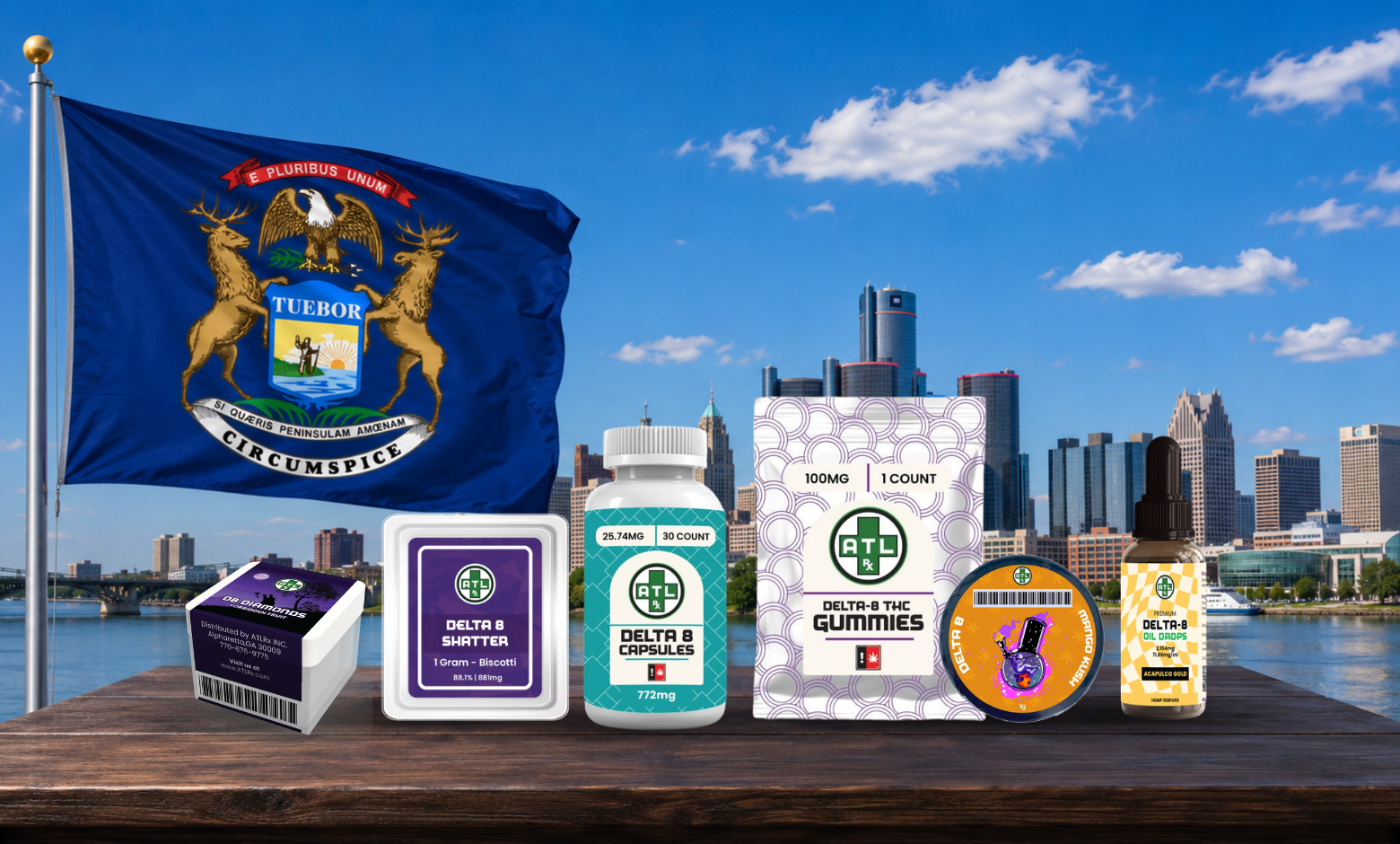
Delta 8 Legal Status in Michigan:
Yes, Delta 8 THC is legal in Michigan in 2026, but only at CRA-licensed dispensaries. Under HB 4517 (effective October 11, 2021), Michigan regulates Delta 8 and all THC isomers as marijuana, regardless of whether they come from hemp or cannabis. A medical card is not required; you must be 21 or older to purchase. Out-of-state online hemp retailers cannot lawfully ship intoxicating Delta 8 into Michigan. At the federal level, Public Law 119-37 (signed November 12, 2025, effective November 12, 2026) is expected to remove most hemp-derived Delta 8 products from federal legality.
If you’re asking, “Is Delta 8 legal in Michigan?” — the short answer is yes, but only when purchased from a CRA-licensed dispensary, and the surrounding federal framework is currently in flux. Since October 11, 2021, Michigan has treated Delta 8 — along with all other intoxicating THC isomers — as marijuana under state law, regulated by the Michigan Cannabis Regulatory Agency (CRA), regardless of whether the cannabinoid was sourced from hemp or marijuana. Separately, a November 2025 federal law (Public Law 119-37) redefined “hemp” to use total THC instead of just Delta 9 THC, with that change scheduled to take effect November 12, 2026 — a shift that will reshape the federal status of Delta 8 nationwide.
This guide breaks down exactly what Michigan’s Delta 8 laws say in 2026, how House Bill 4744 and House Bill 4517 changed the landscape, where you can legally buy Delta 8 THC in the state, and what to look for in a reputable retailer.
Table of contents:
Yes, Delta 8 THC is legal in Michigan, but only through CRA-licensed dispensaries for those 21 and older. Under the 2018 Farm Bill (in effect through November 11, 2026), hemp-derived Delta 8 was legal if the source plant contained no more than 0.3% Delta 9 THC on a dry-weight basis. Michigan’s hemp framework was established by the Industrial Hemp Research and Development Act (Public Act 547 of 2014) and significantly updated by 2018 PA 641 (effective January 15, 2019) and HB 4744 of 2021. The most important change for Delta 8 came with HB 4517, signed by Governor Whitmer on July 13, 2021, and effective October 11, 2021, which brought Delta 8 and every other intoxicating THC isomer under the CRA’s authority and treats them as marijuana regardless of source plant.
For comparison, see how Michigan stacks up against its neighbors: Is Delta 8 Legal in Indiana?
The legal status of Delta 8 in Michigan can be understood by examining how laws have evolved on both the federal and state levels. Below is the full timeline:
During the 2018 Farm Bill, hemp was removed from the Controlled Substances Act and defined as any part of the cannabis plant or its derivatives containing less than 0.3% Delta 9 THC by dry weight. This opened the door for hemp-derived cannabinoids, including Delta 8 THC, to be produced and sold across the United States.
Michigan voters approved Proposal 1 on November 6, 2018, with about 56% in favor, making it the 10th state to legalize recreational marijuana. Possession became legal on December 6, 2018; the first licensed adult-use retail sales did not begin until December 1, 2019.
Signed by Governor Rick Snyder in late 2018 and effective January 15, 2019, this act amended Michigan’s Industrial Hemp Research and Development Act (PA 547 of 2014) to align state hemp law with the new federal Farm Bill and clarified that hemp-derived CBD would not be a controlled substance under state law.
Part of the same legislative package as HB 4517, HB 4744 further amended the Industrial Hemp Research and Development Act, adding statutory definitions for “broker,” “cannabis,” “THC,” and “volunteer cannabis plant,” and updating licensing and handling rules for hemp processors.
This is the most important update for Delta 8 buyers in Michigan. Signed by Governor Whitmer on July 13, 2021, and effective October 11, 2021, HB 4517 placed Delta 8 THC — and all THC isomers — under the regulatory authority of the Michigan CRA. Under this law:
For the CRA’s official Delta-8 consumer guidance, see the state’s Delta-8 information page.
Hemp is now defined as having a total THC concentration (including THCa) of no more than 0.3% by dry weight, replacing the Delta 9 threshold. Additionally, it limits hemp-derived cannabinoid products to 0.4 milligrams of total THC per container and excludes synthetic cannabinoids. The amendment will take effect on November 12, 2026, and most Delta 8 commercial products will no longer be legal under federal law. Bipartisan repeal bills have been introduced; the situation remains fluid going into late 2026.
In Michigan, the only legal in-state purchase channel for Delta 8 THC is a CRA-licensed dispensary or provisioning center. Under HB 4517, intoxicating Delta 8 products sold by unlicensed online hemp retailers, gas stations, or smoke shops are not compliant with state law, even if the seller is operating legally in another state under federal Farm Bill rules. The CRA has issued enforcement actions, including product seizures, against unlicensed sellers shipping into Michigan.
To find a licensed dispensary, use the CRA’s official license lookup at michigan.gov/cra. Look for these signals before purchasing:
For Michigan residents: if you are shopping online from a hemp brand, that brand is not lawfully selling intoxicating Delta 8 into Michigan, regardless of how the website is framed. The legally compliant in-state path is a CRA-licensed dispensary.
No. In Michigan, you do not need a medical marijuana card to purchase Delta 8 THC if you are 21 or older.
Any adult 21+ can purchase from a CRA-licensed adult-use dispensary; a medical card is only needed to access medical-only product categories or to qualify for medical tax savings.
Limits on Delta 8 possession are not set by Michigan. Because Delta 8 is treated as marijuana under HB 4517, the standard MRTMA cannabis possession rules apply (MCL 333.27955):
Always check current CRA guidance, as administrative rules may be refined further.
You must be 21 years of age or older to legally purchase Delta 8 THC in Michigan from a CRA-licensed dispensary. All Michigan dispensaries require government-issued photo ID at entry and at the point of sale.
If you’re buying Delta 8 vape products online (note: in Michigan, intoxicating Delta 8 vapes can only legally come from a CRA-licensed dispensary), the federal PACT Act (Prevent All Cigarette Trafficking Act) applies to the sale. The PACT Act was extended to cover electronic nicotine delivery systems and vape products through the Consolidated Appropriations Act, 2021, signed in December 2020; the vape provisions became enforceable on March 27, 2021. Under the PACT Act:
If a website doesn’t require age verification or makes its compliance status unclear, that’s a major red flag. For full federal details, see the ATF’s vapes and e-cigarettes guidance.
There are two types of tetrahydrocannabinols in cannabis: Delta 8 and Delta 9. Both of them are present in the plant. They have similar chemical structures, but differ in the position of a double bond in their carbon chain. That single structural difference is what gives them different legal classifications, sourcing rules, and regulatory treatment. Delta 9 occurs naturally in significant amounts, while Delta 8 occurs only in trace amounts — so practically all commercial Delta 8 is synthesized from hemp-derived CBD through chemical conversion.
| Attribute | Delta 8 THC | Delta 9 THC |
| Source | Typically converted from hemp-derived CBD | Naturally abundant in marijuana |
| Federal Legality (through Nov 11, 2026) | Legal under the 2018 Farm Bill (hemp-derived, <0.3% Delta 9) | Federally illegal (Schedule I) as marijuana |
| Federal Legality (from Nov 12, 2026) | Largely removed from federal legality under PL 119-37 (total-THC cap) | Federally illegal (Schedule I) as marijuana |
| Michigan Status | Legal at CRA-licensed dispensaries only; regulated as marijuana under HB 4517 | Legal for adults 21+; possession effective Dec 6, 2018; licensed retail sales began Dec 2019 |
| Double Bond Position | On the 8th carbon chain | On the 9th carbon chain |
| Natural Concentration | Trace amounts in cannabis plants | Found in high concentrations in marijuana |
| Age to Purchase | 21+ | 21+ |
Yes. Michigan voters approved Proposal 1 with about 56% in favor on November 6, 2018, making it the 10th state nationwide and the first in the Midwest to legalize recreational marijuana. Personal possession became legal on December 6, 2018; licensed adult-use retail sales did not begin until December 1, 2019. It is legal for adults 21 and older to possess up to 2.5 ounces of marijuana in public (no more than 15 grams in concentrate form), store up to 10 ounces at home (anything over 2.5 ounces must be locked up), and cultivate up to 12 plants for personal use. Retail sales are subject to a 6% sales tax plus a 10% marijuana excise tax.
Yes, as a regulated product. Delta 10 is regulated under the same 2021 framework as Delta 8 — all THC isomers fall under CRA oversight. As with Delta 8, Delta 10 products must meet state licensing and testing standards and may only be sold through CRA-licensed dispensaries.
Under HB 4517, the Michigan CRA treats THCa as a marijuana precursor because THCa decarboxylates into Delta 9 THC when heated. As a practical matter, THCa flower and other intoxicating THCa products may only be sold through CRA-licensed dispensaries in Michigan, regardless of whether the source plant met the federal hemp definition under the 2018 Farm Bill. Hemp-derived THCa products shipped into Michigan from out-of-state online sellers are not compliant with Michigan law. Federal Public Law 119-37, effective November 12, 2026, removes the Farm Bill ambiguity by counting THCa toward total THC at the federal level as well.
Yes. Both hemp-derived and marijuana-derived CBD are legal in Michigan. Hemp-derived CBD with no more than 0.3% Delta 9 THC follows federal Farm Bill rules and Michigan’s hemp framework.
THCP is an intoxicating tetrahydrocannabinol, so it falls under Michigan’s HB 4517 definition of THC and is regulated as marijuana under state law. Any commercial THCP product sold in Michigan would need to come through a CRA-licensed dispensary. Federal Public Law 119-37, effective November 12, 2026, tightens the federal definition of hemp to include all forms of THC in the total THC calculation, which will affect THCP’s federal status as well.
Delta 8 THC is sold in a wide variety of formats. The most common product types include:
Michigan’s approach has been pragmatic: rather than banning Delta 8 outright (as some states have done), it brought the cannabinoid into a regulated framework alongside marijuana. The bigger near-term uncertainty is at the federal level. Public Law 119-37, signed November 12, 2025, redefines hemp to use total THC and takes effect November 12, 2026. That change is expected to remove most hemp-derived Delta 8 products from federal legality, though bipartisan efforts to repeal or amend the provision are already underway.
For Michigan, the immediate impact is limited because the state already requires Delta 8 to move through the CRA-licensed system. As more local governments respond to public demand and as testing standards mature, it’s reasonable to expect:
For Michigan residents and visitors, the practical takeaway is simple: Delta 8 is here to stay in Michigan’s licensed system, but the smart move is to buy only from CRA-licensed dispensaries that provide third-party batch testing.
Yes, Delta 8 THC is legal to buy in Michigan in 2026 — but only through CRA-licensed dispensaries, and the federal framework is changing. Since the 2021 enactment of HB 4517, Michigan has regulated Delta 8 alongside other THC products under the Cannabis Regulatory Agency. Anyone 21 or older can legally purchase Delta 8 in the state at a licensed dispensary. Federally, Public Law 119-37 (signed November 12, 2025, effective November 12, 2026) redefines hemp to use total THC instead of just Delta 9, which is expected to remove most hemp-derived Delta 8 products from federal legality.
Cannabis and hemp laws continue to evolve, so it’s wise to verify the current status before making a purchase and to buy only from retailers who provide lab-tested products and full compliance information.
Michigan shoppers: the only compliant in-state source for Delta 8 THC is a CRA-licensed dispensary — use the CRA license lookup at michigan.gov/cra to find one near you. If you are located outside Michigan, you can explore the ATLRx selection of hemp products — all third-party lab tested and shipped only to addresses where the specific product is legally compliant.
Yes. It is legal to purchase Delta 8 THC in Michigan from CRA-licensed dispensaries. Since October 2021, HB 4517 has placed Delta 8 and all THC isomers under the CRA and treats them as marijuana, regardless of whether the source plant was hemp or cannabis. Federal Public Law 119-37, signed November 12, 2025, and effective November 12, 2026, redefines hemp to use total THC instead of just Delta 9 THC — a change expected to remove most hemp-derived Delta 8 products from federal legality.
No. Anyone 21 or older can legally purchase Delta 8 THC from a CRA-licensed adult-use dispensary in Michigan without a medical marijuana card.
Yes. Michigan legalized recreational marijuana for adults 21+ through Proposal 1, approved by voters on November 6, 2018, with about 56% in favor. Possession became legal on December 6, 2018, and licensed retail sales began on December 1, 2019. Michigan’s medical marijuana program was separately established in 2008.
Yes. Both hemp-derived and marijuana-derived CBD are legal in Michigan.
Yes, when purchased from a CRA-licensed dispensary. Delta 10 is regulated under the same Michigan framework as Delta 8 and is available to adults 21+.
Michigan treats THCa as a marijuana precursor under HB 4517, regardless of source plant. In Michigan, THCa products cannot be sold outside of CRA-licensed dispensaries; out-of-state hemp shipments are prohibited by state law.
The legal age is 21. Michigan state law requires age verification at CRA-licensed dispensaries.
Michigan does not set Delta 8-specific limits. The standard MRTMA cannabis rules apply: up to 2.5 ounces total, no more than 15 grams of which can be concentrates; up to 10 ounces total at home, with anything over 2.5 ounces stored in a locked container.
No. Under HB 4517, intoxicating Delta 8 products may only be lawfully sold in Michigan through CRA-licensed dispensaries. Out-of-state online hemp retailers shipping intoxicating Delta 8 (or Delta 10, THCa, or hemp-derived Delta 9) into Michigan addresses are not compliant with state law, even if their products meet the federal 2018 Farm Bill hemp definition.
Currently, Michigan’s hemp definition matches the federal 2018 Farm Bill: plants that contain no more than 0.3% Delta 9 THC on a dry-weight basis. Federal Public Law 119-37 changes the federal definition to total THC (including THCa) of no more than 0.3% on a dry-weight basis, effective November 12, 2026; Michigan may update its definition to match.
Delta 8 molecules are chemically identical regardless of their source. Source plant and regulatory path make a difference. Under HB 4517, Michigan treats both hemp-derived and marijuana-derived Delta 8 as marijuana under CRA oversight — so for Michigan purchasers, the practical answer is that both can only be lawfully purchased from a CRA-licensed dispensary.
Reputable retailers publish Certificates of Analysis (COAs) for every batch. Always look for batch-specific, third-party COAs before purchasing.
Disclaimer: This article is for informational purposes only and is not legal or medical advice. Delta 8 THC products have not been evaluated or approved by the U.S. Food and Drug Administration. These statements have not been evaluated by the FDA, and Delta 8 products are not intended to diagnose, treat, cure, or prevent any disease. Cannabis and hemp laws change frequently at both the state and federal levels; verify the current status of the law before purchasing. You must be 21 or older to purchase. Do not drive or operate machinery after use.

July 23, 2026
July 22, 2026
July 21, 2026
July 20, 2026
$39.99
$49.99
$49.99
$49.99
$39.99
$39.99
$49.99