



$34.99
ARE YOU 21 YEARS OF AGE OR OLDER?
REMEMBER ME
Seriously, by using this site you are confirming that you are of legal age (21+) to view and purchase these products. If you are you are not over 21. you are not authorized by us to use or view any of the pages of this site. Please review our terms and conditions at checkout for further stipulations.
 >
Blogs
>
CBD >
Is CBD Legal in Nevada? Complete 2026 Legal Guide
>
Blogs
>
CBD >
Is CBD Legal in Nevada? Complete 2026 Legal Guide
THE STATEMENTS ON THIS BLOG ARE NOT INTENDED TO DIAGNOSE, TREAT, CURE, OR PREVENT ANY DISEASE. THE FOOD AND DRUG ADMINISTRATION HAS NOT EVALUATED ANY STATEMENTS CONTAINED WITHIN THE BLOG. ATLRX DOES NOT IN ANY WAY GUARANTEE OR WARRANT THE ACCURACY, COMPLETENESS, OR USEFULNESS OF ANY MESSAGE. THE INFORMATION CONTAINED WITHIN THIS BLOG IS FOR GENERAL INFORMATIONAL PURPOSES ONLY.
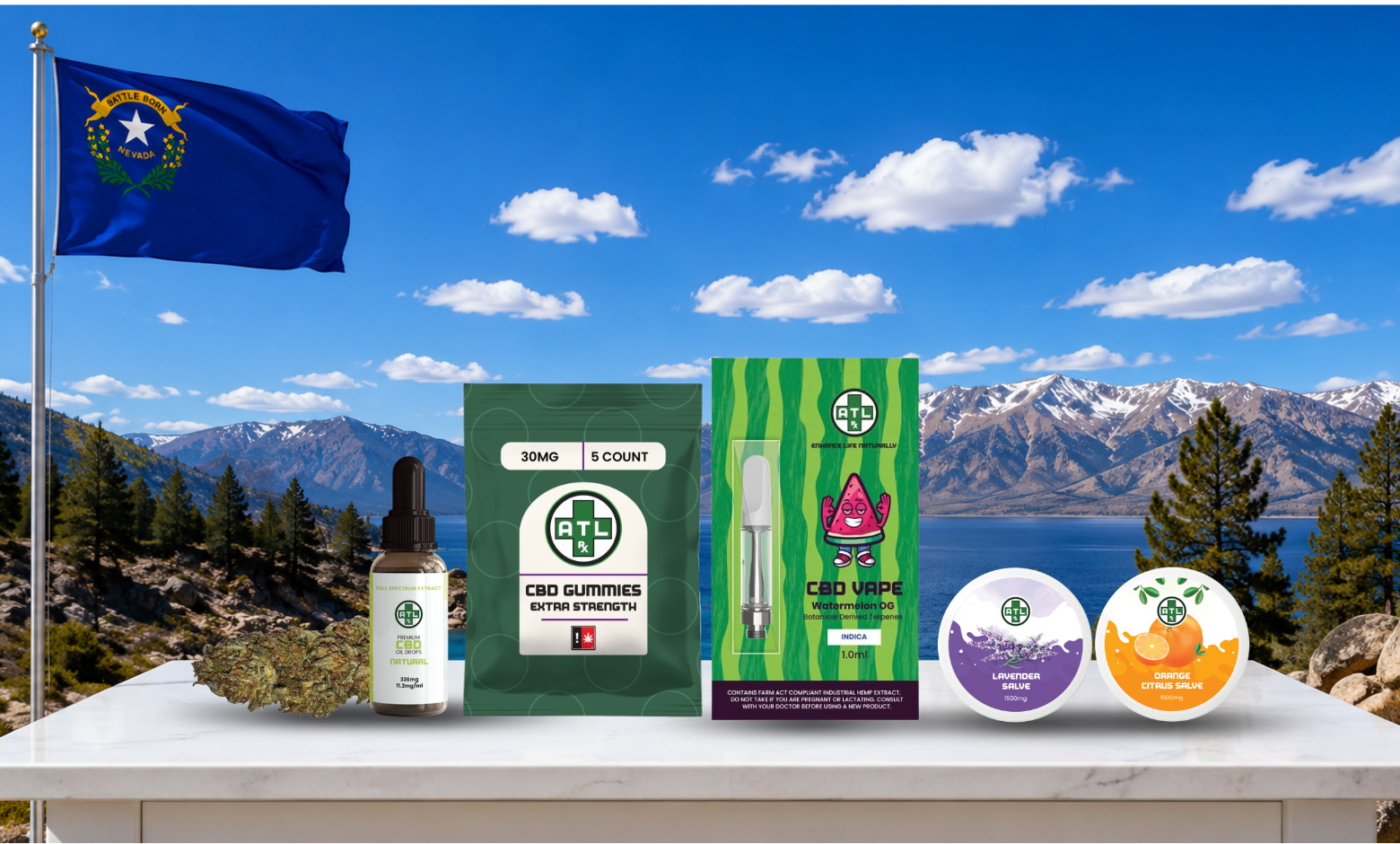
CBD Legal Status in Nevada:
Yes, CBD is legal in Nevada in 2026, but the rules are layered. Hemp-derived CBD with no more than 0.3% delta-9 THC is sold in retail stores statewide under state hemp regulations. The sale of marijuana-derived CBD is also legal in Nevada, but only at state-licensed cannabis dispensaries for adults 21 and older or registered medical patients. A major federal change is also on the horizon for late 2026 that anyone buying or selling hemp products in Nevada should understand.
If you have ever stood in front of a CBD shelf in Las Vegas or scrolled through an online store before placing an order in Reno, you have probably wondered exactly where the law actually stands. Nevada is one of the more cannabis-friendly states in the country, but the rules around CBD specifically are not as simple as a single yes or no. The answer changes depending on where the CBD was sourced from, who is buying it, where in the state you happen to be, and whether the year is 2025 or 2026.
So, is CBD legal in Nevada? Yes, but with a few important conditions. Hemp-derived CBD is sold openly through general retail. Marijuana-derived CBD is sold only through state-licensed dispensaries to adults 21 and over or to registered medical patients. On top of that, a major federal change to how hemp itself is defined is scheduled to take effect on November 12, 2026, and it could reshape which CBD products stay on shelves across Nevada and the rest of the country.
This guide pulls together the current state laws, the relevant federal rules, the 2026 update everyone in the industry is watching, and the practical buying tips that help you stay on the right side of the line. We have cited the actual statute numbers and bill pages throughout so you can verify any detail with the original source. Whether you live in Nevada year-round, are visiting Las Vegas for the weekend, or run a retail operation.
Table of contents:
If you have been asking, “Is CBD legal in Nevada?” the short answer is yes, with two separate legal tracks depending on where the CBD comes from. The state distinguishes between hemp-derived CBD, which is sold widely at retail, and marijuana-derived CBD, which is regulated through the state’s licensed cannabis system. Nevada has been one of the more progressive states on cannabis policy since voters approved Question 2 in November 2016, and the state has built a structured framework around both hemp and marijuana that residents and visitors should know before they purchase or travel with CBD products.
Below, we cover what makes each type legal, the possession and purchase limits in effect for 2026, who regulates the market, and how the federal hemp law changes scheduled for November 12, 2026, may affect what you see on store shelves.
Hemp-derived CBD has been federally legal in the United States since the 2018 Farm Bill, which removed hemp from the Controlled Substances Act. The 2018 Farm Bill defined hemp as cannabis containing no more than 0.3% delta-9 THC by dry weight. Nevada adopted that same federal threshold and built its state hemp program under NRS Chapter 557, administered by the Nevada Department of Agriculture (NDA).
Under the Nevada hemp program:
If you’re searching for hemp-derived CBD oil, CBD tinctures, gummies, or CBD topicals in Nevada, this is the framework you’re buying under.
CBD can also be extracted from marijuana plants, where the THC content is much higher. In Nevada, this type of CBD is regulated as a cannabis product, not a hemp product. It is overseen by the Cannabis Compliance Board (CCB), an independent state agency created under Assembly Bill 533 in 2019.
Marijuana-derived CBD is legal in Nevada for:
These products are governed by NRS Chapter 678D (adult use) and NRS Chapter 678C (medical). They cannot be sold in general retail stores. The only legal place to buy is a state-licensed dispensary.
This is where many older guides are wrong. Nevada’s possession limits changed on January 1, 2024, when Senate Bill 277 took effect. The updated thresholds remain in place for 2026:
| Product Type | Adult-Use Limit (21+) | Medical Patient Limit |
| Cannabis flower | Up to 2.5 ounces | Up to 2.5 ounces |
| Cannabis concentrate | Up to 1/4 ounce | Up to 1/4 ounce |
| Hemp-derived CBD products | No state-set possession limit | No state-set possession limit |
Penalties scale with the total amount possessed. Possession of more than 2.5 ounces but less than one ounce above the limit is generally charged as a misdemeanor with a fine of up to $600 for a first offense. Larger amounts — generally one ounce or more above the limit, or any amount of concentrate above the 1/4-ounce cap, can be charged as a category E felony. Carry within the limits, keep products in their original sealed packaging, and consult a Nevada attorney for case-specific guidance, since penalties depend on the exact circumstances.
There are a few different retail pathways depending on the type of CBD:
If you order hemp-derived CBD online from out of state, it must still meet the 0.3% delta-9 THC threshold, and the Nevada hemp program’s labeling rules apply at the point of sale. A third-party Certificate of Analysis (COA) is published by reputable brands for every batch. ATLRx publishes a COA for every batch on every product page; always check for one before you buy.
Several Nevada counties have opted out of allowing adult-use marijuana dispensaries within their borders:
In these counties, you may not find a licensed dispensary, but hemp-derived CBD remains available through general retail and online channels. Cities and tribal partnerships within those counties can sometimes carve out exceptions.

It is just as important where you consume as what you consume. All public spaces in Nevada are prohibited from using cannabis. This includes:
Public consumption is generally a misdemeanor, with a fine of up to $600 for a first offense; repeat offenses and aggravating circumstances can carry steeper penalties.
For Las Vegas visitors and locals who do not have a private residence to consume in, Assembly Bill 341 (signed in 2021) created licensed cannabis consumption lounges. Two types are licensed by the CCB: standalone lounges and retail-attached lounges connected to a dispensary. These are the only public-facing venues in Nevada where on-site consumption is legal. Alcohol is not served, and products cannot leave the premises.
According to a 2019 TSA policy update, hemp-derived CBD products containing less than 0.3% delta-9 THC are allowed on domestic flights. A marijuana-based product cannot be taken on a flight or crossed state lines legally. In Nevada, cannabis should be transported in sealed original packaging in your trunk or a locked compartment.
This is the single most important update for anyone buying or selling CBD in Nevada in 2026, and it is what most older guides on this topic are missing.
In November 2025, Congress passed H.R. 5371 — the Continuing Appropriations, Agriculture, Legislative Branch, Military Construction and Veterans Affairs, and Extensions Act, 2026 (Public Law 119-37), which President Trump signed into law on November 12, 2025. Section 781 of that law amends the Agricultural Marketing Act of 1946 and rewrites the federal definition of hemp. The changes take effect on November 12, 2026.
Two changes matter for the CBD market:
The hemp industry and several bipartisan groups in Congress are actively pushing back. As of mid-2026:
A presidential executive order signed by President Trump on December 18, 2025 (“Increasing Medical Marijuana and Cannabidiol Research”) instructs senior White House staff to work with Congress to update the statutory definition of hemp-derived cannabinoid products so Americans can continue to receive full-spectrum CBD. The President followed up publicly on April 23, 2026, with a direct call on Congress to amend the law before the November deadline. The situation is fluid. Anyone selling or buying CBD in Nevada should track these bills through the second half of 2026 because the shelf availability of certain full-spectrum products could shift.
The federal change does not happen until November 12, 2026, and even then, Nevada’s CCB-regulated cannabis market will continue to operate under state law. The state hemp program under NRS Chapter 557 currently mirrors the 2018 Farm Bill’s 0.3% delta-9 standard, and the Nevada Department of Agriculture is expected to align the state framework with the new federal “total THC” definition, though formal guidance has not yet been issued. Here is the practical takeaway:
| Topic | Federal Rule (Current) | Nevada State Rule |
| Hemp-derived CBD legality | Legal under the 2018 Farm Bill (until Nov 12, 2026) | Legal under NRS Chapter 557 |
| Marijuana-derived CBD | Schedule I controlled substance | Legal for 21+ adults and medical patients |
| THC threshold for hemp | 0.3% delta-9 THC by dry weight | Same |
| THC threshold after Nov 12, 2026 | 0.3% total THC + 0.4 mg per container | Nevada is expected to align with the new federal definition, though the Nevada Department of Agriculture has not yet issued formal guidance on how NRS Chapter 557 will be updated |
| Regulating body | USDA (hemp), FDA (finished products) | NDA (hemp), CCB (cannabis) |
| Age requirement | None federally for hemp CBD | 21 for adult-use cannabis; medical patients per program rules |
Whether you’re a Nevada resident or visiting Las Vegas, a few practical checks help you stay compliant and confident — and they’re the same standards ATLRx applies to every product we sell:
ATLRx has been in the hemp and CBD space for over eight years, with USA-grown hemp, third-party lab testing on every batch, and easy access to COAs on every product page. Browse our CBD product collection or explore our CBD hemp oil, CBD gummies, and CBD topicals.
Yes. Hemp-derived CBD with no more than 0.3% delta-9 THC is sold at general retail without a medical card. Marijuana-derived CBD requires either an adult-use purchase (21 and over) from a licensed dispensary or a Nevada medical marijuana card.
Yes. Las Vegas has the largest concentration of both hemp-derived CBD retailers and CCB-licensed cannabis dispensaries in the state. Public consumption is not legal, but licensed consumption lounges operate in the city under AB 341.
CBD products derived from hemp that meet the 0.3% delta-9 THC limit are allowed on domestic flights under the current TSA policy. Marijuana-derived products are not, and you cannot legally carry them across state lines.
Yes, full-spectrum CBD is legal as long as it does not contain more than 0.3% delta-9 THC by dry weight. After November 12, 2026, the federal definition is set to shift to total THC, including THCA, so some full-spectrum products could be affected unless Congress changes the law. Follow the news on H.R. 7024 and H.R. 6209.
The Nevada hemp program does not set a state-specific possession limit on hemp-derived CBD products for personal use. Adult-use marijuana products are capped at 2.5 ounces of flower or 1/4 ounce of concentrate under Senate Bill 277.
Two state agencies are your primary sources: the Nevada Cannabis Compliance Board for marijuana-derived products and the Nevada Department of Agriculture for the hemp program. For federal updates, congress.gov tracks the active hemp bills.
This article is provided for general informational purposes only and does not constitute legal or medical advice. CBD products sold by ATLRx have not been evaluated by the FDA and are not intended to diagnose, treat, cure, or prevent any disease. Laws change frequently — verify current rules with the Nevada Department of Agriculture, the Nevada Cannabis Compliance Board, or a qualified attorney before relying on any information here.

August 4, 2026
July 30, 2026

$39.99

$39.99
$39.99
$49.99
$49.99
$49.99
$39.99