

$39.99

ARE YOU 21 YEARS OF AGE OR OLDER?
REMEMBER ME
Seriously, by using this site you are confirming that you are of legal age (21+) to view and purchase these products. If you are you are not over 21. you are not authorized by us to use or view any of the pages of this site. Please review our terms and conditions at checkout for further stipulations.
 >
Blogs
>
THCA >
Is THCA Legal in New Hampshire? Complete 2026 Legal Guide
>
Blogs
>
THCA >
Is THCA Legal in New Hampshire? Complete 2026 Legal Guide
THE STATEMENTS ON THIS BLOG ARE NOT INTENDED TO DIAGNOSE, TREAT, CURE, OR PREVENT ANY DISEASE. THE FOOD AND DRUG ADMINISTRATION HAS NOT EVALUATED ANY STATEMENTS CONTAINED WITHIN THE BLOG. ATLRX DOES NOT IN ANY WAY GUARANTEE OR WARRANT THE ACCURACY, COMPLETENESS, OR USEFULNESS OF ANY MESSAGE. THE INFORMATION CONTAINED WITHIN THIS BLOG IS FOR GENERAL INFORMATIONAL PURPOSES ONLY.
THCA Legal Status in New Hampshire:
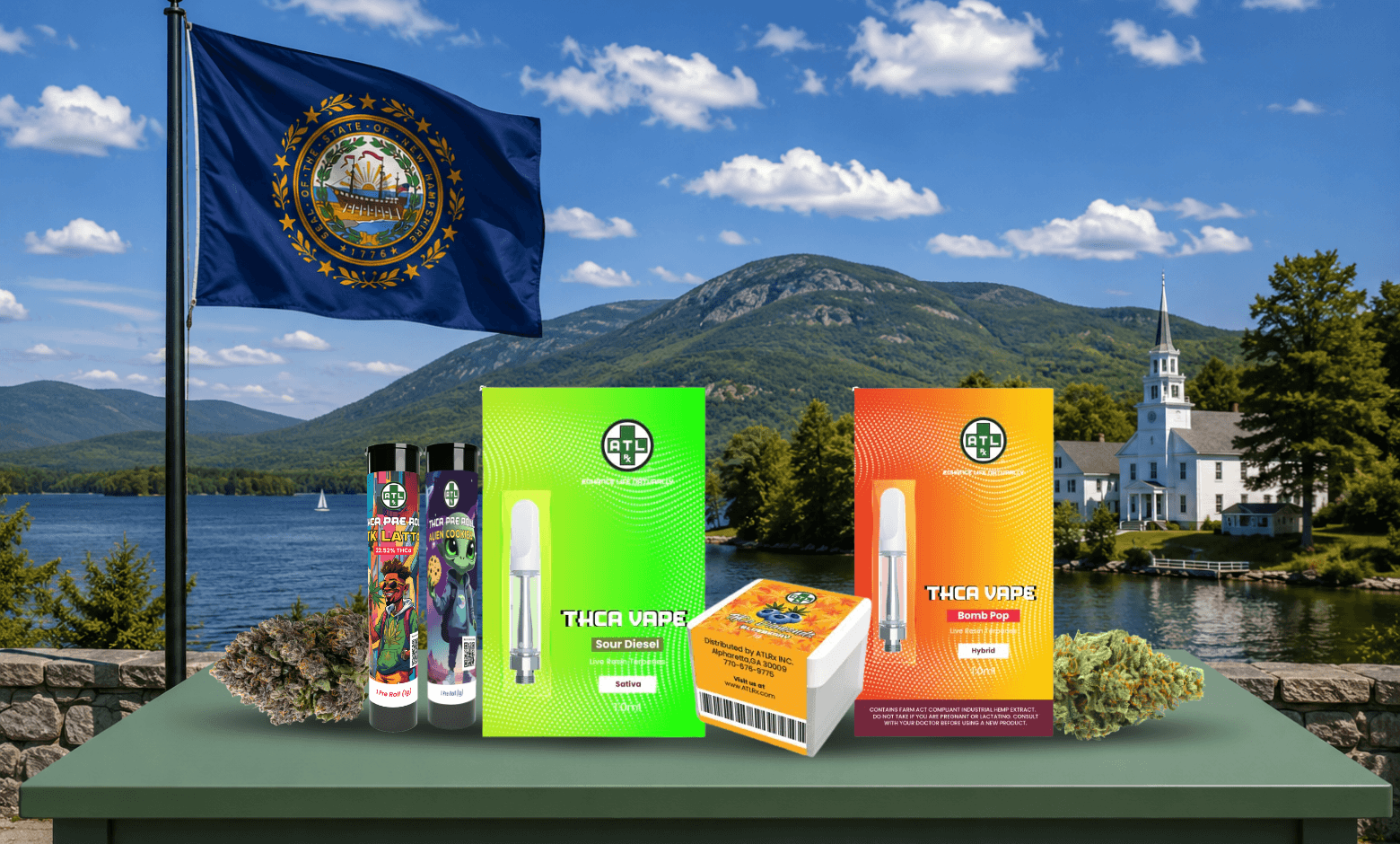
THCA flower and other intoxicating hemp-derived THC products are not authorized for retail sale in New Hampshire. Under RSA 439-A:4, the state already prohibits the sale of hemp-derived products containing more than 0.3% THC in any formulation, and state regulators treat THCA as part of that restriction because THCA converts into delta-9 THC when heated. New Hampshire also has no adult-use cannabis market, so the only fully regulated channel for higher-THC products is the state’s medical Therapeutic Cannabis Program.
On top of that, a federal law takes effect on November 12, 2026, that redefines hemp using a “total THC” standard that specifically counts THCA. So, even setting aside state rules, the federal framework that previously allowed high-THCA hemp flower is scheduled to close nationwide.
If you have been asking, “Is THCA legal in New Hampshire?” the honest answer in 2026 is that it is complicated, and the rules are tightening at both the state and federal levels. New Hampshire has one of the most restrictive hemp and cannabis frameworks in New England, and recent legislative activity is narrowing the window for hemp-derived THCA products even further. This guide breaks down the current state statutes, the federal law signed in late 2025, the bills moving through the New Hampshire legislature in 2026, and what all of it means for consumers in the Granite State.
We would like to remind you that this article is intended for general informational purposes only and does not constitute legal advice. The law on cannabis and hemp is constantly changing. Verify the current status of any law with an attorney or an official state source before making a purchase or possession decision.
Table of contents:
The raw, acidic precursor to delta-9 THC is tetrahydrocannabinolic acid (THCA). It occurs naturally in the live and freshly harvested cannabis plant. Raw, unheated THCA is chemically distinct from delta-9 THC and not intoxicating.
The key chemical detail that drives the legal debate is decarboxylation. When heated, such as when smoked, vaporized, or baked, THCA loses a carboxyl group and becomes delta-9 THC. The popularity of “THCA flower” is due to this reason. Raw hemp flower can test below the 0.3% delta-9 THC threshold while still containing a high percentage of THCA that converts to delta-9 THC after heating.
This conversion is exactly why lawmakers and regulators have moved toward measuring “total THC” rather than delta-9 THC alone.
According to the federal Agriculture Improvement Act of 2018, hemp is Cannabis sativa L. with a delta-9 THC concentration of not more than 0.3% on a dry weight basis. Hemp meeting that definition was removed from the federal Controlled Substances Act.
The 2018 definition measured only delta-9 THC and did not account for THCA. That wording is what the industry has called the “hemp loophole.” It allowed THCA-rich flower to be marketed as legal hemp as long as the delta-9 THC reading stayed under 0.3%. New Hampshire, however, layered its own stricter rules on top of the federal baseline, which is the part many out-of-state guides get wrong.
New Hampshire built its hemp framework in two stages.
HB 459 (2019). On July 30, 2019, Governor Chris Sununu signed HB 459, which created RSA 439-A. The statute defined hemp as Cannabis sativa L. with no more than 0.3% delta-9 THC on a dry weight basis and treated hemp as an agricultural product that could be grown, processed, possessed, and commercially traded under a USDA-licensed program. This aligned New Hampshire’s cultivation rules with the 2018 Farm Bill.
HB 611 (2023). On August 8, 2023, Governor Sununu signed HB 611, which added RSA 439-A:4, effective October 7, 2023. This is its most important provision for THCA. As per RSA 439-A:4, hemp products are not allowed to contain more than 0.3% natural or synthetic THC by dry weight in any formulation, including delta-8 THC, delta-9 THC, or any other THC isomer variant.
In plain terms, New Hampshire does not just regulate delta-9 THC. It restricts intoxicating hemp-derived THC products broadly, and “any other THC isomer variant” is the language regulators rely on when treating products like high-THCA flower as outside what is authorized for retail sale. The 2025 New Hampshire Revised Statutes still list RSA 439-A:4 as in force.
For practical purposes, THCA flower is not a product you should expect to legally buy from hemp retailers in New Hampshire.
Industry and legal trackers covering New Hampshire in 2026 describe the state as one of the strictest in the region and report that THCA is effectively unavailable outside the licensed medical system. The reasoning is straightforward: THCA converts to delta-9 THC when heated, so for regulatory purposes, a THCA flower product is treated as a high-THC product, and RSA 439-A:4 does not authorize the retail sale of hemp-derived products exceeding 0.3% THC in any formulation.
This is different from the situation in many other states, where high-THCA hemp flower has been widely sold under the 2018 Farm Bill’s delta-9-only standard. New Hampshire’s RSA 439-A:4 closed that path at the state level well before the federal change.
Several bills in the 2026 session directly affect THCA and hemp-derived THC products. Anyone following this topic should track them closely.
SB 461 was filed by State Senator Donovan Fenton, with State Senators Tara Reardon and Regina Birdsell and State Representative Wayne MacDonald listed as sponsors. The bill would revise New Hampshire’s hemp definition to use “total THC” rather than delta-9 THC. After the House Criminal Justice and Public Safety Committee advanced SB 461 on a 13 to 0 vote, the New Hampshire House passed it by voice vote on May 14, 2026. In the House-amended version, hemp is defined as Cannabis sativa L. and any part of the plant, including seeds, derivatives, extracts, cannabinoids, isomers, acids, salts, and salts of isomers, with a total THC concentration of no more than 0.3% by dry weight, and total THC is defined as the sum of all THC, including THCA. Upon passage, the measure would take effect 60 days after being enacted. Readers should verify the bill’s final status, since legislation can still be amended, vetoed, or fail before becoming law.
SB 624, sponsored by State Senator William Gannon with State Representatives Melissa Litchfield, Mark Pearson, and JD Bernardy, would amend RSA 439-A:4 to add possession penalties, an age restriction, and a per-container THC limit. As written, it would prohibit anyone under 21 from purchasing, possessing, or consuming a hemp-derived THC product in any formulation, and it would make knowing possession of a prohibited product a violation for a first offense and a class B misdemeanor for subsequent offenses. One of its most consequential provisions would set a per-container cap: final hemp-derived cannabinoid products could not contain more than 0.4 milligrams of total THC per container, including delta-9 THC, THCA, and other cannabinoids with similar human or animal effects. The amended bill also establishes new offenses related to criminal adulteration and distribution of adulterated controlled substances, and it directs liquor licensees to comply with the prohibition. On May 14, 2026, the New Hampshire House passed an amended version of SB 624 by a 189 to 165 vote, and the Senate concurred with the amended bill on May 21, 2026, sending it to the governor. The bill lists an effective date of January 1, 2027. Track this bill directly, as its status may change and the governor could still sign, veto, or allow it to become law.
The direction of travel in Concord is clear. New Hampshire lawmakers are moving toward tighter, not looser, regulation of hemp-derived THC.
In November 2025, the Continuing Appropriations, Agriculture, Legislative Branch, Military Construction and Veterans Affairs, and Extensions Act, 2026 (Public Law 119-37) became law. This law was enacted through H.R. 5371. Section 781 of Division B of that law amends the federal definition of hemp.
Here is what Section 781 changes, according to the Congressional Research Service and multiple law firm analyses:
Total THC standard. Hemp is now defined as Cannabis sativa L. with a total THC concentration of not more than 0.3% on a dry weight basis, inclusive of THCA, delta-8 THC, and other cannabinoids designated by the Secretary of Health and Human Services as having similar effects. This replaces the 2018 Farm Bill’s delta-9-only threshold.
Per-container limit. Final hemp-derived cannabinoid products intended for human or animal use (through ingestion, inhalation, or topical application) are limited to 0.4 milligrams of total THC per container.
Synthetic exclusion. A cannabinoid that is not produced naturally by the plant, or that is synthesized or manufactured outside the plant, is excluded from the hemp definition.
The changes will take effect 365 days after enactment, or November 12, 2026. Because the new definition explicitly counts THCA toward the total THC limit, THCA flower would no longer fit the federal definition of hemp once Section 781 is in force. According to the U.S. Hemp Roundtable, the redefinition would affect roughly 95% of existing hemp-derived cannabinoid products.
There is an active, bipartisan effort in Congress to delay, repeal, or replace Section 781, including bills that would push the effective date to a later year and proposals to build a permanent regulatory framework. None of those outcomes is guaranteed. Until the effective date arrives or Congress acts, the 2018 Farm Bill framework remains the operative federal standard, but the November 12, 2026, deadline is firmly on the calendar.
New Hampshire legalized medical cannabis in 2013 through HB 573. In New Hampshire, the Therapeutic Cannabis Program is administered by the Department of Health and Human Services. A limited number of Alternative Treatment Centers, operating as vertically integrated entities, are licensed to serve registered patients.
Access is restricted to registered patients with qualifying conditions, and patients may possess up to two ounces of cannabis within a defined period. Recreational, adult-use cannabis remains illegal in New Hampshire, which is the only New England state without an adult-use market. For consumers, this means the licensed medical program is the primary regulated channel for higher-THC cannabis products in the state.
It helps to see how New Hampshire treats the different categories side by side.
| Product category | New Hampshire status (2026) |
| Hemp plant at or below 0.3% delta-9 THC (cultivation) | Permitted under RSA 439-A through a USDA-licensed program |
| Non-intoxicating hemp products (such as compliant CBD) | Generally available, subject to labeling and compliance rules |
| THCA flower and other intoxicating hemp-derived THC products | Not authorized for retail sale under RSA 439-A:4 |
| Delta-8 THC retail products | Restricted; not authorized for unregulated retail sale |
| Recreational marijuana | Illegal; no adult-use market exists |
| Medical cannabis | Legal for registered patients through the Therapeutic Cannabis Program |
New Hampshire restricts intoxicating hemp-derived THC products as a category, and THCA is not carved out as an exception.
Here is a practical summary for anyone navigating this topic in 2026:
Because both the state and federal landscapes are shifting in 2026, the single most important habit for a New Hampshire consumer is to verify the law at the time of purchase rather than relying on older articles.
Laws referenced in this article can change through new legislation, amendments, or court action. To confirm the current status, consult primary sources:
Licensed attorneys in New Hampshire can provide guidance specific to your situation.
So, is THCA legal in New Hampshire? Functionally, no. The state’s RSA 439-A:4 already restricts intoxicating hemp-derived THC products in any formulation. New Hampshire has no adult-use cannabis market, and 2026 legislation like SB 461 and SB 624 is moving the state toward an explicit total THC standard with new penalties and limits. At the federal level, the Section 781 redefinition, effective November 12, 2026, would count THCA toward the total THC limit nationwide. The clear trend in both Concord and Washington is tighter regulation, so the smartest approach for any New Hampshire consumer is to verify the law through official state and federal sources before acting.
THCA flower and other intoxicating hemp-derived THC products are not authorized for retail sale in New Hampshire. RSA 439-A:4 restricts hemp-derived products containing more than 0.3% THC in any formulation, and regulators treat THCA-rich products within that restriction because THCA converts to delta-9 THC when heated.
When heated, THCA converts into delta-9 THC through decarboxylation, such as when smoking or vaping. Because the finished, heated product is regulated as a high-THC product, lawmakers increasingly measure “total THC,” which includes THCA.
SB 461 is a 2026 bill that would revise New Hampshire’s hemp definition to use a total THC standard that counts THCA toward the 0.3% limit. The New Hampshire House passed an amended version on May 14, 2026. Its final status should be verified directly, since bills can still change.
SB 624 is a 2026 bill that would add possession penalties, a 21-and-over age restriction, and a 0.4 mg total THC per-container limit to RSA 439-A:4 and establish offenses related to adulterated products. The New Hampshire House passed an amended version on May 14, 2026, and the Senate concurred on May 21, 2026, sending it to the governor. It lists a January 1, 2027, effective date, and its final status should be verified directly.
That is the effective date of the federal hemp redefinition under Section 781 of Public Law 119-37. The new federal definition counts THCA toward a total THC limit, so THCA flower would no longer meet the federal definition of hemp unless Congress amends, delays, or repeals the provision first.
Registered patients with qualifying conditions can access New Hampshire’s Therapeutic Cannabis Program through Alternative Treatment Centers. Product availability is set by the program and the centers. Registered patients should consult the program and a participating center directly.
Yes, non-intoxicating hemp products such as compliant CBD are generally available in New Hampshire, subject to labeling and compliance requirements. The restrictions discussed above pertain to intoxicating hemp-derived THC products.

August 12, 2026
August 7, 2026
August 5, 2026
August 4, 2026
$39.99
$39.99
$39.99
$49.99
$49.99
$49.99
$39.99