


$34.99

ARE YOU 21 YEARS OF AGE OR OLDER?
REMEMBER ME
Seriously, by using this site you are confirming that you are of legal age (21+) to view and purchase these products. If you are you are not over 21. you are not authorized by us to use or view any of the pages of this site. Please review our terms and conditions at checkout for further stipulations.
 >
Blogs
>
THCA >
Is THCA Legal in Arizona? 2026 Law Updates & Guide
>
Blogs
>
THCA >
Is THCA Legal in Arizona? 2026 Law Updates & Guide
THE STATEMENTS ON THIS BLOG ARE NOT INTENDED TO DIAGNOSE, TREAT, CURE, OR PREVENT ANY DISEASE. THE FOOD AND DRUG ADMINISTRATION HAS NOT EVALUATED ANY STATEMENTS CONTAINED WITHIN THE BLOG. ATLRX DOES NOT IN ANY WAY GUARANTEE OR WARRANT THE ACCURACY, COMPLETENESS, OR USEFULNESS OF ANY MESSAGE. THE INFORMATION CONTAINED WITHIN THIS BLOG IS FOR GENERAL INFORMATIONAL PURPOSES ONLY.
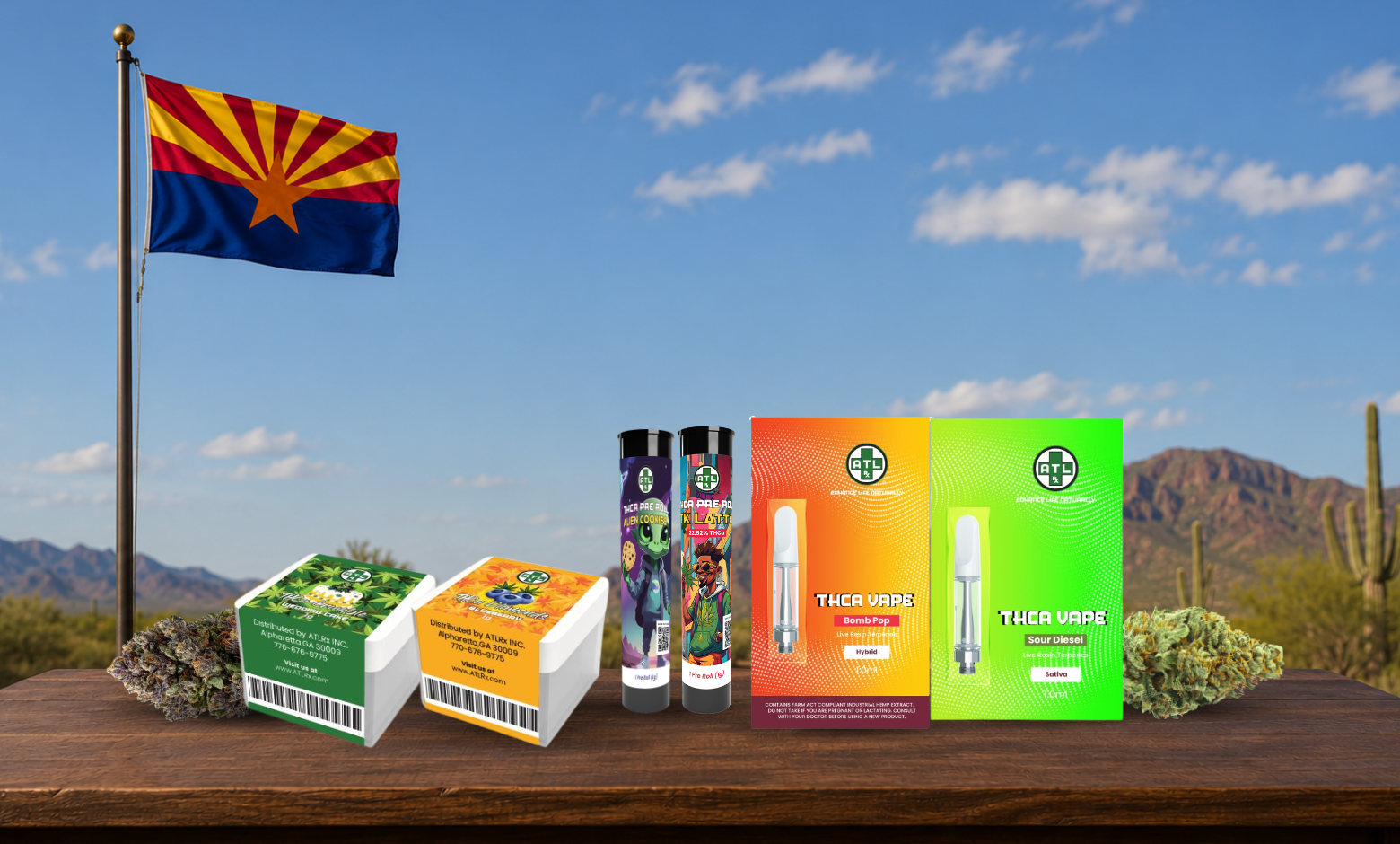
THCA Legal Status in Arizona:
Yes, but only through licensed dispensaries, not general retail. In Arizona, THCA is treated under the state’s cannabis framework rather than as an unregulated hemp product. A 2024 Arizona Attorney General opinion concluded that intoxicating hemp-derived products do not belong in general retail, and in June 2025, a Maricopa County Superior Court judge denied a preliminary injunction sought by the Hemp Industry Trade Association of Arizona (HITA). The judge affirmed that ruling in August 2025 by dismissing the case with prejudice, and HITA has filed an appeal with the Arizona Court of Appeals, where the matter is now pending. Attorney General opinions are not legally binding on their own, but this one signaled the state’s enforcement position, and the court decisions indicate the state’s reading is likely to hold while the appeal moves forward.
Selling these products in smoke shops, convenience stores, gas stations, or through direct-to-consumer online shipping in Arizona carries enforcement risk.
A separate change applies nationwide. A federal law signed on November 12, 2025, redefines hemp using a “total THC” standard that counts THCA, and it takes effect on November 12, 2026. After that date, most high-THCA flower and concentrates will no longer meet the federal definition of hemp.
The short version: in 2026, THCA is not freely available in Arizona’s general retail or hemp market the way it is in some other states. It is routed through the regulated dispensary system, and the federal rules will tighten further in November.
If you have searched for whether THCA is legal in Arizona, you have likely found older articles that no longer reflect the current rules, and the honest answer in 2026 is that the law has changed significantly and continues to shift. Arizona once sat comfortably alongside the 2018 Farm Bill, but a 2024 Attorney General opinion, 2025 court rulings, and a new federal definition of hemp taking effect in November 2026 have reshaped the landscape. This guide breaks down exactly where things stand right now, what is changing, and what Arizona shoppers should verify before buying any THCA product.
Table of contents:
THCA, or tetrahydrocannabinolic acid, is a naturally occurring cannabinoid found in raw, unheated cannabis and hemp plants. In its raw form, THCA has an extra carboxyl group in its molecular structure. That structural difference is the key to understanding the legal debate around it.
When THCA is exposed to heat through smoking, vaping, or cooking, it goes through a process called decarboxylation. During decarboxylation, the carboxyl group is removed, and THCA converts into delta-9 THC, the well-known intoxicating compound in cannabis. This conversion is the entire reason regulators have moved to treat THCA differently than they once did. A flower product can test low in delta-9 THC on paper while still being capable of producing a high once heated.
| Feature | THCA | Delta-9 THC |
| Found in | Raw, unheated cannabis and hemp | Heated or aged cannabis |
| Molecular structure | Has an extra carboxyl group | Carboxyl group removed |
| Intoxicating in raw form | No | Yes |
| Converts when heated | Yes, becomes delta-9 THC | Already active |
| How regulators view it (2026) | Increasingly counted as part of “total THC” | Directly regulated |
THCA itself is not intoxicating until it is heated, but the law is moving toward measuring what a product becomes after heating, not just what it is on the shelf.
Arizona has two parallel systems that consumers should understand before buying any THC or THCA product.
Arizona has a well-established legal cannabis market. The Arizona Medical Marijuana Act, passed in 2010 through Proposition 203, allows qualifying patients with a state-issued registry card to purchase cannabis from licensed dispensaries. In 2020, voters passed Proposition 207, the Smart and Safe Arizona Act, which legalized adult-use recreational cannabis. Under Proposition 207, adults aged 21 and older may possess up to one ounce of cannabis, with no more than five grams in concentrate form, and households may cultivate up to six plants, or up to twelve in a home with two or more adults. The law took effect on November 30, 2020, and licensed retail sales began on January 22, 2021.
The Arizona Department of Health Services oversees both the medical and adult-use dispensary systems.
Arizona legalized industrial hemp in 2018 through Senate Bill 1098, aligning the state with the 2018 federal Farm Bill. The Arizona Department of Agriculture runs the state’s Industrial Hemp Program and licenses growers, harvesters, and processors.
Here is the detail that matters most for THCA. The Arizona Department of Agriculture defines industrial hemp using a total THC standard, not a delta-9-only standard. The state’s definition of hemp counts the total calculable amount of THC after the conversion of THCA is included. In plain terms, Arizona has, at the agricultural level, long looked at what a hemp plant becomes after decarboxylation rather than only its raw delta-9 reading.
This is the most important update for anyone relying on older articles.
On March 11, 2024, the Arizona Attorney General issued Opinion No. I24-005, concluding that delta-8 and other hemp-synthesized intoxicants cannot legally be sold by businesses that are not licensed cannabis sellers. The opinion’s language was written broadly enough to cover similar derivatives, currently existing or developed in the future, including hemp-derived delta-9 THC. The reasoning was that Arizona defines and regulates “industrial hemp” in a way that does not permit the sale of hemp-synthesized intoxicants in convenience stores, smoke shops, and similar unlicensed locations. Importantly, an Attorney General opinion is an interpretation of the law, not a binding law in itself.
The enforcement push came roughly a year later. In a letter dated March 24, 2025, the Attorney General’s office stated that retail sales of hemp-derived THC products without a marijuana establishment license are illegal, and gave retailers a deadline to remove those products or face penalties, with threatened fines reported at up to $20,000 per item and the possibility of criminal prosecution.
HITA challenged the enforcement in court. In a ruling issued June 25, 2025, Maricopa County Superior Court Judge Randall Warner denied HITA’s request for a preliminary injunction, finding that the group was not likely to succeed on the merits. The judge reasoned that Arizona’s 2018 Hemp Act treats “industrial hemp” as the plant itself, a lawful agricultural commodity, while consumable products containing hemp-derived THC fall under Arizona’s criminal code and the dispensary licensing system administered by the Arizona Department of Health Services. In August 2025, the same court affirmed that finding and dismissed the case with prejudice. HITA has appealed to the Arizona Court of Appeals, where the case is now pending.
The 2024 opinion addressed delta-8 and other hemp-synthesized intoxicants, with language broad enough to reach similar derivatives. The 2025 court rulings then applied that reasoning further: products containing psychoactive THC, regardless of concentration and regardless of whether the THC derives from hemp or marijuana, may only be sold through licensed dispensaries. Under that reasoning, high-THCA flower, which can become intoxicating when heated, falls within the dispensary channel rather than general retail under the current enforcement posture.
A second major shift is happening at the federal level, and it affects every state.
On November 12, 2025, President Trump signed the Continuing Appropriations, Agriculture, Legislative Branch, Military Construction and Veterans Affairs, and Extensions Act, 2026 (Public Law No. 119-37). Section 781 of Division B amends the federal statutory definition of hemp under 7 U.S.C. § 1639o, and the new definition takes effect on November 12, 2026, exactly 365 days after enactment.
The law makes two key changes. First, the 2018 Farm Bill defined hemp using only delta-9 THC, capped at 0.3% by dry weight. The new law replaces that with a total THC standard that explicitly includes THCA and delta-8 in the 0.3% dry-weight calculation for the plant. Second, it sets a separate cap for finished consumer products: no more than 0.4 milligrams of total THC per container, including any other cannabinoids with similar effects or marketed as having similar effects. The “container” is defined as the innermost packaging that holds the finished product for retail sale.
Once the change is in force, most high-THCA flower, THCA concentrates, and similar products will no longer meet the federal definition of hemp, because their THCA content, when calculated as total THC, far exceeds the new threshold.
Congress has not stopped debating these issues. In December 2025, Senators Ron Wyden and Jeff Merkley introduced the Cannabinoid Safety and Regulation Act, which would replace the Section 781 prohibition with a federal regulatory framework rather than an effective ban. Other proposals are circulating in connection with the next Farm Bill reauthorization. None of these proposals is law at the time of writing, so the November 12, 2026, effective date remains the operative deadline unless Congress acts.
For Arizona shoppers, the practical point is that the window for any open-market THCA flower is closing on two tracks at once: state enforcement that already routes these products through dispensaries, and a federal redefinition arriving in November 2026.
Because the rules are strict and shifting, due diligence matters more than ever. If you are considering any THCA or hemp-derived product in Arizona, here is a practical checklist.
Cannabis and hemp laws differ from state to state, and a product that is compliant in a neighboring state may not be treated the same way in Arizona. Crossing state lines with THCA products can create legal exposure, and federal facilities such as airports operate under federal law. The lowest-risk approach is to research the specific rules of every state on your route and avoid assumptions based on one state’s market.
The question of whether THCA is legal in Arizona no longer has a simple yes-or-no answer. Arizona has effectively folded intoxicating hemp-derived products, including high-THCA flower, into its licensed cannabis system through the 2024 Attorney General opinion and the 2025 court rulings, and a new federal definition of hemp arriving in November 2026 will tighten the rules further by counting THCA toward total THC.
It is worth noting that HITA’s appeal is now before the Arizona Court of Appeals, so the state-law picture could still shift. For Arizona shoppers, the practical path forward is the same regardless of how the politics play out: buy through licensed channels, insist on current third-party lab reports, read total THC rather than delta-9 alone, and rely only on up-to-date information. When in doubt, a licensed Arizona attorney is the most reliable source for guidance specific to your circumstances.
Is THCA Flower Legal to Buy in Arizona Right Now?
Under the 2024 Attorney General opinion and the 2025 court rulings, intoxicating hemp-derived products such as high-THCA flower are treated as belonging in Arizona’s licensed dispensary system rather than general retail or direct-to-consumer hemp shipping. The case has been dismissed at the Superior Court level and is now on appeal before the Arizona Court of Appeals, so verify the current status with the retailer and a licensed attorney before purchasing.
Does THCA Show up the Same as THC in Arizona’s Legal Definition?
Arizona’s Department of Agriculture defines industrial hemp using a total THC calculation that includes the conversion of THCA. The federal definition moves to a similar total THC standard on November 12, 2026.
What Changes for THCA in November 2026?
Effective November 12, 2026, a federal law (Public Law No. 119-37, Section 781) redefines hemp using a total THC standard that counts THCA, and it limits finished hemp-derived products to 0.4 milligrams per container of combined total THC and similar cannabinoids. Most high-THCA products will no longer meet the federal hemp definition once the change takes effect.
Can I Order THCA Online and Have It Shipped to Arizona?
Direct-to-consumer shipment of intoxicating hemp-derived products into Arizona carries enforcement risk under the current state posture. Always confirm a retailer’s shipping policy and the product’s compliance status before ordering.
Is CBD Still Legal in Arizona?
Non-intoxicating CBD products remain widely available in Arizona, but two federal layers apply. First, the FDA continues to take the position that CBD cannot lawfully be added to food, beverages, or dietary supplements under current regulations, and the agency has issued warning letters to companies making unapproved disease claims. Second, the federal redefinition of hemp, effective November 12, 2026, introduces a 0.4 milligram per-container total-THC cap, which could affect some full-spectrum CBD products depending on forthcoming FDA guidance. Review a current Certificate of Analysis before buying, and watch for FDA guidance ahead of the 2026 effective date.
ATLRx is committed to compliance and transparency. Every ATLRx product is third-party lab tested, and Certificates of Analysis are available for review on each product page.
Disclaimer: The statements in this article have not been evaluated by the Food and Drug Administration. ATLRx products are not intended to diagnose, treat, cure, or prevent any disease. This guide is provided for general educational purposes only and does not constitute legal or medical advice. Laws change frequently — consult a licensed Arizona attorney for legal questions specific to your situation.

August 4, 2026
July 30, 2026
$39.99
$49.99
$49.99
$49.99
$39.99