

$39.99
ARE YOU 21 YEARS OF AGE OR OLDER?
REMEMBER ME
Seriously, by using this site you are confirming that you are of legal age (21+) to view and purchase these products. If you are you are not over 21. you are not authorized by us to use or view any of the pages of this site. Please review our terms and conditions at checkout for further stipulations.
 >
Blogs
>
THCA Legality >
Is THCA Legal in Maryland? 2026 Legal Guide
>
Blogs
>
THCA Legality >
Is THCA Legal in Maryland? 2026 Legal Guide
THE STATEMENTS ON THIS BLOG ARE NOT INTENDED TO DIAGNOSE, TREAT, CURE, OR PREVENT ANY DISEASE. THE FOOD AND DRUG ADMINISTRATION HAS NOT EVALUATED ANY STATEMENTS CONTAINED WITHIN THE BLOG. ATLRX DOES NOT IN ANY WAY GUARANTEE OR WARRANT THE ACCURACY, COMPLETENESS, OR USEFULNESS OF ANY MESSAGE. THE INFORMATION CONTAINED WITHIN THIS BLOG IS FOR GENERAL INFORMATIONAL PURPOSES ONLY.
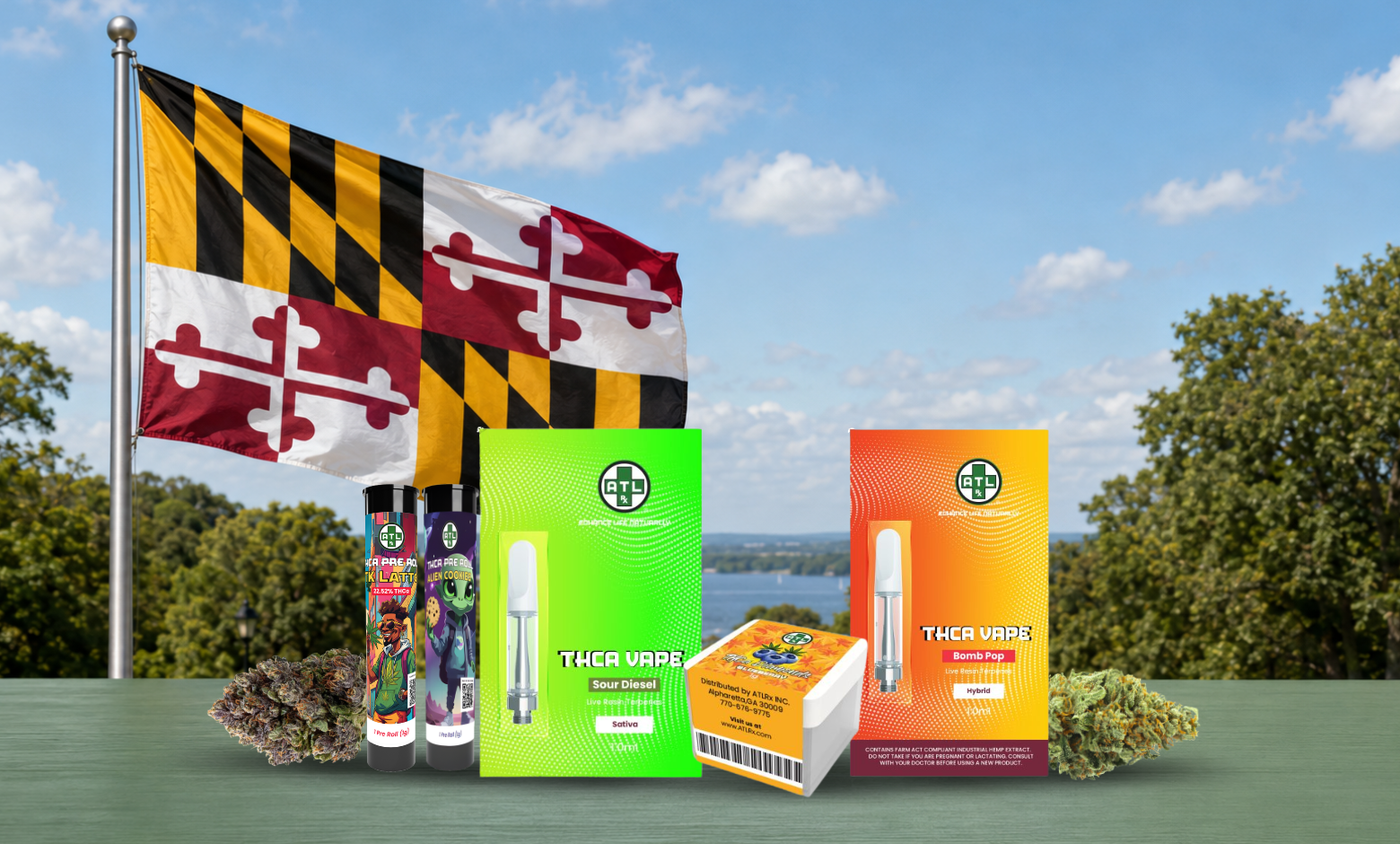
THCA Legal Status in Maryland:
Short Answer: THCA’s legal status in Maryland is layered. Under the 2018 Federal Farm Bill (in effect through November 12, 2026), hemp-derived THCA is not federally classified as a controlled substance when total Delta-9 THC stays at or below 0.3% by dry weight. In Maryland, however, the Cannabis Reform Act of 2023 and the September 2025 Appellate Court decision restrict intoxicating hemp-derived products, including high-potency THCA, to Maryland Cannabis Administration (MCA) licensed dispensaries. There is a limit of 0.5 mg total THC per serving and 2.5 mg total THC per package for non-dispensary retail. Those 21 and older may possess up to 1.5 ounces of cannabis flower for personal use. Beginning November 12, 2026, federal law shifts to a total-THC standard under Section 781 of the Continuing Appropriations Act.
If you have recently searched online for THCA flower, vapes, or concentrates, you have probably asked the same question many Maryland shoppers are asking right now: Is THCA legal in Maryland in 2026, and has anything changed compared to last year? The short answer is that the legal picture has shifted significantly since 2024, and the rules are no longer as straightforward as the federal Farm Bill alone might suggest. Maryland now sits at the intersection of three big developments: the 2018 Federal Farm Bill, the Maryland Cannabis Reform Act of 2023, and a major September 2025 Appellate Court ruling that reshaped how the state treats hemp-derived intoxicating products.
This guide walks you through the 2026 legal landscape in plain language so you can understand exactly where THCA stands, who can sell it, where it can be purchased, what is changing on the federal side later this year, and how to stay compliant as an informed adult buyer.
Table of contents:
Tetrahydrocannabinolic acid, or THCA, is a naturally occurring compound found in raw and freshly harvested cannabis and hemp plants. THCA is non-intoxicating in its unheated form. Heat causes THCA to undergo a chemical process known as decarboxylation and transform it into Delta-9 THC, the compound commonly associated with cannabis intoxication.
This conversion behavior is at the center of the entire THCA legal debate. Federal law historically measured only Delta-9 THC content, so high-THCA hemp flower could test as legal hemp while still being capable of producing intoxication after heating. State legislatures and courts across the country, including in Maryland, have spent the past two years closing that gap.
In Maryland in 2026, THCA exists in a layered legal status that depends on three things:
Hemp-derived THCA itself is not federally listed as a controlled substance, and the 2018 Farm Bill’s Delta-9-only hemp definition remains in effect until November 12, 2026, when Section 781 of H.R. 5371 replaces it with the new total-THC standard. However, Maryland law treats finished products differently. The Maryland Cannabis Reform Act (CRA) restricts the sale of intoxicating hemp-derived products to licensed cannabis businesses, and products sold outside that licensed channel are capped at 0.5 mg total THC per serving and 2.5 mg total THC per package. In Governor Wes Moore et al. v. Maryland Hemp Coalition et al., the Appellate Court of Maryland ruled on September 9, 2025, that synthetically derived hemp psychoactive products, including delta-8 and delta-10 THC, are prohibited by the CRA and that an earlier injunction preventing enforcement has been lifted.
So, in practical terms, for 2026:
Under the Agriculture Improvement Act of 2018, hemp was removed from the Controlled Substances Act and defined as cannabis containing no more than 0.3% Delta-9 THC by dry weight. Because THCA was not technically Delta-9 THC, hemp flower with high THCA levels could still meet the federal hemp definition.
This framework is what created the nationwide THCA market that grew through 2023 and 2024. Note that H.R. 5371 also extended the underlying 2018 Farm Bill itself through September 30, 2026, with the new hemp definition taking effect six weeks later, on November 12, 2026.
When Maryland voters approved Question 4 in November 2022 (with 67.2% in favor), the General Assembly enacted the framework legislation HB 837/SB 833 (2022) and the full implementing legislation HB 556/SB 516 in 2023. Governor Wes Moore signed HB 556 into law on May 3, 2023, and adult-use possession and sales began on July 1, 2023. Together, these statutes are commonly referred to as the Cannabis Reform Act.
Those 21 and older are allowed to possess up to 1.5 ounces of cannabis flower, 12 grams of concentrated cannabis, or products containing no more than 750 mg of delta-9-THC. Maryland taxes adult-use cannabis sales with a 9% sales tax. A portion of the resulting revenue funds the Community Reinvestment and Repair Fund, the Cannabis Public Health Fund, and county/municipal allocations.
The CRA also created the Maryland Cannabis Administration to oversee the licensed market and authorized the Alcohol, Tobacco, and Cannabis Commission (ATCC) to enforce the rules for unlicensed THC products. Crucially, the CRA captured hemp-derived intoxicating products inside its regulatory net.
Appellate Court of Maryland reversed a preliminary injunction imposed by a Washington County judge in Governor Wes Moore, et al. v. Maryland Hemp Coalition, et al. on September 9, 2025. Synthetically derived hemp psychoactive products like delta-8 and delta-10 THC, which are typically produced by chemically converting hemp-derived CBD, are prohibited under the CRA because they are “not derived from naturally occurring biologically active chemical constituents.” According to Judge Dan Friedman, these products are illegal in Maryland and have always been, and lax enforcement cannot establish their legality.
The Maryland General Assembly authorized industrial hemp under state law in 2018, and the state submitted its USDA-approved hemp production plan in 2020. The September 2025 ruling confirmed that these agricultural hemp laws never authorized the sale of intoxicating hemp-derived products outside the licensed cannabis system.
The court did not directly address THCA, but Maryland’s statutory definition of THC under the CRA covers delta-9, delta-8, and delta-10 THC regardless of how it is derived, and MCA guidance applies the 0.5 mg per serving and 2.5 mg per package caps to all THC isomers and derivatives. Because heating converts THCA into delta-9 THC, state regulators are applying the same framework to high-potency THCA products intended for combustion or vaporization.
The President of the United States signed H.R. 5371, the Continuing Appropriations, Agriculture, Legislative Branch, Military Construction and Veterans Affairs, and Extensions Act, 2026, to end the federal government shutdown. Buried within the FY2026 Agriculture appropriations division was Section 781, which redefines hemp using a total-THC standard (including THCA) and caps finished hemp products at 0.4 mg total THC per container, with “container” defined as the innermost packaging that directly holds the product (e.g., a bottle, can, cartridge, or pouch — not the outer box). These provisions take effect on November 12, 2026.
This is the single most important federal development for THCA buyers and brands in 2026. In short, until November 12, 2026, the federal hemp definition still uses the Delta-9-only standard. After that date, total-THC math becomes the federal rule, and THCA counts toward the total.
Maryland has effectively been ahead of the federal curve. The state already moved beyond the Delta-9-only framework when it passed the Cannabis Reform Act and again when the Appellate Court issued its 2025 ruling. So while the federal change in November 2026 will be a national event, Maryland’s day-to-day rules will not shift dramatically because the state has already chosen the stricter path.
Here is what that practically looks like:
Only licensed Maryland cannabis dispensaries regulated by the Maryland Cannabis Administration may sell products that exceed the 0.5 mg per serving and 2.5 mg per package caps. Cannabis/THC products that are intoxicating can only be sold by businesses that hold an MCA cannabis license in Maryland. The sale of intoxicating cannabis/THC products without authorization can result in criminal charges and fines.
A person 21 or older can possess up to 1.5 ounces of cannabis flower, 12 grams of concentrated cannabis, or 750 mg of delta-9-THC. These amounts are also called the “personal use amount.”
Cannabis use is restricted to private property. Smoking cannabis in public spaces is illegal, the same as cigarettes, which means it is not permitted on streets, in public parks, restaurants, bars, or their outdoor areas. Landlords may also prohibit cannabis use on their property.
Marijuana-impaired driving remains illegal under Maryland law. Under HB 1071 (2023), Maryland police may not search a person or vehicle based solely on the odor of cannabis or on observation of a personal-use amount. A traffic stop itself must still be supported by a lawful basis (such as a traffic violation), and impaired driving remains illegal — odor combined with other indicators of impairment can still factor into a DUI investigation.
Adults 21 and older may grow up to two cannabis plants per residence, regardless of the number of adults living in the home. Plants must be kept out of public view and secured to prevent access by anyone under 21.

The Maryland Alcohol, Tobacco, and Cannabis Commission (ATCC) requires that THC products intended for consumption or inhalation adhere to the same packaging, labeling, and manufacturing standards as licensed cannabis dispensaries regulated by the Maryland Cannabis Administration. Following the September 2025 Appellate Court ruling, ATCC began aggressive enforcement of these standards against non-licensed retailers. Packages must be tamper-evident, child-resistant, include warning labels, display a QR code or link to a Certificate of Analysis, list cannabinoid ingredients and weights, and show the MCA-approved cannabis symbol on the front.
For consumers, the takeaway is simple: look for the MCA universal symbol, scan the QR code to view a third-party Certificate of Analysis, and avoid products that lack clear cannabinoid breakdowns or batch information.
This is where many shoppers get confused. Federally legal hemp is clearly separated from what Maryland now defines as cannabis. The state treats intoxicating cannabinoids, including THCA, delta-8, and delta-10, as cannabis, which means they fall under rules that limit sales and shipping to state-licensed cannabis businesses. A THCA product’s federal legality under the Farm Bill is, in practice, secondary to Maryland’s state framework within its borders.
This means for online orders:
Always confirm a retailer’s current shipping policy for Maryland before placing an order. Many reputable brands maintain restricted-state lists that are updated as state laws evolve.
A quick at-a-glance comparison helps put Maryland’s position in context:
| State | THCA Status in 2026 | Notes |
|---|---|---|
| Maryland | Restricted | Intoxicating hemp products limited to MCA-licensed dispensaries; 0.5 mg/serving and 2.5 mg/package caps for non-dispensary sales |
| Virginia | Restricted | Total-THC framework under SB 903 (2023); 2 mg per package cap and 25:1 CBD: THC ratio for non-dispensary retail |
| Pennsylvania | Transitioning | Hemp-derived products historically sold through general retail; in March 2026, the PA Senate Law and Justice Committee voted 10–1 to amend SB 49 to ban intoxicating hemp products, mirroring the federal H.R. 5371 framework |
| Delaware | Transitioning | Adult-use cannabis legalized under HB 1 (2023); intoxicating hemp products remain in a regulatory gap, with a 2025 THC beverage bill tabled and a state workgroup developing intoxicating-hemp policy |
| West Virginia | Restricted | SB 546 (2023) classified delta-8 and delta-10 THC as Schedule I; the Select Plant-Based Derivatives Regulation Act tightly limits intoxicating hemp cannabinoid products |
| Washington, D.C. | Limited framework | Possession and home cultivation are legal under Initiative 71 (2014); no regulated adult-use retail market due to the federal Harris Rider — operates through a medical program plus an unregulated “gifting” gray market |
The bigger picture is that Maryland sits firmly on the regulated side of the map, alongside other states that moved early to apply state-level standards to hemp-derived intoxicants.
If you are a Maryland adult shopping for hemp-derived products in 2026, here is a practical checklist:
The most important date on the THCA calendar this year is November 12, 2026, when Section 781 of the Continuing Appropriations Act of 2026 changes the federal hemp definition from Delta-9-only to total-THC. After that date:
For consumers, this is the moment when the national market and Maryland’s state market begin to look more alike.
The answer to “Is THCA legal in Maryland?” in 2026 is no longer a simple yes or no. Maryland operates under a layered framework where federal law sets a baseline through November 12, 2026, the Cannabis Reform Act governs in-state sales, and the September 2025 Appellate Court ruling confirmed that intoxicating hemp products fall under the licensed cannabis system. For adults 21 and older, the safest path is to buy from compliant, transparent retailers, review Certificates of Analysis, and stay current on the November 2026 federal update.
At ATLRx, we publish blogs like this one to help adult readers understand the changing legal landscape around hemp-derived cannabinoids. We are committed to lab-tested, federally compliant hemp products, transparent labeling, and ongoing education for our community.
This article is for general informational purposes only and is not legal advice. Cannabis and hemp laws change frequently. Always check the current Maryland statutes, regulations, and official guidance from the Maryland Cannabis Administration and the Alcohol, Tobacco, and Cannabis Commission, and consult a qualified attorney for specific situations.
You must be 21 or older to purchase hemp-derived products. The Food and Drug Administration has not evaluated statements regarding hemp products. These products are not intended to diagnose, treat, cure, or prevent any disease.
No. Cannabis and hemp plants naturally produce THCA, which is an acidic precursor. Raw cannabis is not intoxicating. Through decarboxylation, THCA is converted into Delta-9 THC. The two compounds are chemically distinct, but they are closely linked because of that conversion process.
Licensed cannabis channels will be the only places where intoxicating hemp products can be purchased in Maryland in 2026. Many reputable brands now exclude Maryland from shipping for high-potency THCA goods, while non-intoxicating, low-THC hemp products remain available to adults 21+ from compliant retailers. Always check the retailer’s current Maryland shipping policy.
It is legal for adults 21 and older to possess 1.5 ounces of cannabis flower, 12 grams of concentrated cannabis, or cannabis products totaling no more than 750 mg of delta-9-THC, known as the “personal use amount.”
Yes. Adults 21+ may grow up to two cannabis plants per residence, regardless of the number of adults in the home, provided the plants are out of public view and secured from anyone under 21.
Section 781 of the Continuing Appropriations Act, 2026, takes effect on that date, which redefines hemp at the federal level using a total-THC standard (including THCA) and caps total THC at 0.4 mg per container for finished hemp products.
As of this writing, Maryland’s caps for non-dispensary retail remain 0.5 mg total THC per serving and 2.5 mg per package, established under the Cannabis Reform Act. Any updates would come from the General Assembly or regulatory action by the MCA or ATCC.
The Maryland Cannabis Administration (cannabis.maryland.gov), the Alcohol, Tobacco, and Cannabis Commission (atcc.maryland.gov), and the Maryland People’s Law Library (peoples-law.org) are the primary public resources.

August 25, 2026
August 23, 2026
August 20, 2026
August 20, 2026
August 18, 2026
$39.99
$49.99
$39.99
$39.99
$39.99
$39.99
$49.99