



$39.99

ARE YOU 21 YEARS OF AGE OR OLDER?
REMEMBER ME
Seriously, by using this site you are confirming that you are of legal age (21+) to view and purchase these products. If you are you are not over 21. you are not authorized by us to use or view any of the pages of this site. Please review our terms and conditions at checkout for further stipulations.
 >
Blogs
>
THCA >
Is THCa Legal in Missouri? Complete 2026 Legal Guide
>
Blogs
>
THCA >
Is THCa Legal in Missouri? Complete 2026 Legal Guide
THE STATEMENTS ON THIS BLOG ARE NOT INTENDED TO DIAGNOSE, TREAT, CURE, OR PREVENT ANY DISEASE. THE FOOD AND DRUG ADMINISTRATION HAS NOT EVALUATED ANY STATEMENTS CONTAINED WITHIN THE BLOG. ATLRX DOES NOT IN ANY WAY GUARANTEE OR WARRANT THE ACCURACY, COMPLETENESS, OR USEFULNESS OF ANY MESSAGE. THE INFORMATION CONTAINED WITHIN THIS BLOG IS FOR GENERAL INFORMATIONAL PURPOSES ONLY.
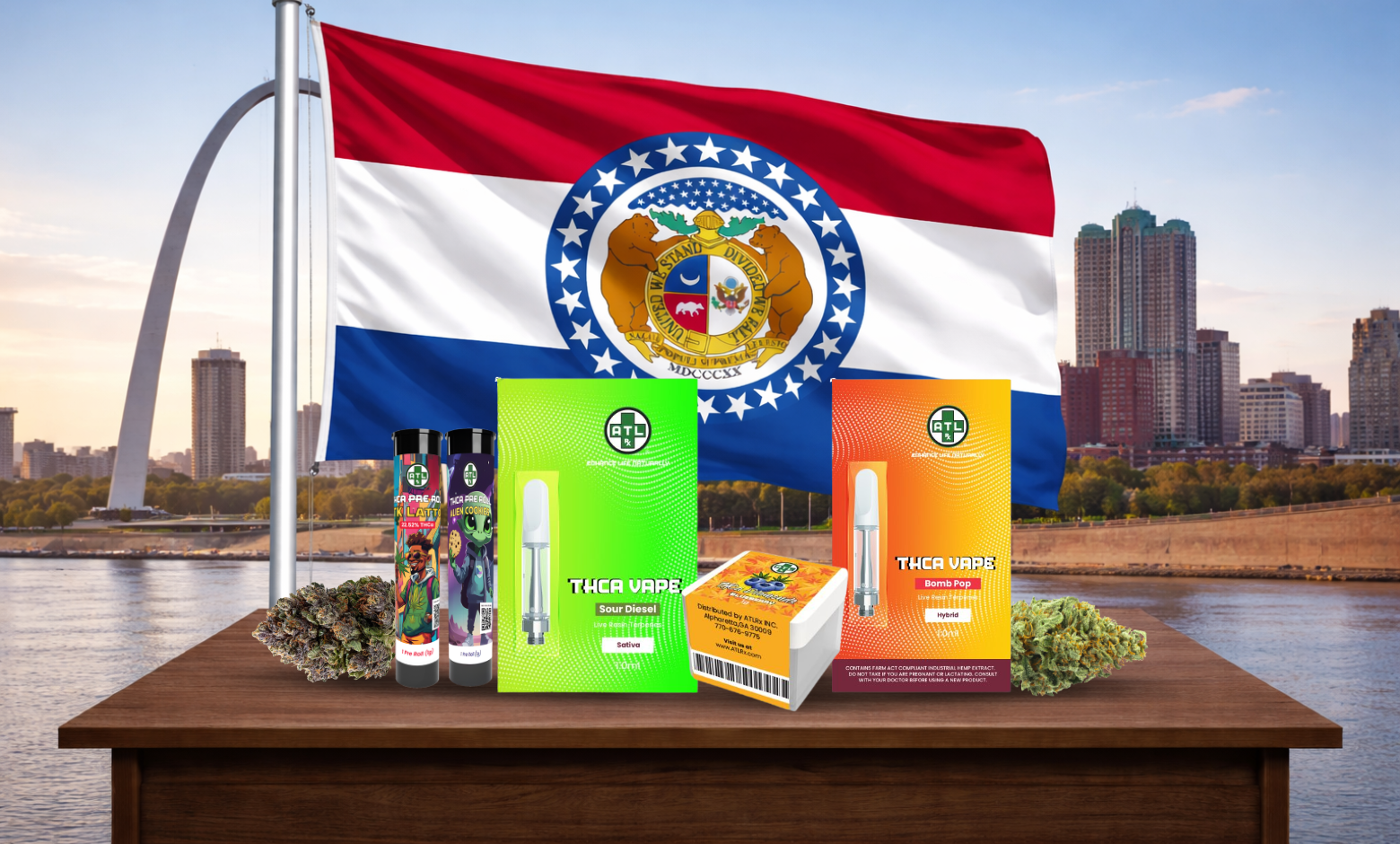
THCA Legal Status in Missouri:
THCA products derived from hemp with a delta-9 THC concentration below 0.3% by dry weight are still permitted under Missouri’s existing hemp law (SB 133, 2019). However, a major federal law change and a pending Missouri House bill could both restrict access by November 2026.
If you have been wondering whether THCA is legal in Missouri, you are far from alone. Missouri sits in a genuinely complex position in 2026: the state still has no specific law banning hemp-derived THCA, yet a sweeping federal redefinition of hemp signed in November 2025 is set to take effect in November 2026, and the Missouri House has already passed a bill to align state rules with that federal shift.
Understanding where things stand right now and where they are heading is essential for any Missouri resident or business that works with THCA products.
This guide covers everything in plain American English: what THCA is, its current legal status under both Missouri and federal law, the key bills and enforcement actions shaping 2026, and what to look for when buying THCA products in the Show-Me State. We will update this post as new legislation is enacted.
Always verify the latest rules with a licensed legal professional before making any purchasing decisions.
Table of contents:
THCA stands for tetrahydrocannabinolic acid. A raw, naturally occurring compound found in fresh, unheated cannabis and hemp plants. In its raw, unheated state, THCA has not undergone the chemical change that creates the intoxicating properties associated with delta-9 THC.
The conversion process matters enormously for legal purposes. When cannabis flower or THCA is heated, such as through smoking, vaping, or baking, a chemical reaction called decarboxylation occurs. By decarboxylation, THCA loses its carboxylic acid group and becomes delta-9 THC, the main psychoactive component of cannabis.
This chemistry is at the heart of why THCA has become a legal flashpoint across the United States. Hemp-derived THCA products can test below 0.3% delta-9 THC on a Certificate of Analysis (COA) while containing 20% to 30% THCA by weight. Once those products are heated, they deliver a potency similar to conventional marijuana. That gap between pre-heat and post-heat chemistry is precisely the loophole that federal and state lawmakers are now working to close.
| Feature | THCA | Delta-9 THC |
| Pre-heat the chemical state | Acid form — not yet converted to THC | Active, converted form |
| Found in raw hemp/cannabis | Yes (natural form) | Trace amounts |
| Converts when heated | Yes (via decarboxylation into delta-9 THC) | Already in active form |
| Federal legal status (pre-Nov. 2026) | Legal if hemp-derived, delta-9 below 0.3% | Schedule I (marijuana); legal in hemp |
| Typical COA potency of the flower | 15% to 30% | Below 0.3% in legal hemp |
To understand the THCA question in Missouri, you first need to know how the state regulates cannabis broadly.
Medical Cannabis: Missouri voters approved Amendment 2 in November 2018, establishing a regulated medical marijuana program. Qualifying patients may purchase cannabis products, including those with high THCA content, from licensed dispensaries.
Recreational Cannabis: Missouri voters passed Amendment 3 in November 2022, legalizing recreational adult use of cannabis. It is legal for adults aged 21 and older to possess up to three ounces of dried cannabis. Recreational sales launched through licensed dispensaries in February 2023.
Industrial Hemp: Missouri legalized hemp cultivation and processing through Senate Bill 133 in June 2019, aligning with the federal 2018 Farm Bill. Products derived from hemp are legal if their delta-9 THC concentration does not exceed 0.3% by dry weight.
That 0.3% delta-9 standard under SB 133 is the foundation on which hemp-derived THCA products have operated in Missouri. Because delta-9 THC and THCA are tested separately in many lab reports, THCA flower with less than 0.3% delta-9 THC has been treated as compliant hemp, even when THCA levels are very high.
Missouri statutes, as of early 2026, do not contain a specific definition or prohibition targeting THCA. State hemp regulations under SB 133 apply the delta-9 THC standard only. This means that, technically, a THCA product testing below 0.3% delta-9 THC falls within the legal hemp category under current Missouri code.
However, the regulatory picture is not as straightforward as that sentence suggests. Missouri has seen a significant escalation in enforcement actions targeting high-THCA hemp products outside of licensed dispensaries.
The then-Governor Mike Parson issued Executive Order 24-10 in August 2024, which directed the Department of Health and Senior Services and other regulatory partners to use existing food and drug authorities to ban the sale of intoxicating hemp products outside of licensed marijuana dispensaries, including THCA flower, delta-8, and related cannabinoids.
As a result of that executive action, the Missouri Attorney General’s office established a specialized legal unit in 2025 to assist the Division of Alcohol and Tobacco Control. As of mid-2025, the AG’s office had issued at least 18 cease-and-desist letters to retailers and wholesalers selling THCA hemp flower in unlicensed retail settings. Enforcement warnings cited potential civil penalties, injunctions, and possible court-ordered shutdowns.
The Attorney General’s legal theory relies on DEA interpretation letters from 2023 to 2024, which state that THCA should be counted toward total THC, in effect treating high-THCA hemp as marijuana under the Controlled Substances Act, regardless of how Missouri’s own hemp statute is worded.
Enforcement actions, cease-and-desist letters, and executive orders create real legal risk for retailers. Even where a product may technically meet Missouri’s delta-9 threshold, businesses selling high-THCA products outside of licensed dispensaries face ongoing enforcement pressure. Consulting a Missouri cannabis attorney before selling or purchasing THCA products in retail or commercial settings is strongly recommended.
The single most significant development for THCA legality anywhere in the United States, including Missouri, occurred on November 12, 2025, when President Trump signed H.R. 5371, the Continuing Appropriations and Extensions Act, on November 12, 2025.
Section 781 of H.R. 5371 amends the statutory definition of hemp under the Agricultural Marketing Act, replacing the old delta-9 THC-only standard with a total THC standard. Hemp is now legally defined as Cannabis sativa L. and its derivatives containing not more than 0.3 percent tetrahydrocannabinol on a dry-weight basis.
Additional restrictions are also introduced by the law. Hemp-derived cannabinoid products containing more than 0.4 milligrams per container of combined total THC (including THCA) and other THC-like cannabinoids will be excluded. Synthetic or chemically manufactured cannabinoids, including delta-8 THC produced through the isomerization of CBD, are expressly excluded regardless of source.
A new federal definition will take effect exactly 365 days after enactment, on November 12, 2026. Until that date, the previous delta-9-only standard technically remains in force at the federal level for products already on the market. After November 12, 2026, high-THCA products that exceed the 0.3% total THC threshold will be classified as marijuana under the Controlled Substances Act, making them federally illegal outside of state-licensed cannabis programs.
According to industry groups, the amended definition would eliminate approximately 95% of existing hemp-derived cannabinoid products on the market.
Congress has seen several countermoves since H.R. 5371 was enacted. In January 2026, Representative Griffith and Representative Veasey introduced the HEMP Act (H.R. 1287), which would create a federal regulatory framework for hemp-derived cannabinoids while preserving legal access to THCA and delta-9 products. Representative Baird introduced the Hemp Planting Predictability Act (H.R. 7024) in order to delay the effective date from 2026 to 2028. Neither proposal has been enacted as of March 2026.
At the state level, Missouri lawmakers are not waiting passively for federal enforcement. House Bill 2641, sponsored by Representative Dave Hinman (R-O’Fallon), was passed by the Missouri House on February 19, 2026, by 109 votes to 34. A companion bill, SB 904, sponsored by state Senator David Gregory (R-St. Louis), is simultaneously advancing in the Senate. SB 904 would similarly require hemp-derived cannabinoid products to be sold exclusively within licensed marijuana facilities and treat them under the same regulatory framework as marijuana. The Intoxicating Cannabinoid Control Act (ICCA) now heads to the Missouri Senate.
What HB 2641 Would Do
HB 2641 would align Missouri law precisely with the new federal definition of hemp in H.R. 5371. Its key provisions include the following.
If HB 2641 or SB 904 passes and is signed into law, Missouri’s hemp regulations will mirror the new federal standard before the November 2026 federal deadline. Notably, similar House bills have passed in prior years but have stalled in the Senate, making the outcome uncertain. If neither passes, Missouri will still be subject to federal enforcement after November 12, 2026, but would lack a parallel state enforcement framework in the meantime.
| Topic | Current Status (2026) | Key Date / Deadline |
| Hemp-Derived THCA (delta-9 below 0.3%) | Permitted under Missouri hemp law (SB 133) | Ongoing |
| Missouri Recreational Cannabis | Legal for adults 21+ (up to 3 oz) | Since Nov. 2022 |
| Missouri Medical Cannabis | Legal for qualifying patients | Since Nov. 2018 |
| Federal Hemp Definition (H.R. 5371) | New total THC standard (incl. THCA) enacted | Effective Nov. 12, 2026 |
| Missouri HB 2641 (ICCA) | Passed House 109-34 on Feb. 19, 2026; pending Senate | Senate vote TBD |
| High-THCA Products Outside Dispensaries | Under enforcement pressure since 2024 AG actions | Ongoing scrutiny |
| Missouri SB 904 (ICCA companion | On Senate Informal Calendar for Perfection as of Feb. 23, 2026 | Senate vote TBD |
Note: This table reflects the legal landscape as of March 2026. Laws are changing rapidly. Bookmark this page or consult the Missouri Division of Cannabis Regulation and a licensed attorney for real-time updates.
For residents of Missouri who want to purchase THCA products while navigating the current regulatory climate, product quality and documentation are more important than ever. Here is what to look for.
Valid Certificates of Analysis from accredited third-party laboratories are the most important documentation for any hemp-derived THCA product. You should look for a COA that shows the following.
Reputable THCA brands provide information about where their hemp is grown, how it is cultivated, and what extraction or production methods were used. Hemp grown in the United States under USDA-registered programs offers more regulatory predictability than imported raw materials.
Although Missouri does not currently have a state-level age restriction for hemp products sold outside of dispensaries, the evolving regulatory environment and pending legislation mean that age-gated retail is increasingly the responsible standard. Purchasing from retailers that follow voluntary best practices, including age verification and proper labeling, provides additional assurance of compliance.
At ATLRx, every THCA product we carry is sourced from reputable U.S.-based cultivators and backed by a full Certificate of Analysis. Our products are tested by accredited third-party labs so that you can verify potency, purity, and compliance before you buy. Our COAs are publicly available on each product page, and our customer support team is available at 1-855-420-8278 if you have questions about any specific product’s documentation or compliance status.
Online purchases and interstate shipping of hemp-derived products have operated under the 2018 Farm Bill’s delta-9 THC standard. Under current law, hemp-derived THCA products that meet the delta-9 threshold may be legally purchased online and shipped to Missouri.
However, businesses shipping THCA products to Missouri should be aware of these key points.
Missouri’s THCA situation sits in contrast to most of its neighbors. Arkansas, for example, has already banned hemp-derived THCA outside of licensed dispensaries following a 2025 court ruling upholding the state’s Act 629. Kansas restricts smokable hemp formats entirely and does not permit THCA flower in retail settings. Illinois, which borders Missouri to the east, has a regulated adult-use cannabis market and sells high-THCA products exclusively through licensed dispensaries.
Missouri’s combination of recreational cannabis legalization and an unregulated hemp market has created a situation where identical high-THCA products may be sold legally in a licensed dispensary and in a gas station simultaneously, a fact that has driven much of the legislative pressure to reform the system.
The clearest scenario is that after November 12, 2026, hemp-derived THCA products with a total THC concentration above 0.3% will be federally classified as marijuana. Selling such products outside of a state-licensed cannabis program would constitute a federal law violation under the Controlled Substances Act.
Whether that changes at the federal level depends on whether Congress acts before the deadline. Proposals to delay the effective date, create a new regulatory framework, or repeal the hemp provisions in H.R. 5371 are all in play. The outcome remains genuinely uncertain as of this writing.
At the state level, if Missouri HB 2641 passes the Senate and is signed, the state will have its own enforcement mechanism aligned with the federal standard. If it does not pass, Missouri will still be bound by federal law but may lack explicit state enforcement authority for products above the total THC threshold.
The question of whether THCA is legal in Missouri does not have a single yes or no answer in 2026. Hemp-derived THCA products with delta-9 THC at or below 0.3% currently fall within Missouri’s hemp statute, but enforcement actions, a pending state bill (HB 2641), and the incoming federal total THC standard all signal a significant tightening of the rules by November 2026.
For Missouri residents and businesses that work with THCA products, the most important steps right now are to stay informed, work only with products that carry full third-party COA documentation, and consult legal counsel for compliance-sensitive decisions. ATLRx remains committed to transparent, lab-tested, compliant products and will continue to update our customers as Missouri’s regulatory landscape evolves.
No. The acid precursor to THC, THCA (tetrahydrocannabinolic acid), is found in raw, unheated cannabis and hemp. In its raw, unheated state, THCA has not undergone decarboxylation and does not carry the same properties as delta-9 THC. When THCA is heated through smoking, vaping, or cooking, it converts into delta-9 THC through decarboxylation.
As of March 2026, THCA flower with delta-9 THC at or below 0.3% by dry weight is not explicitly prohibited under Missouri’s hemp statute (SB 133). However, enforcement actions by the Missouri AG’s office and the governor’s executive order have created real legal risk for retailers selling high-THCA products outside of licensed dispensaries. The situation is actively changing.
Missouri’s House passed HB 2641 in February 2026, which would prohibit most high-THCA products outside of licensed dispensaries by November 12, 2026. The bill is pending in the Senate. Separately, federal law under H.R. 5371 will restrict products with more than 0.3% total THC (including THCA) after November 12, 2026. Both developments could effectively end the unregulated THCA market in Missouri, though exact timelines depend on legislative outcomes.
Missouri residents aged 21 and older can legally possess recreational cannabis, including high-THCA products purchased from licensed dispensaries. For hemp-derived THCA products purchased outside of dispensaries, possession is currently not explicitly prohibited under Missouri hemp law, but the legal landscape is shifting quickly. Licensed Missouri attorneys can provide guidance specific to your situation.
THCA products that comply with current federal and state hemp standards are available online through retailers like ATLRx, which ships with full COA documentation. Products are also available through licensed Missouri cannabis dispensaries. Given the current enforcement climate, purchasing from a reputable, lab-tested source with transparent documentation is especially important.
Yes. ATLRx ships hemp-derived THCA products to Missouri in compliance with current federal hemp law. A third-party Certificate of Analysis is included with each product so that you can verify compliance before using it. As legislation evolves, we will update our shipping policies to reflect any changes. You can reach our team at 1-855-420-8278 for questions about specific products.
Stay Informed
Missouri’s cannabis and hemp laws are changing rapidly in 2026. Bookmark this page for updates, monitor the Missouri Division of Cannabis Regulation website at health.mo.gov, and follow ATLRx’s blog for ongoing coverage. Consult a Missouri attorney if you have legal questions specific to your situation.

July 27, 2026

July 23, 2026
July 22, 2026
July 21, 2026
$39.99
$49.99
$49.99
$49.99
$39.99
$39.99
$49.99