

$6.99

ARE YOU 21 YEARS OF AGE OR OLDER?
REMEMBER ME
Seriously, by using this site you are confirming that you are of legal age (21+) to view and purchase these products. If you are you are not over 21. you are not authorized by us to use or view any of the pages of this site. Please review our terms and conditions at checkout for further stipulations.
FREE SHIPPING ON ALL ORDERS OVER $49 —— FREE EXPEDITED SHIPPING ON ALL ORDERS OVER $149 —— FREE SHIPPING ON ALL ORDERS OVER $49 —— FREE EXPEDITED SHIPPING ON ALL ORDERS OVER $149 —— FREE SHIPPING ON ALL ORDERS OVER $49 —— FREE EXPEDITED SHIPPING ON ALL ORDERS OVER $149 —— FREE SHIPPING ON ALL ORDERS OVER $49 —— FREE EXPEDITED SHIPPING ON ALL ORDERS OVER $149 ——
FREE SHIPPING ON ALL ORDERS OVER $49 —— FREE EXPEDITED SHIPPING ON ALL ORDERS OVER $149 —— FREE SHIPPING ON ALL ORDERS OVER $49 —— FREE EXPEDITED SHIPPING ON ALL ORDERS OVER $149 —— FREE SHIPPING ON ALL ORDERS OVER $49 —— FREE EXPEDITED SHIPPING ON ALL ORDERS OVER $149 —— FREE SHIPPING ON ALL ORDERS OVER $49 —— FREE EXPEDITED SHIPPING ON ALL ORDERS OVER $149 ——
 >
Blogs
>
Delta 8 >
Is Delta 8 Legal in Nebraska? Complete 2026 Guide to Nebraska Laws
>
Blogs
>
Delta 8 >
Is Delta 8 Legal in Nebraska? Complete 2026 Guide to Nebraska Laws
THE STATEMENTS ON THIS BLOG ARE NOT INTENDED TO DIAGNOSE, TREAT, CURE, OR PREVENT ANY DISEASE. THE FOOD AND DRUG ADMINISTRATION HAS NOT EVALUATED ANY STATEMENTS CONTAINED WITHIN THE BLOG. ATLRX DOES NOT IN ANY WAY GUARANTEE OR WARRANT THE ACCURACY, COMPLETENESS, OR USEFULNESS OF ANY MESSAGE. THE INFORMATION CONTAINED WITHIN THIS BLOG IS FOR GENERAL INFORMATIONAL PURPOSES ONLY.
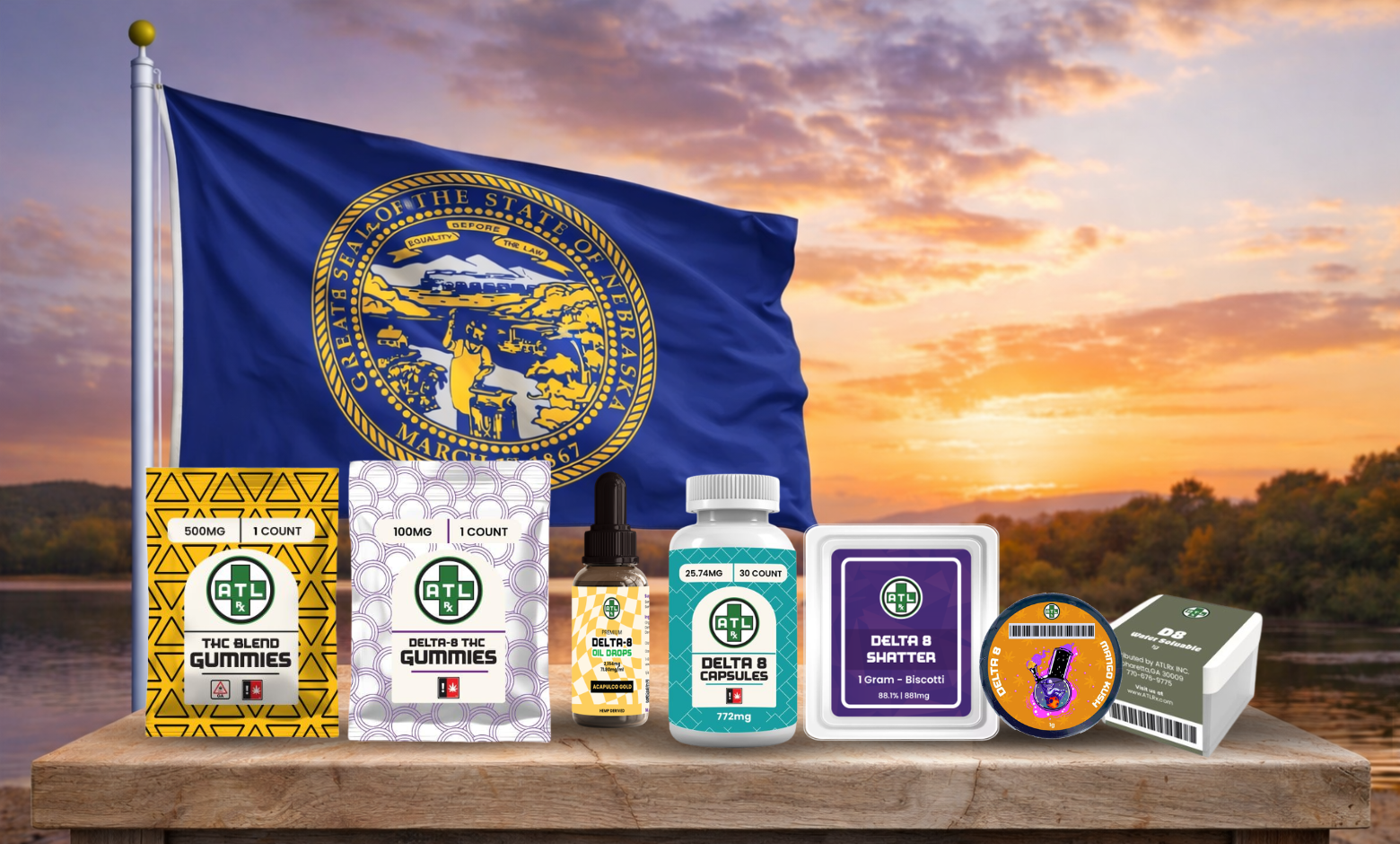
Delta 8 Legal Status in Nebraska:
Yes, Delta 8 THC is legal in Nebraska under the Nebraska Hemp Farming Act (LB 657) and the federal 2018 Farm Bill, provided it is hemp-derived and contains no more than 0.3% Delta-9 THC by dry weight.
However, there is an important catch:
If you’re a Nebraska resident wondering whether Delta 8 THC is legal to buy, possess, or use, you are not alone. Delta 8 is technically legal in Nebraska under both state and federal law. However, the legal landscape has shifted dramatically in 2025, with the state’s Attorney General launching one of the most aggressive crackdowns on Delta 8 retailers in the country.
This guide breaks down everything you need to know: the exact laws that govern Delta 8 in Nebraska, what the 2025 enforcement wave means for buyers, the fate of legislation that would have banned it outright, and how to purchase Delta 8 safely and legally if you choose to do so.
Table of contents:
Here are the most important points from this article:
1. Delta 8 is technically legal in Nebraska, but not without risk. Hemp-derived Delta 8 with 0.3% or less Delta-9 THC is legal under both LB 657 and the 2018 Farm Bill. There is no explicit ban. However, the AG’s aggressive enforcement against retailers makes staying informed essential.
2. Nebraska’s 2025 AG crackdown is the biggest development to know about. AG Mike Hilgers issued cease-and-desist letters to 200+ stores statewide, citing mislabeled products containing Delta-9 THC above the 0.3% legal limit. Enforcement actions are ongoing.
3. The ban bill (LB316) failed, but the fight is not over. LB316, which would have banned Delta 8 outright, was withdrawn on May 30, 2025. No active ban bill is pending as of early 2026, but the AG continues enforcement, and future legislative sessions may revisit the issue.
4. COA documentation is your most important protection as a buyer. A third-party Certificate of Analysis (COA) that confirms Delta-9 THC at or below 0.3% is the clearest sign that a product is legally compliant. Make sure you request it before purchasing.
5. Buying online is the most convenient and safest option for Nebraska residents. Given the AG’s enforcement against hundreds of brick-and-mortar retailers, purchasing from a reputable online vendor who provides COA documentation reduces legal and product quality risk significantly.
6. Nebraska’s legal landscape is actively evolving; check back for updates. The 2026 legislative session, ongoing AG enforcement, and potential federal action on hemp cannabinoids could all change Delta 8’s status quickly. Regular updates are made to this page to reflect the latest developments.
Important 2025 Legal Update
Nebraska’s Attorney General issued cease-and-desist letters to over 200 stores statewide in 2025, citing mislabeled products and deceptive trade practices. While Delta 8 remains technically legal under Nebraska law, the enforcement environment has made this a more complex and rapidly changing topic. Regular updates are made to this page to reflect current conditions.
Here is a fast-reference summary of Delta 8’s current legal standing in Nebraska. Full explanations for each row follow in the sections below.
| Category | Status / Detail |
|---|---|
| Current Legal Status (State) | Technically legal under LB 657 (Nebraska Hemp Farming Act) |
| Current Legal Status (Federal) | Legal under 2018 Farm Bill if Delta-9 THC ≤ 0.3% dry weight |
| Governing State Law | Nebraska Hemp Farming Act (LB 657), enacted 2019 |
| AG Enforcement Activity | Active — 200+ cease-and-desist letters issued statewide as of 2025 |
| Pending Legislation | LB316 (ban bill) failed in May 2025; no active ban bill as of early 2026 |
| Minimum Purchase Age | 21+ (state-aligned standard; some retailers require 21) |
| Possession Limits | No defined limit for hemp-derived products under state law |
| Marijuana (Delta-9) | Illegal; decriminalized (≤1 oz = $300 civil fine, first offense) |
| Medical Cannabis Program | No medical cannabis program in Nebraska |
| Online Purchase & Shipping | Currently permitted — most Nebraska buyers purchase online |
Delta-8-tetrahydrocannabinol is a naturally occurring cannabinoid found in the cannabis plant. It is structurally similar to the more widely known Delta 9 THC (the primary psychoactive compound in marijuana), but with a key difference: the double bond in its molecular chain sits on the eighth carbon rather than the ninth. This difference in chemical structure distinguishes Delta 8 from Delta 9 THC at a molecular level and is the basis for how regulators and courts assess its legal classification.
Since Delta 8 occurs only in trace amounts in hemp plants, Delta 8 products are usually created by chemically converting hemp-derived CBD into Delta 8 THC through an isomerization process. This manufacturing method is central to the ongoing legal debate at both the state and federal levels about whether Delta 8 should be classified as a synthetic or naturally occurring cannabinoid.
Delta 8 products are sold in many of the same formats as other hemp-derived cannabinoids, including gummies, tinctures, vape cartridges, disposable pens, capsules, flower, pre-rolls, and concentrates.
Under state and federal law, Delta 8 THC is technically legal in Nebraska as long as it is derived from hemp and does not contain more than 0.3% Delta-9 THC on a dry weight basis. At the state level, there is no explicit ban on Delta 8.
However, “technically legal” does not mean “without risk” in 2025. The Nebraska Attorney General has taken an aggressive stance against Delta 8 retailers, and the enforcement environment means that buyers and sellers alike should be informed before acting.
The 2018 Farm Bill (Agriculture Improvement Act) removed hemp from the Controlled Substances Act, defining hemp as Cannabis sativa plants and their derivatives with a Delta-9 THC concentration below 0.3% on a dry weight basis. When hemp-derived Delta 8 THC products meet the 0.3% threshold, they are federally legal.
That said, the Drug Enforcement Administration (DEA) issued an Interim Final Rule in 2020 declaring that synthetically derived tetrahydrocannabinols remain Schedule I controlled substances regardless of THC concentration. The open legal question of whether commercially produced Delta 8, which is typically synthesized from CBD, qualifies as “synthetically derived” has not been definitively resolved in federal court. This federal ambiguity adds a layer of risk for retailers, though it has not yet resulted in widespread federal enforcement against Delta 8 consumers.
Nebraska enacted the Nebraska Hemp Farming Act (LB 657) in 2019, aligning state law with the 2018 Farm Bill. Under the Act, hemp refers to Cannabis sativa and its derivatives, extracts, isomers, cannabinoids, salts, and acids of isomers, regardless of whether they are growing, as long as the Delta-9 THC concentration does not exceed 0.3% on a dry weight basis.
Because Delta 8 THC is an isomer of tetrahydrocannabinol derived from hemp, it falls within the plain language of LB 657 and is not classified as a controlled substance under Nebraska’s Uniform Controlled Substances Act. Nebraska’s controlled substances list names delta-1, delta-6, and delta-3, 4-cis or trans tetrahydrocannabinols specifically, but does not explicitly list hemp-derived Delta 8 THC.
This is the legal basis on which Delta 8 retailers have operated in Nebraska. However, as detailed in the section below, the state’s enforcement approach has not reflected this technical legality.
Key Distinction: Hemp vs. Marijuana Under Nebraska Law
Nebraska law draws a clear line between hemp (legal) and marijuana (illegal) based on Delta-9 THC content. A hemp plant contains 0.3% or less Delta-9 THC. Marijuana, which remains fully illegal in Nebraska (possession of 1 oz or less carries a $300 civil fine), is cannabis exceeding that threshold. Delta 8, as a hemp-derived product meeting the 0.3% limit, falls on the hemp side of this line under current state law.
Even though Delta 8 is technically legal under LB 657, the Nebraska Attorney General’s office has pursued one of the most sustained enforcement campaigns against Delta 8 retailers in the nation. Understanding this enforcement wave is essential for anyone buying, selling, or researching Delta 8 in Nebraska.
Attorney General Mike Hilgers began targeting Delta 8 retailers in smaller Nebraska communities before expanding statewide. The core of the AG’s enforcement argument is not that Delta 8 itself is illegal. Rather, the office contends that the products being sold are mislabeled, contain Delta-9 THC above the legal 0.3% threshold (making them marijuana under state law), and violate Nebraska’s consumer protection and pure food safety laws.
Key 2025 enforcement milestones:
What This Means for Consumers
The AG’s enforcement has primarily targeted retailers, not individual consumers. However, Nebraska buyers should be aware that purchasing from a retailer that is under a cease-and-desist order or stocking mislabeled products carries risk. Buying from reputable, licensed online vendors who provide third-party Certificates of Analysis (COAs) is the lowest-risk purchasing method for Nebraska residents.
The AG’s strategy is to use consumer protection law and food safety statutes as enforcement tools rather than prosecuting Delta 8 as an outright illegal substance. Hilgers and state lawmakers have cited unregulated production processes, widespread mislabeling (76% of tested products in a CBD Oracle study contained Delta-9 THC above the 0.3% legal limit), and concerns about products reaching minors.
This enforcement approach creates a legal paradox for retailers: the products may be technically legal, but selling a mislabeled product that actually contains illegal levels of Delta-9 THC, even unknowingly, exposes the business to significant civil and potentially criminal liability.
In January 2025, state Senator Kathleen Kauth introduced LB316, a bill that would have effectively banned most Delta 8 and intoxicating hemp products in Nebraska by prohibiting the sale of hemp products containing more than 0.3% of any strain of THC (not just Delta-9). Supported by AG Hilgers, the bill was prioritized by Senator Jared Storm and moved quickly through committee.
LB316 would have carried steep consequences, including classifying hemp products above the THC threshold as marijuana and imposing criminal penalties. Opponents argued the bill would eliminate hundreds of jobs, cost the state millions in sales tax revenue (one study cited $139 million in economic impact from the hemp-derived cannabinoid industry), and drive consumers to unregulated black market products.
Sen. Kauth withdrew LB316 on May 30, 2025, because there were not enough votes to overcome a filibuster. As of early 2026, no active legislation to formally ban Delta 8 is pending in Nebraska’s legislature, although the AG’s office has signaled it will continue enforcement, and future legislative sessions could revisit the issue.
Current Legislative Status (Early 2026)
LB316 failed in the 2025 session. No active ban bill is currently pending. The Nebraska AG continues enforcement actions under consumer protection and food safety law. Monitor the Nebraska Legislature’s Unicameral Update for any new bills introduced in the 2026 session.
Yes. Delta 8 products can be purchased in Nebraska both physically and online. Given the AG’s ongoing enforcement against brick-and-mortar retailers, purchasing from a reputable online vendor is the safer and more practical option for most Nebraska residents.
Buying Delta 8 online and having it shipped directly to a Nebraska address is currently legal and is the method most Nebraska users prefer. Online vendors typically offer:
ATLRx offers a full range of lab-tested, hemp-derived Delta 8 products with free shipping on every order.
Delta 8 products are sold at some CBD stores, smoke shops, and hemp specialty retailers across Nebraska. However, given the AG’s enforcement wave that has targeted hundreds of in-state retailers, buyers purchasing locally should exercise caution and ask to see third-party COA documentation for any product before buying.
Nebraska does not have a state-mandated minimum age for purchasing hemp-derived Delta 8 products under current law. However, most responsible retailers, both online and in-store, align with the 21+ standard that applies to cannabis products in states where it is regulated. Some retailers may apply an 18+ policy. ATLRx sells only to customers aged 21 and over.
Nebraska state law does not define a possession limit specifically for hemp-derived Delta 8 products. However, because Delta 8 can be visually and physically indistinguishable from illegal Delta-9 THC products, carrying COA documentation that confirms the product’s Delta-9 THC content at or below 0.3% is strongly advisable when transporting Delta 8 in Nebraska.

Given Nebraska’s enforcement environment, here are the most important steps for buying Delta 8 with confidence:
No. Under Nebraska law, the distinction between Delta 8 (legal) and marijuana (illegal) comes down to the source of the product and its Delta-9 THC content, not the presence of psychoactive effects.
Hemp-derived Delta 8 THC with 0.3% or less Delta-9 THC is classified as hemp and is legal under LB 657. As a Schedule I controlled substance, marijuana is defined as cannabis with more than 0.3% Delta-9 THC in Nebraska. Marijuana possession has been partially decriminalized:
possession of one ounce or less carries a $300 civil infraction for a first offense, but sale of any amount of marijuana remains a felony with mandatory minimum sentencing.
The AG’s enforcement actions against Delta 8 retailers have largely been predicated on the claim that many products marketed as hemp-derived Delta 8 actually contain Delta-9 THC above the 0.3% legal threshold, making them marijuana under state law, rather than legal hemp.
Nebraska’s approach to Delta 8 is distinctive even among its neighboring states, most of which have taken clearer legislative positions: either explicitly legalizing or banning it.
| State | Delta 8 Status | Cannabis (Rec) | Notes |
|---|---|---|---|
| Nebraska | Technically legal; AG enforcement active | Illegal | 200+ cease-and-desist letters; LB316 failed 2025 |
| Iowa | Banned | Illegal | Explicitly prohibited under state law |
| Missouri | Permitted (broader access) | Legal (2022) | Amendment 3 legalized recreational cannabis |
| Kansas | Banned | Illegal | Bans all cannabis and derivatives |
| South Dakota | Regulated | Illegal (med only) | Prohibits sales to those under 21 |
| Colorado | Banned | Legal | Banned Delta 8 despite full recreational legalization |
Nebraska is unusual in that Delta 8 has not been formally banned, yet the state pursues some of the most aggressive retailer enforcement in the region. Rather than creating specific hemp cannabinoid regulations, Nebraska has relied on consumer protection and food safety statutes as its enforcement tools, a strategy that has left retailers in legal limbo and consumers uncertain.
Delta 8’s legal future in Nebraska remains uncertain, and the situation continues to evolve. The failure of LB316 in 2025 was a significant development that prevented an outright ban, but the AG’s enforcement posture has not softened. Key factors to monitor heading into 2026:
ATLRx will continue to update this page as Nebraska’s laws and enforcement environment evolve.
Yes, Delta 8 is legally permitted under Nebraska’s Hemp Farming Act (LB 657) and the federal 2018 Farm Bill. However, the Nebraska Attorney General continues aggressive enforcement against retailers, primarily citing mislabeled products. No active legislative ban is in effect as of early 2026.
Yes. Online purchases and shipping of Delta 8 to Nebraska are currently legal. This is the most commonly used and lowest-risk method for Nebraska residents to obtain Delta 8 products.
LB316 was a bill introduced in Nebraska’s 2025 legislative session that banned hemp products containing more than 0.3% THC, effectively outlawing Delta 8. The bill failed on May 30, 2025, when its sponsor withdrew it after it could not overcome a filibuster. No equivalent bill is currently active heading into 2026.
No, Nebraska law does not specify a possession limit for hemp-derived Delta 8 products. However, buyers should carry product COA documentation when transporting Delta 8, as it can be indistinguishable from illegal THC products without lab testing.
No. Delta 8 is a hemp-derived product, not a medical cannabis product. Nebraska does not have a medical cannabis program, and no card or prescription is required to purchase Delta 8.
ATLRx offers a full range of lab-tested Delta 8 products available for delivery to Nebraska, including:
Each ATLRx product comes with a COA and free shipping with every order.
Disclaimer: This article is for informational purposes only and does not constitute legal advice. Laws change frequently. Consult a licensed Nebraska attorney for guidance specific to your situation.

March 16, 2026
March 16, 2026
March 13, 2026
$6.99
$5.99
$39.99
$39.99
$34.99
$39.99
$49.99