



$34.99
ARE YOU 21 YEARS OF AGE OR OLDER?
REMEMBER ME
Seriously, by using this site you are confirming that you are of legal age (21+) to view and purchase these products. If you are you are not over 21. you are not authorized by us to use or view any of the pages of this site. Please review our terms and conditions at checkout for further stipulations.
 >
Blogs
>
CBD >
Is CBD Legal in West Virginia? 2026 Legal Guide
>
Blogs
>
CBD >
Is CBD Legal in West Virginia? 2026 Legal Guide
THE STATEMENTS ON THIS BLOG ARE NOT INTENDED TO DIAGNOSE, TREAT, CURE, OR PREVENT ANY DISEASE. THE FOOD AND DRUG ADMINISTRATION HAS NOT EVALUATED ANY STATEMENTS CONTAINED WITHIN THE BLOG. ATLRX DOES NOT IN ANY WAY GUARANTEE OR WARRANT THE ACCURACY, COMPLETENESS, OR USEFULNESS OF ANY MESSAGE. THE INFORMATION CONTAINED WITHIN THIS BLOG IS FOR GENERAL INFORMATIONAL PURPOSES ONLY.
CBD Legal Status in West Virginia:
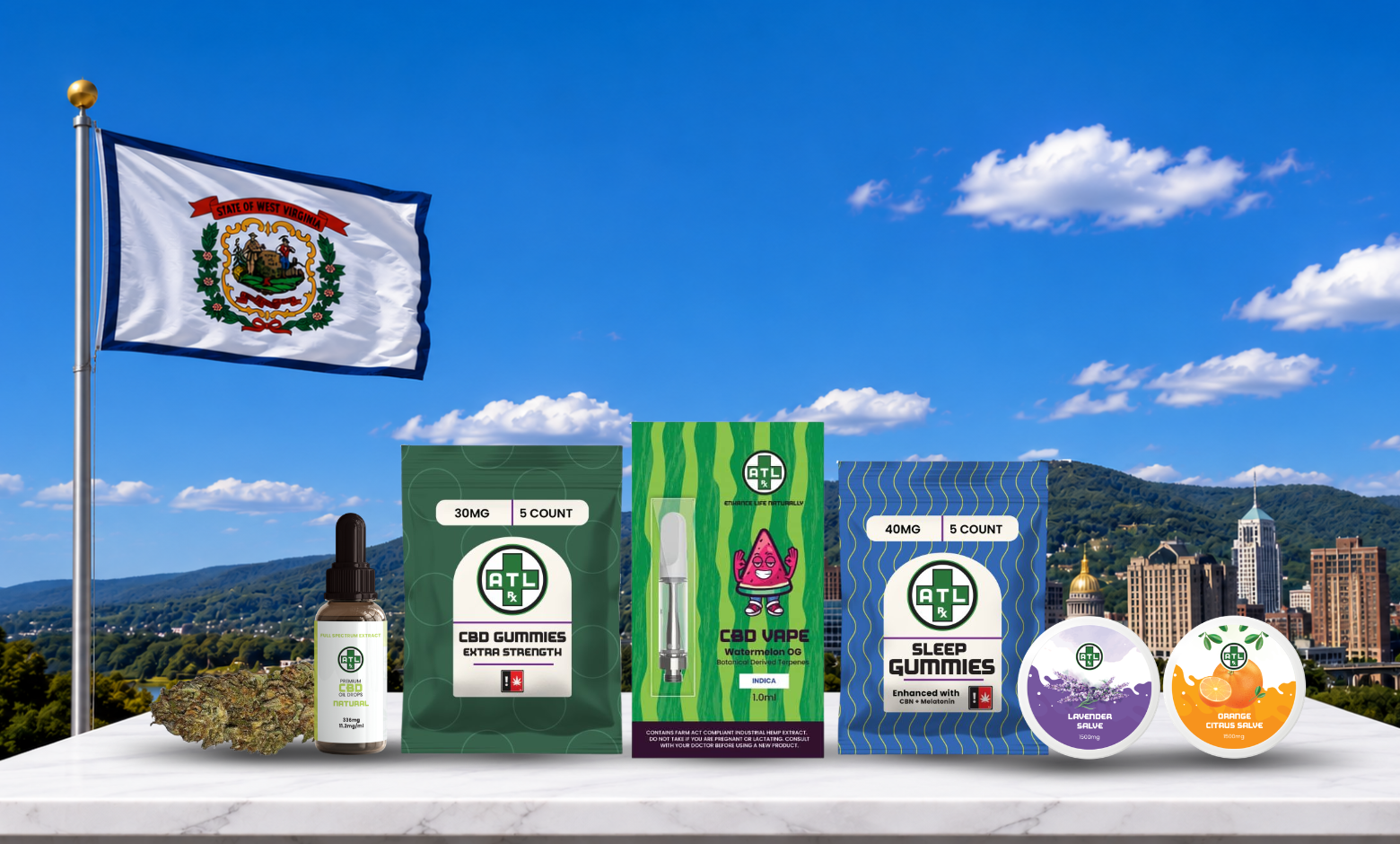
If you live in the Mountain State or plan to travel through it with a tincture in your bag, the first thing you want a clear answer to is this: Is CBD legal in West Virginia in 2026? Yes, hemp-derived CBD is legal in West Virginia for adults 21 and older, as long as it contains 0.3% delta-9 THC or less by dry weight and is sold by a licensed retailer. The longer answer is where it gets interesting, because West Virginia has rolled out some of the most active hemp rulemaking in the country between 2023 and 2026, and a major federal change is now scheduled for November 12, 2026, that will reshape what “hemp-derived CBD” means at the federal level.
The ATLRx guide to CBD in West Virginia has been updated for 2026. We walk through the federal framework, the state statute, the SB 220 reforms, the SB 546 controlled-substance changes, the 2025 Alcohol Beverage Control Administration rules, age limits, taxes, where to buy, and what is coming next at the federal level.
Table of contents:
| Topic | West Virginia 2026 Status |
| Hemp-Derived CBD | Legal for adults 21+ when it contains 0.3% delta-9 THC or less by dry weight (current federal standard; changes November 12, 2026). |
| Marijuana-Derived CBD | Restricted to registered medical cannabis patients through licensed dispensaries. |
| Delta-8 / Delta-10 THC | Illegal. Classified as Schedule I controlled substances under SB 546 (effective June 8, 2023). |
| Minimum Age | 21 for hemp-derived cannabinoid products (SB 220, 2023). |
| Possession Limit | No statutory cap for hemp-derived CBD that meets the federal hemp definition. |
| Retailer Requirement | Permit issued by the West Virginia Alcohol Beverage Control Administration (ABCA). |
| State Excise Tax | 11% on hemp-derived cannabinoid products at retail under SB 220. |
| Online Orders | Allowed for adults 21+ with verified age and proper labeling. |
| Recreational Marijuana | Not legal as of 2026. |
| Federal Change Coming | New federal hemp definition takes effect November 12, 2026 (total-THC standard plus 0.4 mg per-container cap). Will affect many CBD products. |
CBD legality in any state starts with federal law. In the 2018 Farm Bill, formally the Agriculture Improvement Act of 2018, hemp, defined as Cannabis sativa L. with 0.3% or less delta-9 THC on a dry weight basis, was excluded from the definition of marijuana. Since then, CBD derived from compliant hemp has been treated as an agricultural commodity instead of a controlled substance by the federal government.
Because Congress did not pass a full successor Farm Bill in 2024, the 2018 framework was kept alive through extensions. Upon signing of the American Relief Act, 2025, on December 21, 2024, the 2018 Farm Bill was extended until the end of the fiscal year 2025 (September 30, 2025). Additional appropriations action has carried the same hemp definitions into 2026.
The major 2026 development is now law. On November 12, 2025, President Trump signed H.R. 5371, the Continuing Appropriations, Agriculture, Legislative Branch, Military Construction and Veterans Affairs, and Extensions Act of 2026 (Public Law 119-37). Section 781 of Division B of that act rewrites the federal definition of hemp. The new definition becomes effective on November 12, 2026 (365 days after enactment), and it changes the framework in three significant ways:
The basic legality of non-intoxicating CBD remains intact through November 11, 2026, though state permitting rules still apply today. As of November 12, 2026, however, industry groups, including the U.S. Hemp Roundtable, estimate that the 0.4 mg per-container cap, applied on its face, would push a large share of currently sold full-spectrum CBD products outside the federal hemp definition. The exact impact is debated. CBD isolate and broad-spectrum products that test at or below 0.4 mg of total THC per container would still qualify. Congress could amend, delay, or replace the language before the effective date, and several bills aimed at doing exactly that have been introduced. None has passed as of May 2026.
For West Virginia shoppers, the practical takeaway in mid-2026 is that hemp-derived CBD remains lawful at both the state and federal levels today. If you order from a brand, look for one that already tests, labels, and tracks total-THC content per container, so you can tell quickly whether a given SKU will still be compliant after the November 12 change.
West Virginia was an early mover on hemp. The state passed the Industrial Hemp Development Act in 2002 under Senate Bill 447, which recognized industrial hemp (then defined as cannabis with 1% THC or less) as an agricultural crop. That statute sits in Chapter 19, Article 12E of the West Virginia Code (§§19-12E-1 through 19-12E-11).
Following the passage of the 2018 Farm Bill, West Virginia updated its hemp framework to align with federal law. Senate Bill 475 (signed March 27, 2018) amended the existing Industrial Hemp Development Act, and House Bill 2694 (2019) further aligned the state’s definitions and licensing scheme with the federal 0.3% delta-9 THC threshold.
Under the Industrial Hemp Development Act as amended, the framework treats hemp-derived CBD as a regulated consumer category rather than a controlled substance. The original 2018 update did not require consumers to hold a license to possess, handle, or transport CBD. That changed in 2023, when SB 220 layered new commercial and retail rules on top, and SB 546 placed all delta tetrahydrocannabinols on the controlled substances list (with carve-outs for products lawfully made under the Industrial Hemp Development Act and the Medical Cannabis Act).
Senate Bill 220, signed by Governor Jim Justice on March 23, 2023, added §19-12E-12 to the state code and created what is commonly called the Hemp-Derived Cannabinoid Regulation Act. It is the single most important update that consumers and retailers need to understand in 2026.
SB 220 made the following changes to West Virginia CBD law:
SB 220 also covers kratom under a parallel framework.
Alongside SB 220, the 2023 Legislature also passed Senate Bill 546, signed by Governor Justice on March 29, 2023, and effective June 8, 2023. West Virginia’s Uniform Controlled Substances Act was amended by SB 546 to include all delta-tetrahydrocannabinols in Schedule I. The bill explicitly names delta-8 THC, delta-10 THC, and synthetic and non-naturally occurring cannabinoids.
The exemption is narrow. It is not subject to Schedule I treatment if the product is manufactured, distributed, or possessed in accordance with the Industrial Hemp Development Act or the Medical Cannabis Act. In practice, this means hemp-derived CBD that meets the federal hemp definition remains legal, but converted and intoxicating hemp cannabinoids like delta-8 and delta-10 are controlled substances in West Virginia regardless of whether they came from federally legal hemp. The possession or sale of delta-8 in West Virginia can result in criminal charges.
This matters for shoppers: any 2026 guide or older article telling you that delta-8 is legal in West Virginia under SB 220 is out of date. Delta-8 and delta-10 are not legal here.
In May 2025, the West Virginia Alcohol Beverage Control Administration (ABCA) implemented a new retail rule that brought hemp-derived cannabinoid products and kratom under tighter oversight. The rule took effect on May 15, 2025, and will remain in effect through 2026.
Key elements of the 2025 ABCA framework that matter for CBD shoppers and sellers:
If you are a consumer, the simplest way to confirm a store is following the 2025 rule is to look for posted permits, a clear age-check policy, child-resistant packaging on shelves, and the ability to show a current COA when you ask.
West Virginia maintains two separate regulatory tracks for CBD. A common mistake shoppers make is treating them all the same. A line is drawn at 0.3% delta-9 THC by dry weight (and, after November 12, 2026, total THC under the new federal definition).
CBD derived from hemp comes from Cannabis sativa L. that holds 0.3% delta-9 THC or less. It is regulated under the Industrial Hemp Development Act, SB 220, and the 2025 ABCA rule. It is sold in retail shops, convenience stores, and online to adults 21 and older. No medical card is required.
CBD sourced from cannabis plants with more than 0.3% delta-9 THC is covered by the West Virginia Medical Cannabis Act (SB 386), signed by Governor Jim Justice on April 19, 2017. It is overseen by the Office of Medical Cannabis (OMC). Only registered patients who meet the program’s statutory eligibility criteria, and their designated caregivers, can purchase higher-THC CBD products from licensed West Virginia dispensaries. Possession outside the program remains a state-level offense.
Compliant hemp products will identify the source as industrial hemp, disclose cannabinoid content (typically mg per serving and mg per container, with percentage on the COA), and include a batch number that ties back to a publicly accessible certificate of analysis. Medical cannabis products will carry an OMC license number, a registered patient warning, and a dispensary-specific label.
The minimum age for purchasing or possessing hemp-derived cannabinoid products in West Virginia is 21, established by SB 220 in 2023. This applies to in-person sales, online purchases shipped into the state, and curbside pickup.
West Virginia does not impose a fixed quantity cap on hemp-derived CBD for adults 21 and older, as long as the product meets the hemp definition. For marijuana-derived CBD, registered medical patients may possess up to a 30-day supply as determined by their certifying physician.
Adults 21 and older can buy hemp-derived CBD in West Virginia at the following types of outlets, provided the seller holds the required permits:
Buying online from a permitted, transparent brand is often the simplest route in 2026 because you can verify the COA before you order, choose from a wider product range, and avoid markups that some local resellers add.

Hemp-derived CBD does not require a prescription and is sold as a standard consumer product. For higher-THC products available through the state medical cannabis program, individuals need a certification from an OMC-approved physician and a state-issued medical cannabis ID.
Possessing and transporting hemp-derived CBD within West Virginia is lawful for adults 21 and older. Keep products in their original, labeled packaging with the COA available. Driving while impaired by any substance is illegal, and law enforcement officers may investigate suspected impairment regardless of whether the substance is otherwise legal.
Federal law currently allows the interstate transport of hemp products containing 0.3% delta-9 THC or less. After November 12, 2026, the federal definition tightens, so verify the rules in any state you cross before you travel and keep documentation showing the product is hemp-derived and compliant.
Standard workplace drug screens look for THC metabolites, not CBD. Full-spectrum hemp CBD contains trace amounts of THC within the federal limit, and frequent use can result in a positive screen for some people. Broad-spectrum and CBD isolate products are formulated without detectable THC. Always review your employer’s substance policy before adding any new product to your routine.
West Virginia sits between several states with very different cannabis frameworks. Here is a quick comparison for hemp-derived CBD in 2026:
| State | Is Hemp CBD Legal? | Age Limit | Recreational Cannabis | Medical Cannabis |
| West Virginia | Yes | 21 | No | Yes |
| Virginia | Yes | 21 | Possession legal; no adult-use retail market | Yes |
| Ohio | Yes | 21 | Yes | Yes |
| Maryland | Yes | 21 | Yes | Yes |
| Pennsylvania | Yes | 18 statewide; many retailers require 21 | No | Yes |
| Kentucky | Yes (regulated) | 21 | No | Yes (sales launched 2025) |
West Virginia’s framework is closer to that of its neighbors on age and retail oversight, but the state has not legalized recreational cannabis. House Joint Resolution 27, introduced in 2025, would put adult-use legalization on a future ballot. It faces a difficult path through the Republican-controlled legislature, but the policy conversation is shifting.
If you read a CBD guide for West Virginia written in 2024, here is what is outdated:
ATLRx updates state CBD guides as the rules change, so you are not reading 2024 guidance in 2026.
Buying CBD in a regulated state is straightforward when you know what to check. Use this short list every time you shop a new brand:
ATLRx ships hemp-derived CBD products to adults 21 and older in West Virginia. Every product meets the current federal 0.3% delta-9 THC threshold by dry weight and is backed by third-party lab testing. Available categories include:
Every order ships with a batch-specific COA and child-resistant packaging that complies with state requirements. ATLRx confirms the buyer is 21 or older through an age verification step at checkout, which is part of meeting West Virginia’s online sale rules.
West Virginia gives adults 21 and older a clear path to legal, hemp-derived CBD in 2026. The Industrial Hemp Development Act, SB 220, SB 546, and the 2025 ABCA retail rule all work together to keep the market open for compliant CBD while keeping intoxicating hemp isomers like delta-8 off the shelves and raising the standard for testing, labeling, and age controls. As long as the brand you choose follows those rules and publishes a current COA, you are on solid ground today.
Looking forward, the November 12, 2026, federal hemp redefinition is the next inflection point the industry is watching. ATLRx is tracking it closely and will update this guide as the rules develop. In the meantime, every ATLRx product is third-party tested, every batch ships with a COA, and every order is age-verified. Browse the ATLRx CBD collection, check the lab results, and place an order to ship straight to your West Virginia address.
Yes. Hemp-derived CBD is legal in West Virginia for adults 21 and older, provided the product contains 0.3% delta-9 THC or less by dry weight and is sold by a permitted retailer. The new federal hemp definition takes effect on November 12, 2026; we recommend buying from brands that publish total-THC content per container so you can track compliance.
No, a medical card is required for hemp-derived CBD. A medical cannabis card is only required to purchase higher-THC products through a licensed West Virginia dispensary.
Yes, when the brand holds the required West Virginia permit, uses age verification at checkout, and ships products that meet the federal hemp definition. ATLRx complies with these requirements.
State law does not set a fixed possession cap for hemp-derived CBD that meets the federal hemp definition. Retailers may set their own limits per order.
Federal law currently allows the interstate transport of compliant hemp-derived CBD. Each state has its own rules, so review the destination state’s requirements and keep your COA and original packaging. Federal rules tighten on November 12, 2026.
Standard drug screens look for THC metabolites. Pure CBD isolate and most broad-spectrum products contain no detectable THC, while full-spectrum products contain trace amounts within the federal limit. Frequent use of full-spectrum products can result in a positive screen for some users.
Yes. Hemp flower with 0.3% delta-9 THC or less is legal for adults 21 and older when sold by a permitted retailer and properly packaged and labeled.
No. Senate Bill 546, signed March 29, 2023, and effective June 8, 2023, placed delta-8 THC, delta-10 THC, and synthetic THC isomers on Schedule I of West Virginia’s controlled substances list. The exemption for the Industrial Hemp Development Act covers traditional hemp products meeting the federal definition, but not converted or intoxicating hemp cannabinoids like delta-8.
Yes. Hemp-derived cannabinoid products carry an 11% state excise tax at retail under SB 220.
Section 781 of Division B of Public Law 119-37, signed November 12, 2025, rewrites the federal hemp definition. Effective November 12, 2026, hemp is measured by total THC (including THCA) at 0.3% on a dry-weight basis, finished products are capped at 0.4 mg total THC per container, and synthetic or converted cannabinoids are excluded. Industry analysts expect this to materially affect the hemp-derived CBD market unless Congress amends the language first.
The West Virginia Department of Agriculture publishes information on its hemp program, and the Alcohol Beverage Control Administration handles retail permitting. Both sites are good places to confirm a retailer is in good standing.
FDA Disclaimer: These statements have not been evaluated by the Food and Drug Administration. This product is not intended to diagnose, treat, cure, or prevent any disease.
Legal Disclaimer: This article is for general informational purposes only and is not legal, medical, or financial advice. State and federal laws change frequently. Verify the current rules with the West Virginia Department of Agriculture, the West Virginia Alcohol Beverage Control Administration, and a licensed attorney before making decisions for your business. ATLRx does not guarantee or warrant the accuracy, completeness, or usefulness of any information contained in this article.
Age Restriction: ATLRx products are intended for adults 21 years of age or older. Keep all hemp-derived cannabinoid products out of reach of children and pets.

August 5, 2026
August 4, 2026
July 30, 2026

$39.99

$39.99
$39.99
$49.99
$49.99
$49.99
$39.99