

$39.99
ARE YOU 21 YEARS OF AGE OR OLDER?
REMEMBER ME
Seriously, by using this site you are confirming that you are of legal age (21+) to view and purchase these products. If you are you are not over 21. you are not authorized by us to use or view any of the pages of this site. Please review our terms and conditions at checkout for further stipulations.
 >
Blogs
>
THCA >
Is THCa Legal in New York? 2026 Law Updates & Guide
>
Blogs
>
THCA >
Is THCa Legal in New York? 2026 Law Updates & Guide
THE STATEMENTS ON THIS BLOG ARE NOT INTENDED TO DIAGNOSE, TREAT, CURE, OR PREVENT ANY DISEASE. THE FOOD AND DRUG ADMINISTRATION HAS NOT EVALUATED ANY STATEMENTS CONTAINED WITHIN THE BLOG. ATLRX DOES NOT IN ANY WAY GUARANTEE OR WARRANT THE ACCURACY, COMPLETENESS, OR USEFULNESS OF ANY MESSAGE. THE INFORMATION CONTAINED WITHIN THIS BLOG IS FOR GENERAL INFORMATIONAL PURPOSES ONLY.
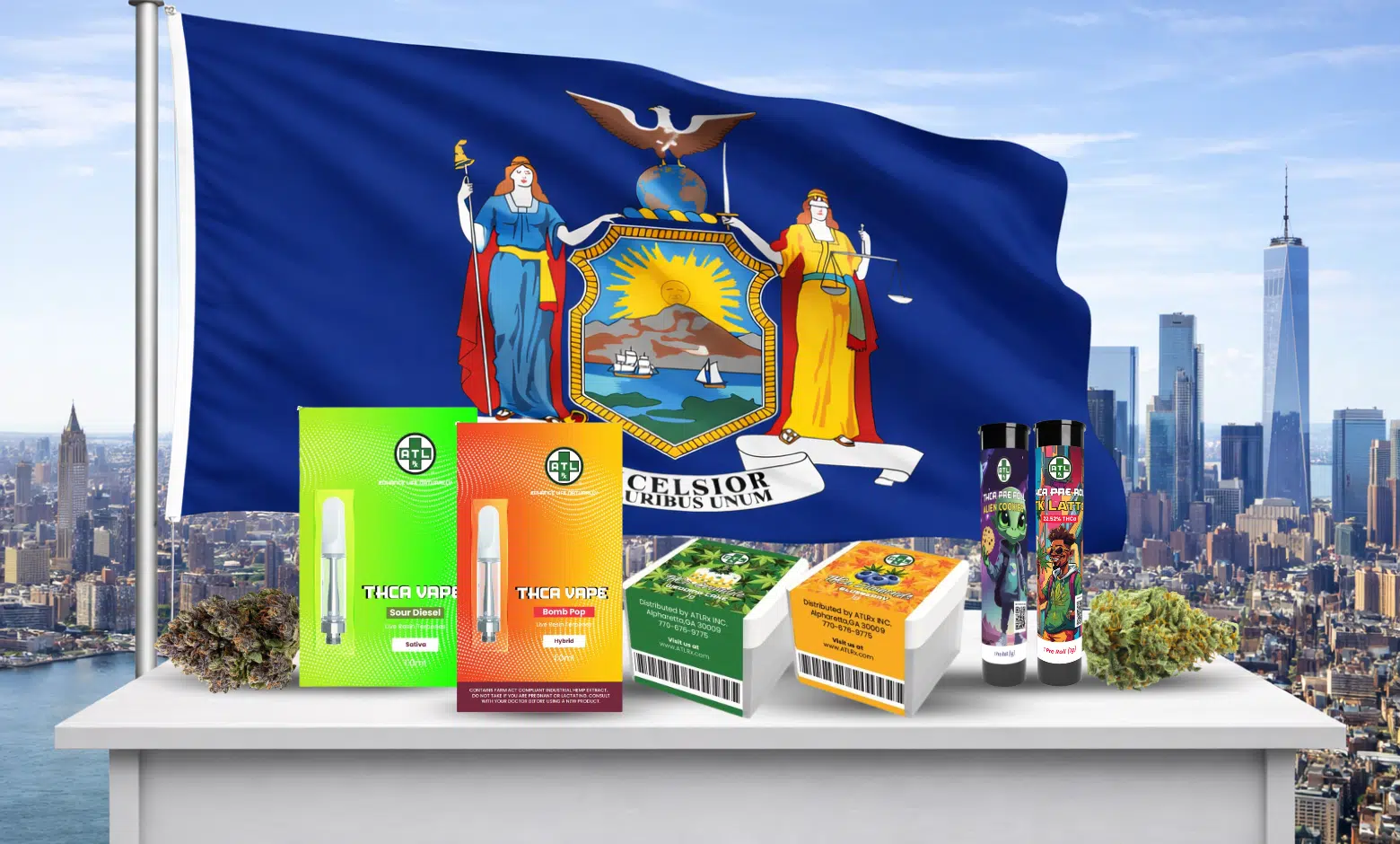
THCA Legal Status in New York:
Yes, starting in early 2026, hemp-derived THCA products with a Delta-9 THC content of 0.3% or less are considered hemp under the 2018 Farm Bill. However, New York applies some of the strictest hemp regulations in the country through the Office of Cannabis Management (OCM). THCA products intended to produce intoxicating effects are treated as cannabis under state law, not hemp. Significant federal law changes are also scheduled to take effect in late 2026, which will further restrict how THCA products are classified. Read on for a complete breakdown.
If you have been asking yourself, ” Is THCA legal in New York, you are not alone. This is one of the most searched hemp questions in the state right now, and for good reason: New York’s cannabis and hemp laws are among the most detailed and actively evolving in the United States. Between state-level Office of Cannabis Management (OCM) regulations, the 2025 federal appropriations law that rewrote parts of the 2018 Farm Bill, and upcoming enforcement changes expected later in 2026, consumers and businesses alike need a clear, current answer.
This guide breaks down everything you need to know about THCA and New York law in 2026, including what THCA is, how the state regulates it, what is legal and what is not, and what changes are coming that could affect the hemp market.
Table of contents:
Tetrahydrocannabinolic acid is also known as THCA. Delta-9 THC is the natural, non-psychoactive precursor found in hemp and cannabis plants. In its natural state, THCA does not produce intoxicating effects.
THCA is converted into Delta-9 THC through a chemical process called decarboxylation when exposed to heat. This is why New York regulators treat THCA flower intended for smoking or vaporizing as cannabis rather than hemp.
This chemical relationship sits at the center of most THCA legal debates, including in New York. Because THCA itself is not listed as a controlled substance on the federal schedules, hemp plants with high THCA content can technically meet the federal definition of hemp as long as Delta-9 THC remains at or below 0.3% on a dry-weight basis. New York’s regulators, however, take a broader view.
The 2018 Farm Bill, formally known as the Agriculture Improvement Act of 2018, established the federal legal foundation for hemp and hemp-derived cannabinoids in the United States. Before this law, all cannabis plants, regardless of their THC content, were treated as controlled substances under federal law.
The 2018 Farm Bill changed that by creating a clear legal distinction between hemp and marijuana. Under the law, hemp is defined as the cannabis plant and any of its derivatives that contain a Delta-9 THC concentration of 0.3% or less on a dry-weight basis. Products meeting that threshold, including CBD, THCA, and other hemp-derived cannabinoids, became federally legal for cultivation, processing, sale, and interstate commerce.
For THCA specifically, this threshold matters because THCA is measured separately from Delta-9 THC in its raw, unheated form. A hemp plant can carry high levels of THCA and still technically meet the 0.3% Delta-9 THC federal standard, as long as decarboxylation has not occurred. This distinction is at the heart of most THCA legal debates in 2026.
In November 2025, Congress passed a federal appropriations law that made permanent and far-reaching changes to the hemp framework established by the 2018 Farm Bill. These amendments are not temporary measures. They directly modify the Agricultural Marketing Act of 1946, which means they carry lasting authority beyond a single budget cycle.
The 2025 federal appropriations law introduces three major changes that directly affect THCA and the broader hemp market in 2026:1. A new distinction between industrial hemp and hemp-derived cannabinoid consumer products — many items previously marketed as legal hemp no longer qualify under the updated definition.2. Stricter total THC limits on consumable hemp products — the new standard moves toward measuring total THC (including THCA) rather than only Delta-9 THC on a dry-weight basis.3. A federal ban on synthetic cannabinoids under hemp law, closing a long-standing regulatory gap that allowed products like Delta-8 THC to be sold as hemp in states without their own bans. Full enforcement is scheduled to begin in November 2026, giving businesses approximately one year to come into compliance.
The November 2026 enforcement deadline is the single most important date in the hemp industry right now. Once the total-THC standard takes full effect, THCA will be counted alongside Delta-9 THC in the federal legal calculation. A hemp flower product carrying 25% THCA and 0.2% Delta-9 THC would have a combined total THC content far above the 0.3% threshold, making it non-compliant under federal law regardless of how it was previously labeled or sold.
The FDA has also been directed to publish guidance distinguishing natural from synthetic cannabinoids within 90 days of the law’s passage. That guidance is expected to bring further clarity, and potentially further restrictions, to the range of cannabinoid products that can legally be sold as hemp in the United States.
For New York consumers and businesses, this federal shift largely aligns with regulations the state has already been enforcing through the OCM. New York’s framework has treated high-THCA intoxicating products as cannabis since the passage of the MRTA in 2021. The federal law is, in many ways, catching up to where New York already stands.
Cannabis became legal for adults aged 21 and older in April 2021 after the passage of the Marijuana Regulation and Taxation Act (MRTA). New York State’s Office of Cannabis Management (OCM) oversees medical cannabis, adult-use cannabis, and cannabinoid hemp products.
For hemp specifically, the OCM’s Cannabinoid Hemp Program regulates any hemp product marketed or used for its cannabinoid content. In New York, any business processing, distributing, or selling cannabinoid hemp products is required to obtain a license from the OCM. The program mandates third-party lab testing, strict packaging and labeling standards, and age verification for all ingestible hemp products (21 and older only).
In New York, hemp-derived cannabinoids are one of the strictest cannabinoids. The following are explicitly prohibited from the hemp market under OCM rules:
THCA occupies a complex regulatory position in New York. Here is the straightforward breakdown:
The OCM has stated that intoxicating hemp products are illegal in New York’s cannabinoid hemp market. THCA, in its raw, unheated form, is technically non-intoxicating. The OCM recognizes that THCA converts to Delta-9 THC when heated, which is why:
This regulatory framework means that while hemp-derived THCA products with less than 0.3% Delta-9 THC may technically meet the federal definition of hemp, selling or buying THCA flower and smokable THCA products in New York’s general hemp market is not permitted under current state rules. If you are shopping for compliant hemp products, always check the COA (certificate of analysis) for Delta-9 THC content and confirm the product meets both federal and New York state standards.
| Cannabinoid | NY Status (2026) | Action for Consumers |
| THCA (raw/non-smokable hemp-derived) | Gray area — must not exceed 0.3% Delta-9 THC; intoxicating use regulated as cannabis | Confirm COA and product intent |
| THCA flower / pre-rolls (smokable) | Regulated as cannabis — not permitted in the hemp market; requires a licensed dispensary | Check OCM licensing |
| CBD (hemp-derived) | Legal — licensed cannabinoid hemp retailer required for commercial sale | Widely available |
| Delta-9 THC (hemp-derived, under 0.3%) | Legal — must comply with OCM hemp limits per serving | Check per-serving limits |
| Delta-8 THC | Illegal in the NY hemp market — prohibited by OCM | Not available legally |
| Delta-10 THC | Illegal in the NY hemp market | Not available legally |
| HHC, THCP, THCB | Illegal in the NY hemp market | Not available legally |
The biggest development on the horizon for THCA in New York and nationwide is the scheduled enforcement of the 2025 federal appropriations law in November 2026.
Under the upcoming federal standard, hemp will be redefined to include total THC rather than just Delta-9 THC. The total THC includes both Delta-9 THC and THCA combined. This means a hemp flower with 0.2% Delta-9 THC and 20% THCA would have a total THC content far above the legal threshold, making it illegal under federal law.
What This Means for New York
New York’s OCM already applies a strict regulatory approach that effectively treats high-THCA smokable products as cannabis. The federal total-THC shift in late 2026 will align federal law more closely with what New York has already been enforcing. Businesses in the THCA space should begin compliance planning now to prepare for this shift.
For consumers in New York looking to purchase hemp-derived cannabinoid products, here is what to look for in a compliant retailer:
ATLRx offers a range of federally compliant hemp-derived THCA products, including THCA isolate, THCA diamonds, and THCA concentrates, all tested by accredited third-party laboratories. Each product page includes a certificate of analysis (COA) so you can verify compliance before you buy. ATLRx is committed to sourcing from USA-grown hemp cultivated to meet the 2018 Farm Bill’s federal hemp standard.
Whether THCA will be legal in New York in 2026 does not have a one-word answer. The legal framework depends on the form of the product, the intended use, and whether the product meets both state and federal compliance standards. What is clear is that New York takes hemp regulation seriously, with the OCM maintaining one of the most structured cannabinoid hemp programs in the country.
For hemp enthusiasts and CBD consumers in New York, the practical advice is straightforward: buy from brands that provide full transparency through third-party lab results, verify your products meet the 0.3% Delta-9 THC threshold, and stay current on both OCM guidance and the upcoming 2026 federal changes. Compliance and transparency will continue to be priorities for brands that you can trust.
At ATLRx, we are committed to federally compliant hemp sourcing, transparent lab testing, and keeping our customers informed as regulations develop. Check out our lab-tested THCA products and feel free to contact us with any questions about compliance.
THCA is not explicitly listed as a controlled substance in New York law. However, because THCA converts to Delta-9 THC when heated, products intended for smoking or vaporization are treated as cannabis under the OCM’s regulatory framework, which means they require a cannabis license to sell.
Yes. New York’s compliance testing for cannabinoid hemp counts THCA as part of the total THC calculation. This is significant because a product with high THCA content can exceed state limits even if its Delta-9 THC level is below 0.3%.
Hemp-derived THCA products are subject to both federal and state regulations. Products that meet the current federal 0.3% Delta-9 THC dry-weight threshold may be lawful to ship under current federal law. New York’s OCM requires that retailers shipping to New York addresses hold a valid OCM license or permit, meaning unlicensed out-of-state sellers may not legally ship THCA products to New York customers.
THCA is a non-psychoactive precursor to THC found in raw hemp. Under New York’s rules, THCA products intended for non-intoxicating use may qualify as cannabinoid hemp. Products designed to produce intoxicating effects through decarboxylation (such as smokable THCA flower) are treated as adult-use cannabis and regulated accordingly by the OCM.
Stay informed. The biggest change is the November 2026 enforcement of federal total-THC standards. If you currently use hemp-derived THCA products, purchase from licensed, lab-tested sources, and monitor updates from the New York State Office of Cannabis Management.
Under New York’s current OCM framework, smokable THCA products are classified under cannabis regulations rather than cannabinoid hemp. This means they must be sold through OCM-licensed dispensaries. Purchasing them through unlicensed hemp retailers may not comply with state law. Always verify the legal status of any purchase with the seller’s licensing information.
It depends on the product form. Non-smokable, non-intoxicating hemp-derived THCA with under 0.3% Delta-9 THC may qualify as legal hemp. Smokable THCA (flower, pre-rolls) is regulated as adult-use cannabis.
The New York State Office of Cannabis Management (OCM) regulates all cannabinoid hemp and cannabis products. All sellers must hold a valid OCM license.
Federal enforcement of a total-THC standard will take effect in November 2026. This will include THCA in the 0.3% limit, making most high-THCA hemp flower non-compliant under federal law.
Always request the certificate of analysis (COA) for any THCA product. Confirm Delta-9 THC is at or below 0.3% dry weight and that the retailer is properly licensed.
ATLRx offers a range of federally compliant, lab-verified THCA products. Each batch comes with a third-party COA, so you know exactly what you are getting.
Legal Disclaimer: This article is for informational purposes only and does not constitute legal advice. Cannabis and hemp laws change frequently. Always consult a qualified attorney or check the official New York State Office of Cannabis Management website (cannabis.ny.gov) for the most current regulatory guidance. ATLRx is a hemp retailer and does not provide legal counsel.

July 23, 2026
July 22, 2026
July 21, 2026
July 20, 2026
$39.99
$49.99
$49.99
$49.99
$39.99
$39.99
$49.99