

$34.99

ARE YOU 21 YEARS OF AGE OR OLDER?
REMEMBER ME
Seriously, by using this site you are confirming that you are of legal age (21+) to view and purchase these products. If you are you are not over 21. you are not authorized by us to use or view any of the pages of this site. Please review our terms and conditions at checkout for further stipulations.
FREE SHIPPING ON ALL ORDERS OVER $49 —— FREE EXPEDITED SHIPPING ON ALL ORDERS OVER $149 —— FREE SHIPPING ON ALL ORDERS OVER $49 —— FREE EXPEDITED SHIPPING ON ALL ORDERS OVER $149 —— FREE SHIPPING ON ALL ORDERS OVER $49 —— FREE EXPEDITED SHIPPING ON ALL ORDERS OVER $149 —— FREE SHIPPING ON ALL ORDERS OVER $49 —— FREE EXPEDITED SHIPPING ON ALL ORDERS OVER $149 ——
FREE SHIPPING ON ALL ORDERS OVER $49 —— FREE EXPEDITED SHIPPING ON ALL ORDERS OVER $149 —— FREE SHIPPING ON ALL ORDERS OVER $49 —— FREE EXPEDITED SHIPPING ON ALL ORDERS OVER $149 —— FREE SHIPPING ON ALL ORDERS OVER $49 —— FREE EXPEDITED SHIPPING ON ALL ORDERS OVER $149 —— FREE SHIPPING ON ALL ORDERS OVER $49 —— FREE EXPEDITED SHIPPING ON ALL ORDERS OVER $149 ——
 >
Blogs
>
THCA >
Is THCA Legal in Kansas? 2026 State Law Explained
>
Blogs
>
THCA >
Is THCA Legal in Kansas? 2026 State Law Explained
THE STATEMENTS ON THIS BLOG ARE NOT INTENDED TO DIAGNOSE, TREAT, CURE, OR PREVENT ANY DISEASE. THE FOOD AND DRUG ADMINISTRATION HAS NOT EVALUATED ANY STATEMENTS CONTAINED WITHIN THE BLOG. ATLRX DOES NOT IN ANY WAY GUARANTEE OR WARRANT THE ACCURACY, COMPLETENESS, OR USEFULNESS OF ANY MESSAGE. THE INFORMATION CONTAINED WITHIN THIS BLOG IS FOR GENERAL INFORMATIONAL PURPOSES ONLY.
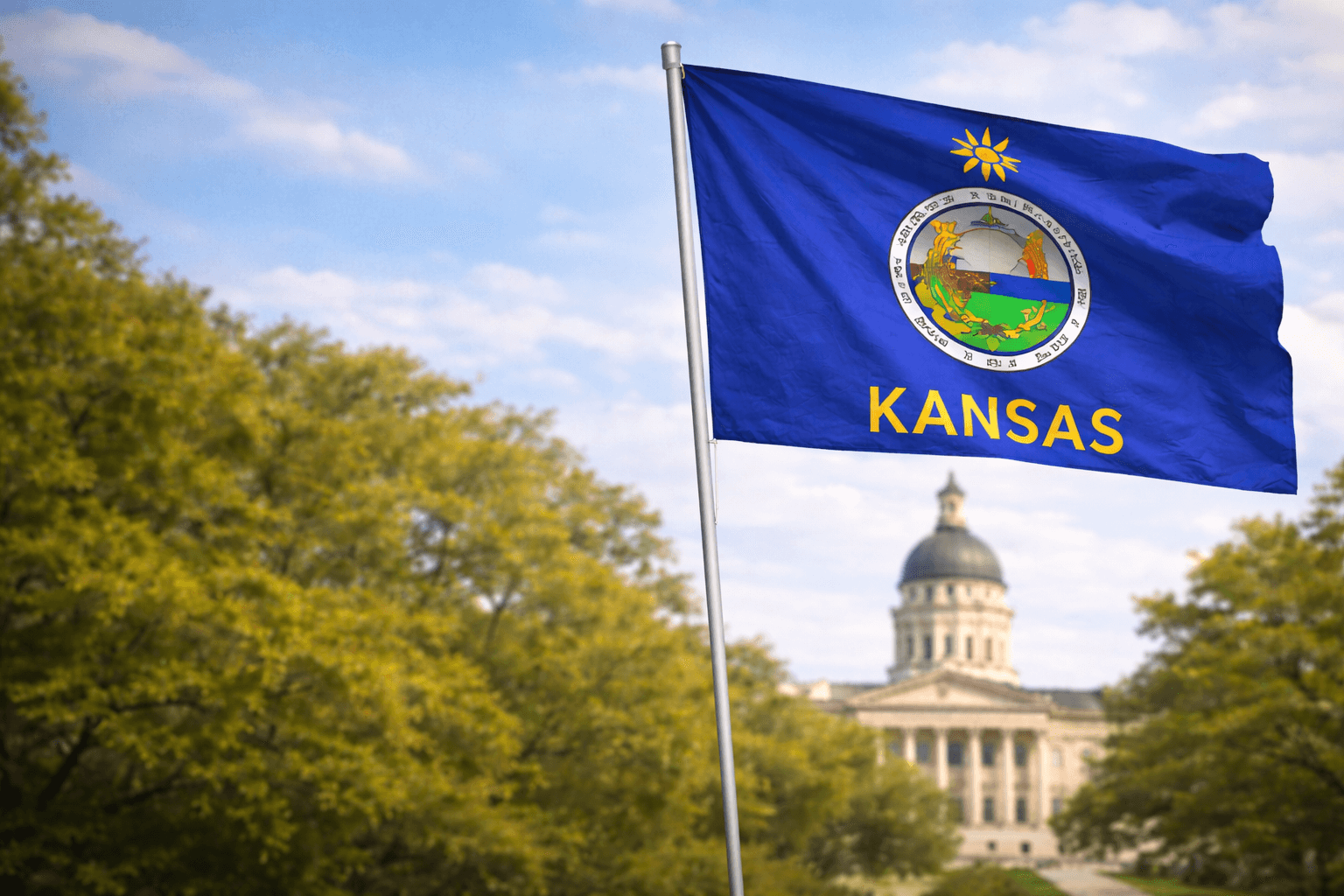
THCA Legal Status in Kansas:
Yes, THCA is conditionally legal in Kansas. Hemp-derived THCA products are permitted if the total THC concentration (delta-9 THC + THCA × 0.877) measures at or below 0.3% on a third-party Certificate of Analysis. However, several product formats are explicitly banned at retail, including smokable flower, vape products, hemp cigarettes, cigars, and teas.
If you’re searching for a straight answer on whether THCA is legal in Kansas, you’ve likely already encountered conflicting information. Some sources say yes. Others call it a gray area. A few say it’s outright illegal. The truth is more nuanced — and getting it wrong could mean purchasing a non-compliant product, or in more serious cases, legal trouble.
Kansas is not a lenient state when it comes to hemp-derived cannabinoids. While it has adopted the 2018 Farm Bill’s hemp framework, it applies a stricter “total THC” measurement that explicitly includes THCA in its compliance calculation — unlike the federal standard, which only counts delta-9 THC. Kansas also bans entire product categories — vapes, smokable flower, hemp cigarettes, and teas — that are legally sold in neighboring states.
ATLRx has been in the hemp industry since 2018. We created this guide to give Kansas residents the most accurate, up-to-date, and actionable information available — covering the law, the product restrictions, how to read a compliance lab report, what legislation is pending in 2026, and how to shop safely. Let’s get into it.
Table of contents:
Key changes since our last update:
| Question | Answer |
| Is THCA legal in Kansas? | Yes — conditionally (with strict format and potency limits) |
| Legal compliance threshold | Total THC (delta-9 + THCA × 0.877) ≤0.3% |
| THCA edibles, tinctures, topicals? | ✓ Legal if total THC ≤0.3% |
| THCA flower/hemp buds at retail? | ✗ Banned — restricted to licensed producers only |
| THCA vapes/hemp cigarettes? | ✗ Explicitly prohibited |
| Hemp teas? | ✗ Banned |
| Hemp licensing authority (2025+)? | USDA (federal program — KDA refers all hemp producers there) |
| Key pending legislation? | SB 292 — age-21 sales, potency caps, new labeling (early 2026) |
THCA (tetrahydrocannabinolic acid) is the raw, naturally occurring precursor to delta-9 THC found in the cannabis plant. In fresh, unheated cannabis, THCA is the dominant cannabinoid — delta-9 THC only forms in significant quantities after decarboxylation, the chemical process triggered by heat, drying, or prolonged aging.
| Property | THCA | Delta-9 THC |
| Found in raw plant? | Yes — abundantly | Trace amounts only |
| Psychoactive in raw form? | No | Yes |
| Converts when heated? | Yes → becomes Delta-9 THC | Already active |
| Federal legal status | Legal if hemp-derived, total THC ≤0.3% | Legal if hemp-derived, delta-9 ≤0.3% |
| Kansas legal status | Legal in permitted formats, total THC ≤0.3% | Legal if total THC ≤0.3% |
| Triggers drug test? | Yes (if heated/metabolized) | Yes |
Kansas regulates hemp under the Commercial Industrial Hemp Act (Kan. Stat. Ann. § 2-3901 et seq.). Unlike most states and the federal government — which test only delta-9 THC against the 0.3% legal limit — Kansas applies a “total tetrahydrocannabinol concentration” standard that folds THCA into the calculation.
This is the single most important thing Kansas hemp consumers need to understand. A product that passes federal compliance testing can still be non-compliant in Kansas if its THCA level pushes the total THC above the 0.3% threshold.
Kansas law calculates total THC for final hemp products using all THC isomers, acids, and analogs — including THCA — converted to their delta-9 equivalent and reported as a combined percentage.
Statutory reference: Kan. Stat. Ann. § 2-3901(b)(7) defines ‘tetrahydrocannabinol concentration’ to include all tetrahydrocannabinols and their acids, isomers, and analogs.
When a hemp product is tested, THCA does not weigh the same as delta-9 THC at the molecular level. The standard conversion factor used by compliant laboratories to calculate total THC is:
Total THC = delta-9 THC + (THCA × 0.877)
The 0.877 factor accounts for the molecular weight lost when the carboxyl group is removed during decarboxylation. THCA has a molecular weight of 358.5 g/mol; delta-9 THC is 314.5 g/mol, and 314.5 ÷ 358.5 = 0.877.
| Scenario | Delta-9 THC % | THCA % | Total THC Calculation | Kansas Compliant? |
| Product A | 0.25% | 0.05% | 0.25 + (0.05 × 0.877) = 0.294% | YES (≤0.3%) |
| Product B | 0.10% | 0.30% | 0.10 + (0.30 × 0.877) = 0.363% | NO (>0.3%) |
| Product C | 0.05% | 0.28% | 0.05 + (0.28 × 0.877) = 0.296% | YES (≤0.3%) |
| Product D | 0.01% | 0.35% | 0.01 + (0.35 × 0.877) = 0.317% | NO (>0.3%) |
Important: Product B and Product D above would pass federal delta-9 testing (both are below 0.3% delta-9 THC), but are non-compliant in Kansas because the total THC exceeds 0.3% when THCA is included. Always check total THC on the COA — not just the delta-9 line.
Under current Kansas law (Kan. Stat. Ann. § 2-3908), the following product formats are permitted for retail consumers when total THC is at or below 0.3%:
| Product Type | Legal in Kansas? | Condition |
| THCA edibles (gummies, capsules, food infusions) | ✓ Yes | Total THC ≤0.3% on COA |
| THCA tinctures / sublingual oils | ✓ Yes | Total THC ≤0.3% on COA |
| THCA topicals (creams, balms, lotions) | ✓ Yes | Total THC ≤0.3% on COA |
| THCA isolate / crystalline powder | ✓ Yes (with compliant total THC) | Must meet total THC threshold |
| CBD + THCA combination products | ✓ Yes | Total THC ≤0.3% on COA |
| THCA capsules / softgels | ✓ Yes | Total THC ≤0.3% on COA |
Kansas law explicitly bans several product categories at the retail consumer level, regardless of THC content. These restrictions apply under K.S.A. 2-3908 and are more restrictive than both federal law and most neighboring states.
| Banned Product Format | Legal in Kansas? | Notes |
| THCA flower/hemp buds | ✗ No | Restricted to licensed producers & processors only |
| Ground hemp flower | ✗ No | Same restriction as the whole flower |
| Hemp cigarettes/cigars | ✗ No | Explicitly named in K.S.A. 2-3908 |
| Hemp vape cartridges/disposables | ✗ No | All liquids/solids/gases for vaping devices are prohibited |
| Hemp teas | ✗ No | Named explicitly in statute |
| Hemp chew/dip products | ✗ No | Explicitly prohibited |
| Pre-rolls / smokable hemp | ✗ No | Falls under the flower/cigarette prohibition |
Even if a product tests below 0.3% total THC, it is still illegal to sell or purchase in Kansas if it falls into one of the banned format categories above. Format compliance and potency compliance are two separate requirements — both must be met.
A Certificate of Analysis (COA) is a third-party lab report documenting the cannabinoid content, safety testing results, and batch-specific data for a hemp product. Knowing how to read one is the most practical skill a Kansas hemp consumer can have.
One of the most common misconceptions is that passing federal hemp compliance means a product is legal in Kansas. It does not. Here is exactly where the two frameworks diverge:
| Criteria | Federal Law (2018 Farm Bill) | Kansas State Law |
| THC measurement method | Delta-9 THC only, ≤0.3% dry weight (pre-harvest) | Total THC (includes THCA via 0.877 formula), ≤0.3% final product |
| Smokable hemp flower | Legal if compliant | BANNED at retail |
| Hemp vape products | Legal if compliant | BANNED (all formats) |
| Hemp cigarettes/cigars | Legal if compliant | BANNED |
| Hemp teas | Legal if compliant | BANNED |
| Hemp licensing authority | USDA (federal) | USDA (as of Jan 1, 2025 — KDA refers producers there) |
| Recreational marijuana | Illegal (Schedule I) | Illegal (Schedule I) |
| Medical marijuana | Illegal federally | No program as of Feb 2026 (SB 294 pending) |
| Delta-8 THC from hemp | Legal if delta-9 ≤0.3% | Technically legal in non-smokable formats (gray area; SB 292 pending) |
A product can be 100% federally compliant and still be illegal in Kansas. This is true for any product with high THCA that passes delta-9-only testing, and for all smokable/vapeable formats regardless of THC content.
Kansas is surrounded by states with very different hemp and cannabis frameworks. If you live near a state border or travel regularly, understanding these differences is important.
| State | THCA Legal? | Key Rule | Flower Legal at Retail? |
| Kansas | Yes (conditional) | Total THC ≤0.3% (THCA counted) | No — banned |
| Missouri | Yes | Delta-9 ≤0.3%; recreational cannabis legal | Yes (hemp); marijuana dispensaries also open |
| Oklahoma | Yes (conditional) | Delta-9 ≤0.3%; medical cannabis program active | Hemp flower, yes; medical marijuana is separately regulated |
| Colorado | Yes | Adult-use cannabis legal; hemp ≤0.3% delta-9 | Yes — both hemp and marijuana |
| Nebraska | Restricted | Total THC approach similar to Kansas; no medical program | No — highly restrictive |
Missouri context: Missouri legalized recreational cannabis in 2022. Missouri residents can legally purchase THCA flower and high-potency products at licensed dispensaries. Kansas residents who cross the border to purchase and bring the product back into Kansas are in violation of Kansas law.
The Kansas 2025–2026 legislative session has produced several bills that could materially change the THCA landscape in the state. Kansas operates on a two-year legislative cycle, meaning bills not passed in 2025 carry over into 2026.
| Bill | Summary | Current Status | Impact on THCA |
| SB 292 | Prohibits hemp cannabinoid product sales to under-21; adds packaging/labeling requirements; may add potency caps | In committee — possible floor vote early 2026 | HIGH: Could restrict or ban high-THCA products regardless of format |
| SB 294 | Enacts the Kansas Medical Cannabis Act — authorizes the cultivation, processing, and sale of medical cannabis | Filed Feb 2026 — early stage | LOW (near-term): Creates a separate medical channel; does not directly affect hemp THCA |
| HB 2405 | Adult use cannabis regulation for 21+ consumers | Introduced — unlikely to pass current session | Long-term: Full legalization would reframe THCA regulation entirely |
| SB 295 | Removes criminal penalties for possession of <1 oz cannabis, replacing them with $25 civil infraction | Filed March 2025 — under review | MODERATE: Reduces enforcement risk for possession but does not legalize THCA products |
Legal compliance and employment or legal drug testing compliance are two completely separate issues. A THCA product can be fully legal to purchase in Kansas and still cause you to fail a drug test.
Standard immunoassay urine drug screens detect THC-COOH — the primary metabolite produced when the body processes delta-9 THC. When THCA is consumed via heated methods (smoking, vaping, baked edibles), it first converts to delta-9 THC, which then metabolizes into THC-COOH. As a result, the drug test detects the metabolite regardless of whether the original source was THCA or delta-9 THC.
This information is for general awareness only. Consult a healthcare professional or attorney for guidance specific to your situation and testing requirements.
Kansas consumers can purchase compliant THCA products both in-store at licensed hemp retailers and online. Online purchasing often provides better transparency, wider selection, and easier access to COA documentation.
ATLRx provides full batch-specific third-party COAs for every product, with total THC clearly calculated using the 0.877 formula. Our Kansas-compliant THCA products include edibles, tinctures, and topicals tested to meet Kansas’ strict total THC standard.
THCA is legal in Kansas — but only within a defined set of conditions that are stricter than federal law and most neighboring states.
The state’s total THC calculation means THCA is not a loophole: high-THCA products that pass federal delta-9-only testing can still be non-compliant here. The product format restrictions are also significant — Kansas bans vapes, smokable flower, hemp cigarettes, hemp teas, and hemp chew/dip products at the retail consumer level, even when they are THC-compliant.
For Kansas consumers who want to purchase hemp-derived THCA products legally and safely, the path is clear: buy compliant edibles, tinctures, or topicals from a reputable vendor who provides third-party COAs with a total THC calculation at or below 0.3%.
Legislative activity in early 2026 — particularly SB 292 — could further restrict the market in the coming months. Staying informed is not optional; it is a practical necessity for anyone in Kansas’s hemp industry or consumer market.
ATLRx carries a full range of THCA edibles, tinctures, and topicals with complete batch COAs showing total THC compliance for Kansas consumers. Shop confidently with full documentation at ATLRx.
No. Regardless of THC content, Kansas law (K.S.A. 2-3908) prohibits the retail sale of hemp buds and ground flower to consumers. Even if THCA flower tests below 0.3% total THC, it remains illegal for consumers to purchase in Kansas. Only licensed hemp producers and registered processors may legally handle hemp flower.
Yes, for permitted formats only. Hemp-derived THCA edibles, tinctures, and topicals that meet Kansas’ 0.3% total THC standard can be legally shipped to Kansas. Vape products, smokable flower, hemp cigarettes, and hemp teas cannot be lawfully shipped to Kansas consumers, regardless of where the vendor is located.
Possibly yes. If you consume THCA through heating (smoking, vaping, or cooked/baked edibles), it converts to delta-9 THC, which metabolizes into THC-COOH — the compound that standard drug tests detect. Even products labeled as ‘THCA’ can cause a positive result. Consult your employer’s policy and a legal or medical professional before use if drug testing is a concern for you.
No, Delta-8 derived from hemp is technically legal in Kansas in non-smokable, non-vapeable formats, provided total THC is within limits. However, this is an active gray area. Pending legislation (SB 292) may add restrictions. Kansas has not passed a specific delta-8 ban, but enforcement remains inconsistent. Monitor legislative developments before purchasing.
Non-compliant THCA (e.g., flower, vape products, or products exceeding 0.3% total THC) could be treated as a controlled substance under Kansas law. First-offense marijuana possession in Kansas can result in up to 6 months in jail and up to $1,000 in fines. Kansas does not have a decriminalization law, though SB 295 proposes replacing criminal penalties with a $25 civil infraction for small amounts. Until that passes, enforcement can result in a misdemeanor charge.
Yes. Effective January 1, 2025, hemp producer licensing in Kansas moved from the Kansas Department of Agriculture (KDA) to the USDA federal program. Growers and processors should refer to the USDA Agricultural Marketing Service (AMS) hemp program at ams.usda.gov/hemp for current licensing requirements. Retail compliance rules (product formats and total THC limits) remain governed by state law.
The 2018 Farm Bill — the federal law that legalized hemp — is up for renewal. As of early 2026, discussions around the new Farm Bill include potential changes to total THC testing methodology, possible explicit THCA restrictions at the federal level, and new cannabinoid classification frameworks. If the federal definition of ‘hemp’ changes to include THCA in the primary calculation, it could align federal and Kansas testing standards — or it could create new compliance challenges. ATLRx will update this article as federal developments unfold.

March 1, 2026
March 1, 2026
March 1, 2026

March 1, 2026
March 1, 2026
$34.99
$39.99
$49.99

$44.99

$6.99
$49.99
$39.99
$29.99