

$5.99
ARE YOU 21 YEARS OF AGE OR OLDER?
REMEMBER ME
Seriously, by using this site you are confirming that you are of legal age (21+) to view and purchase these products. If you are you are not over 21. you are not authorized by us to use or view any of the pages of this site. Please review our terms and conditions at checkout for further stipulations.
FREE SHIPPING ON ALL ORDERS OVER $49 —— FREE EXPEDITED SHIPPING ON ALL ORDERS OVER $149 —— FREE SHIPPING ON ALL ORDERS OVER $49 —— FREE EXPEDITED SHIPPING ON ALL ORDERS OVER $149 —— FREE SHIPPING ON ALL ORDERS OVER $49 —— FREE EXPEDITED SHIPPING ON ALL ORDERS OVER $149 —— FREE SHIPPING ON ALL ORDERS OVER $49 —— FREE EXPEDITED SHIPPING ON ALL ORDERS OVER $149 ——
FREE SHIPPING ON ALL ORDERS OVER $49 —— FREE EXPEDITED SHIPPING ON ALL ORDERS OVER $149 —— FREE SHIPPING ON ALL ORDERS OVER $49 —— FREE EXPEDITED SHIPPING ON ALL ORDERS OVER $149 —— FREE SHIPPING ON ALL ORDERS OVER $49 —— FREE EXPEDITED SHIPPING ON ALL ORDERS OVER $149 —— FREE SHIPPING ON ALL ORDERS OVER $49 —— FREE EXPEDITED SHIPPING ON ALL ORDERS OVER $149 ——
 >
Blogs
>
Delta 8 >
Is Delta 8 Legal in Alabama? State Law Guide 2026
>
Blogs
>
Delta 8 >
Is Delta 8 Legal in Alabama? State Law Guide 2026
THE STATEMENTS ON THIS BLOG ARE NOT INTENDED TO DIAGNOSE, TREAT, CURE, OR PREVENT ANY DISEASE. THE FOOD AND DRUG ADMINISTRATION HAS NOT EVALUATED ANY STATEMENTS CONTAINED WITHIN THE BLOG. ATLRX DOES NOT IN ANY WAY GUARANTEE OR WARRANT THE ACCURACY, COMPLETENESS, OR USEFULNESS OF ANY MESSAGE. THE INFORMATION CONTAINED WITHIN THIS BLOG IS FOR GENERAL INFORMATIONAL PURPOSES ONLY.
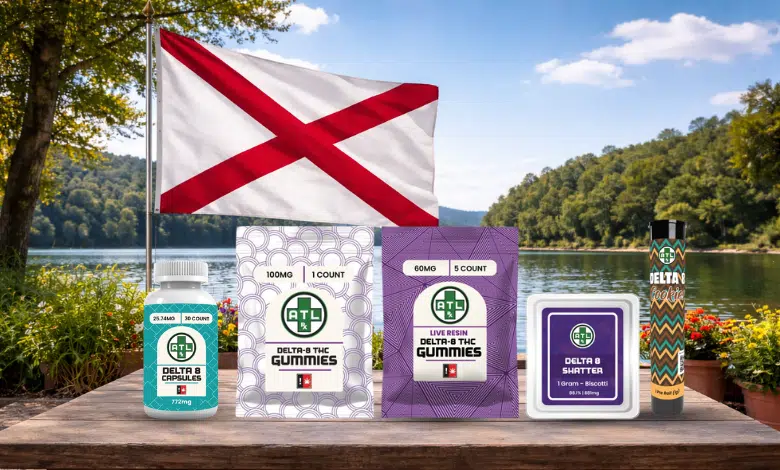
Delta 8 Legal Status in Alabama:
No, Delta 8 THC in Alabama is no longer as freely available as it once was.
Here is where things stand:
✅ Some Delta 8 products are still legal — but only if sold by ABC Board-licensed retailers, properly lab-tested, and correctly labeled.
❌ Smokable Delta 8 (flower, pre-rolls) is BANNED.
❌ Online direct-to-consumer shipments of Delta 8 to Alabama are BANNED.
❌ Delta 8 produced via chemical synthesis from CBD (the most common manufacturing method) is now classified as an unlawful hemp product.
The legal status of most commercially available Delta 8 products is now highly uncertain in Alabama. Proceed with caution and consult a legal professional.
Alabama’s House Bill 445 (HB 445), signed by Governor Kay Ivey in May 2025, dramatically overhauled Delta 8 laws in Alabama.
The new law was implemented in two phases:
Phase 1 — July 1, 2025: All smokable hemp products (Delta 8 flower, pre-rolls, etc.) became illegal statewide.
Phase 2 — January 1, 2026: Full product regulations took effect. Online direct shipments to Alabama are now banned. ABC Board-licensed retailers are the only ones allowed to sell consumable hemp products. Chemically synthesized Delta 8 (the most common form) is now classified as an unlawful hemp product.
Class C felonies carry fines of up to $15,000 and up to 10 years in prison.
If you previously purchased Delta 8 online and had it shipped to Alabama, that is no longer legal as of January 1, 2026.
If you are an Alabama resident asking whether Delta 8 THC is still legal in 2026, you are asking the right question — because the answer is far more complicated than it was just a year ago. Alabama’s hemp laws have fundamentally changed with the passage and full implementation of House Bill 445 (HB 445), and the landscape for Delta 8 consumers and retailers is now dramatically different.
This guide reflects the most current legal status of Delta 8 in Alabama as of March 2026. It covers exactly what changed, what is now prohibited, what remains permissible, and what Alabama consumers and businesses need to know to stay on the right side of the law.
Table of contents:
Hemp-derived Delta 8 THC is a cannabinoid. However, most Delta 8 products sold commercially are produced via chemical conversion from CBD, a process that Alabama’s HB 445 now targets directly as grounds for prohibition.
THC (delta-8-tetrahydrocannabinol) occurs naturally in cannabis plants in trace amounts. It is chemically related to Delta 9 THC – marijuana’s main psychoactive compound, but produces milder effects due to a slight difference in its molecular structure.
Delta 8 naturally occurs in very small amounts, so most commercial Delta 8 products are manufactured by converting hemp-derived CBD into Delta 8 THC in a laboratory setting. This manufacturing method is at the heart of Alabama’s new regulatory crackdown, as HB 445 now classifies psychoactive cannabinoids created through chemical synthesis or conversion as unlawful hemp products.
It is important to understand this distinction: the vast majority of Delta 8 products currently on the market, including gummies, vapes, tinctures, and concentrates, are made through this chemical conversion process. Under HB 445, many of these products may now fall into the category of prohibited goods in Alabama.
Until mid-2025, Alabama’s approach to Delta 8 was relatively permissive. Under the Alabama Hemp Farming Act (SB 225, signed September 29, 2021), Alabama aligned with the federal 2018 Farm Bill, which legalized hemp and all its derivatives, including Delta 8 THC, provided the final product contained no more than 0.3% Delta 9 THC.
Under the previous framework:
A 2021 attempt to ban Delta 8 via an amendment to House Bill 2 was rejected by the Alabama House Health Committee. At that time, Delta 8 THC analogs, Delta 10, and similar cannabinoids remained legal. That changed with HB 445 in 2025.
According to HB 445, any product containing psychoactive cannabinoids must be produced through chemical synthesis, modification, or chemical conversion from another cannabinoid. Since most commercially available Delta 8 is produced by converting CBD into Delta 8 THC via isomerization, a chemical conversion process, most Delta 8 products on the market may qualify as unlawful hemp products under Alabama law.
Possessing or selling such a product in Alabama could carry the same criminal liability as possessing a controlled substance, a Class C felony with penalties up to $15,000 in fines and 10 years in prison.
HB 445 did not simply regulate Delta 8 — it fundamentally restricted it. The two most critical changes for consumers are:
The following table summarizes the key requirements under Alabama’s HB 445, effective January 1, 2026:
| Requirement | Details under HB 445 |
|---|---|
| Effective Date | July 1, 2025 (smokable ban); January 1, 2026 (full product regulations) |
| Regulating Authority | Alabama Alcoholic Beverage Control (ABC) Board |
| Retailer License | Required — issued by ABC Board; hemp dispensaries, pharmacies, or grocery stores only |
| Age Restriction | 21+ — strict state law; violations result in license suspension + fines $5,000–$20,000 |
| Lab Testing | Mandatory independent third-party lab testing for all products |
| Labeling | THC content must be clearly displayed on all products |
| Online Direct Shipment | Prohibited — no direct-to-consumer online shipping to Alabama addresses |
| Smokable Hemp | Banned — no Delta 8 flower, pre-rolls, or smokable products |
| Synthesized Cannabinoids | Banned — psychoactive cannabinoids made via chemical synthesis (e.g., most D8) are unlawful |
| Excise Tax | 10% on all retail sales (90% to state General Fund, 10% to local enforcement) |
| Penalties | Class C felony for violations; fines up to $15,000; up to 10 years imprisonment |
The table below illustrates how dramatically the legal landscape has shifted for Delta 8 in Alabama:
| Aspect | Before HB 445 (Pre-2025) | After HB 445 (2026 & Beyond) |
|---|---|---|
| Legal Status of Delta 8 | Legal — hemp-derived, no specific restrictions | Heavily regulated; chemically synthesized D8 prohibited |
| Smokable Products | Permitted | BANNED as of July 1, 2025 |
| Online Direct Shipment | Permitted | BANNED as of January 1, 2026 |
| Retail Sales | Any retailer, no license required | Licensed ABC Board retailers only |
| Age Requirement | 21+ (industry-enforced only) | 21+ (state law — strictly enforced) |
| Lab Testing | No state mandate | Mandatory independent lab testing required |
| Product Labeling | No state standard | THC content must be clearly labeled |
| Chemically Synthesized D8 | Permitted under the Farm Bill | Prohibited — classified as an unlawful hemp product |
| Penalties for Violations | Minimal/unclear | Up to Class C felony, fines up to $15,000 |
Despite the sweeping changes of HB 445, some Delta 8 products may still be legally sold and purchased in Alabama, but with important caveats. The key question is whether a given product qualifies as a lawful “consumable hemp product” under the new law.
A product may still be legal in Alabama in 2026 if it meets ALL of the following criteria:
Important Caveat for Consumers
The legal gray area around “chemically synthesized” Delta 8 is significant. Because virtually all commercially available Delta 8 involves some form of chemical conversion from CBD, it is genuinely unclear whether any currently marketed Delta 8 product qualifies as a legal consumable hemp product under HB 445.
The Alabama ABC Board is still developing its full regulatory framework. ATLRx strongly recommends consulting a licensed Alabama attorney before purchasing or selling any Delta 8 product in the state.
Some Delta 8 products may technically remain legal in Alabama in 2026, but only those that are naturally derived (not chemically synthesized), sold by licensed retailers, properly tested, and purchased in person. The vast majority of products currently sold online and nationwide do not meet these criteria.
The following are now clearly prohibited in Alabama as of 2026:
Violations of HB 445 are serious criminal offenses in Alabama. Selling or possessing an unlawful hemp product — including a Delta 8 product that does not comply with HB 445 can result in a Class C felony charge, carrying fines up to $15,000 and a prison sentence of up to 10 years. This is the same level of criminal liability as possessing 1 gram of cocaine under Alabama law.
If you are an Alabama resident who currently orders Delta 8 online or purchases it from an unlicensed store, you need to be aware that this activity is now illegal under Alabama state law and carries serious felony-level penalties.
With online sales banned and unlicensed retailers prohibited, the options for legally purchasing consumable hemp products in Alabama in 2026 are significantly more limited than before.
Legal purchasing channels include:
Alabama now permits dedicated hemp dispensaries to sell consumable hemp products, but only to adults 21 and over, only for off-premises consumption, and only products that meet all HB 445 requirements. These dispensaries must be licensed by the ABC Board and are restricted from also operating as general retail stores. The number of licensed dispensaries in Alabama is still growing as the licensing process matures.
Certain pharmacies may be licensed to sell topical hemp products. This category is more restricted in terms of the types of products that can be offered.
Grocery stores may be licensed to sell consumable hemp beverages only, specifically, hemp-derived THC beverages stored separately from other products, behind glass or clear plastic, with signage stating the 21+ age requirement. Hemp beverages cannot be visible from areas containing children’s products.
What About ATLRx and Online Retailers?
As of January 1, 2026, direct-to-consumer online shipping of consumable hemp products to Alabama addresses is prohibited under HB 445. This means that ATLRx and other online retailers are legally unable to ship Delta 8 products directly to Alabama consumers under current state law.
ATLRx complies with all applicable federal and state laws. Delta 8 products are not shipped to states where such shipments are prohibited. Alabama residents seeking Delta 8 products should explore ABC Board-licensed retailers in their area.
We encourage all Alabama customers to stay informed about the evolving regulatory landscape and check back for updates as the ABC Board’s licensing program develops.
In 2026, Alabama residents can only legally purchase compliant consumable hemp products from ABC Board-licensed dispensaries, pharmacies, or qualifying grocery stores. Online purchases and shipments are no longer permitted under state law.

If you are in Alabama and looking for a Delta 8 product that complies with HB 445, here are the key criteria to verify before purchasing from any licensed retailer:
In Alabama’s new regulated environment, COA availability, ABC Board licensing, and production method transparency are the three most important factors when evaluating any Delta 8 product. Never purchase from a retailer that cannot confirm its license status or provide a current lab report.
The passage of HB 445 represents a major turning point for the hemp industry in Alabama, but the regulatory environment continues to evolve. Here is what to watch for in 2026 and beyond:
ATLRx actively monitors all state and federal hemp legislation, including Alabama’s HB 445 and its ongoing implementation. We are committed to operating in full legal compliance in every state we serve. As Alabama’s regulatory landscape evolves, we will update this page with the most current information.
Alabama’s Delta 8 legal landscape is still actively evolving in 2026. Key items to watch include the ABC Board licensing rollout, ongoing legal challenges to HB 445, SB 1 in the 2026 legislative session, and any federal Farm Bill developments.
No, some Delta 8 products may still be legally sold in Alabama in 2026, but only by ABC Board-licensed retailers, only in non-smokable form, only if properly lab-tested and labeled, and only if the products are not produced via chemical synthesis. Most commercially available Delta 8 products (which are produced via chemical conversion from CBD) are likely classified as unlawful hemp products under HB 445. Consult a licensed Alabama attorney for guidance on your specific situation.
No. As of January 1, 2026, direct-to-consumer online shipments of consumable hemp products — including Delta 8 — to Alabama addresses are prohibited under HB 445. ATLRx and other compliant online retailers do not ship Delta 8 to Alabama under the current law.
The Alabama Consumable Hemp Products Act was signed by Governor Kay Ivey in May 2025. It banned smokable hemp products (effective July 1, 2025), prohibited chemically synthesized psychoactive cannabinoids, banned online direct shipments, required ABC Board licensing for all hemp retailers, and mandated lab testing and proper labeling, all effective January 1, 2026. Violations are Class C felonies with penalties up to $15,000 and 10 years in prison.
No. All smokable hemp products, including Delta 8 flower, pre-rolls, and hemp cigarettes, were banned in Alabama as of July 1, 2025, under HB 445. Possession or sale of these products may now result in criminal charges.
Potentially yes, but only from retailers that hold a valid ABC Board consumable hemp product retailer license, and only products that fully comply with HB 445, meaning properly tested, labeled, non-smokable, and not chemically synthesized. The number of fully licensed retailers is still growing as the licensing rollout continues. Always verify a retailer’s license status before purchasing.
No. HB 445 explicitly prohibits psychoactive cannabinoids created by chemical synthesis, modification, or chemical conversion from another cannabinoid. Because the isomerization process used to produce most commercial Delta 8 involves converting CBD into Delta 8 THC through a chemical reaction, most commercially available Delta 8 likely falls into this prohibited category under Alabama law.
A violation of HB 445 can result in a Class C felony charge, punishable by a fine of up to $15,000 and up to 10 years in prison. Sales to minors and operating without a license can result in license suspension, revocation, and civil fines of $5,000 to $20,000. ABC Board members are authorized to seize and destroy illegal hemp products.
Under HB 445, the minimum age to purchase any consumable hemp product in Alabama is 21 years old. This is now a state law requirement, not just an industry standard. Selling to anyone under 21 carries serious civil and criminal penalties for the retailer.
It is possible, but uncertain. Several factors could affect the outcome, including ongoing legal challenges to HB 445, the 2026 SB 1 bill, federal Farm Bill developments, and the ABC Board’s implementation of the licensing framework. ATLRx will update this page as the legal landscape evolves.
Yes. Delta 8 THC can trigger a positive result on standard drug tests, since most tests do not distinguish between Delta 8 and Delta 9 THC. If you are subject to workplace or other drug testing, factor this into your decision before consuming any Delta 8 product.
The information in this article is for general informational purposes only and does not constitute legal advice. The legal status of Delta 8 THC in Alabama is complex, rapidly evolving, and subject to enforcement discretion. Do not rely solely on this article to make purchasing, possession, or business decisions.
ATLRx makes no warranties regarding the accuracy or completeness of this information. Cannabis and hemp laws are subject to change at any time. Always consult a licensed Alabama attorney regarding your specific circumstances before purchasing, possessing, selling, or shipping any hemp-derived cannabinoid product in Alabama.
The statements in this article have not been evaluated by the Food and Drug Administration (FDA). ATLRx products are not intended to diagnose, treat, cure, or prevent any disease or medical condition. Consult your healthcare provider before using any hemp-derived products.

March 6, 2026

March 1, 2026
March 1, 2026
$34.99
$39.99
$49.99

$44.99

$6.99
$49.99
$39.99